Scrap import duty on olive oil in India
India grows almost no olives and taxes the oil as though it did. But the tariff is only half the story: the other half is that most olive oil sold there is refined or pomace grade, which changes everything.
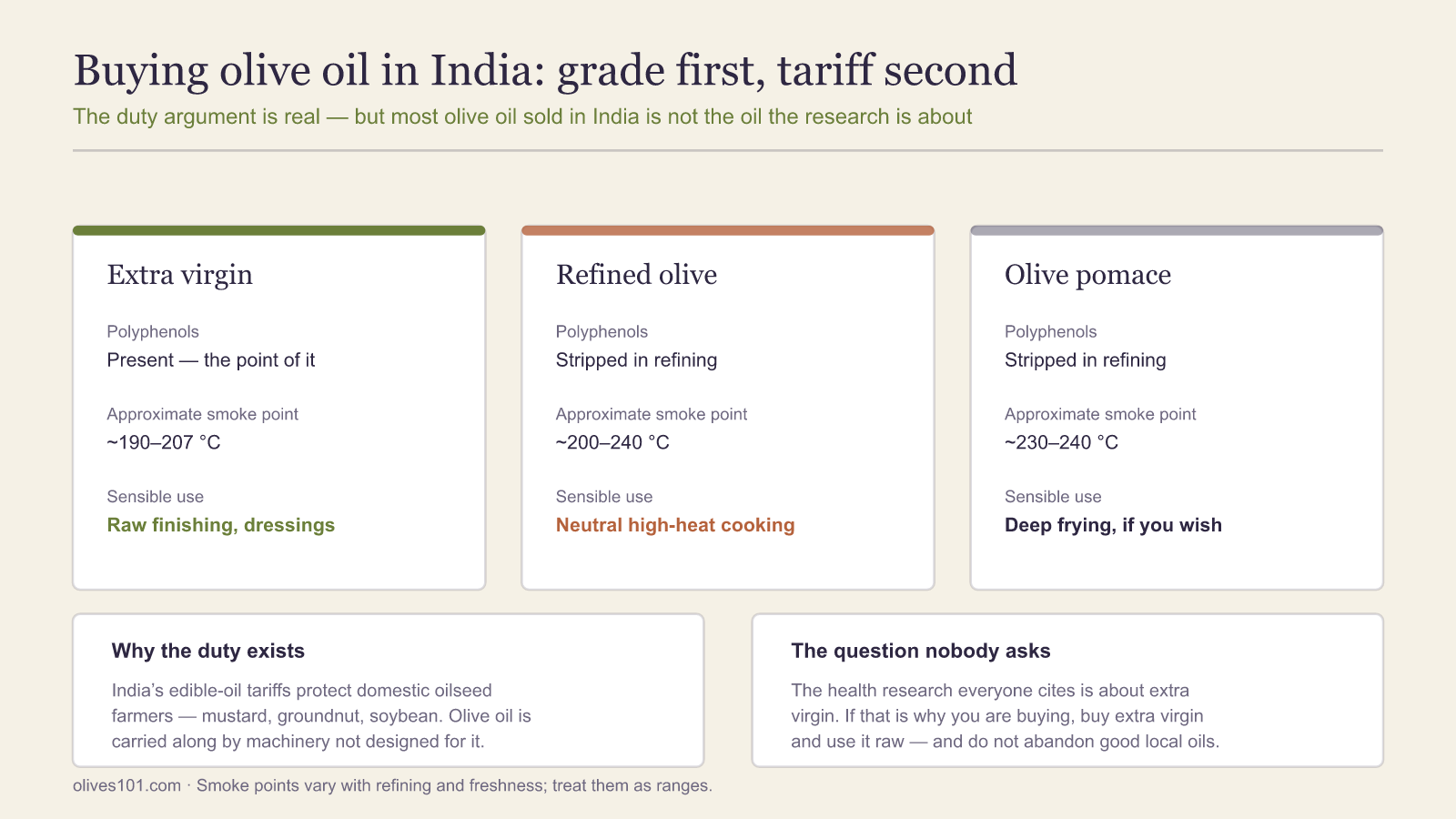
Every few years the same argument surfaces in India: olive oil is taxed heavily, India produces virtually none of it, therefore the duty should go. The producers’ association makes the case, the price comparison is duly published, and nothing much changes. It is a genuinely interesting policy puzzle, but the more useful conversation for anyone actually buying a bottle is a different one — about what is inside it, and whether it suits the way Indian food is cooked.
Why the duty is there at all
India’s edible-oil tariffs are not designed with olives in mind. They are an instrument of agricultural policy, built to protect domestic oilseed farmers — mustard, groundnut, soybean, sunflower, coconut — in a country that imports a very large share of the vegetable oil it consumes. Rates on edible oils move with domestic prices and harvests, sometimes sharply, and olive oil gets carried along in that machinery even though almost nobody in India grows olives.
Rates change with policy, so treat any specific figure as a snapshot rather than a permanent fact. In recent years the duty on olive oil has sat in a band around thirty per cent for virgin grades and somewhat higher for refined, with an additional cess on top. The industry argument is straightforward: since there is no meaningful domestic olive crop to protect, the tariff protects nothing and simply raises the shelf price. The counter-argument is that edible-oil tariff policy is set as a whole and carving out exemptions invites classification games at the border.
India’s own olive experiment
India is not entirely without olive trees. Rajasthan has run a state-backed olive cultivation programme since the late 2000s, established with Israeli technical partnership, planting Mediterranean cultivars in the semi-arid districts on the reasoning that a hot dry climate with cool winters is not so far from what the tree evolved for. It has produced oil, table fruit and even olive leaf tea, and it has demonstrated that the plant will grow and crop there.
What it has not done, and was never going to do quickly, is change the economics. Olive orchards take years to come into bearing, the milling and marketing infrastructure has to be built alongside them, and the volumes involved are tiny beside a domestic edible-oil market measured in tens of millions of tonnes. It is a serious, worthwhile agricultural experiment; it is not a tariff argument.
The question nobody asks: does it suit the cooking?
This is where the health-benefits argument quietly breaks down, and it has nothing to do with tax. The research everyone cites — the Mediterranean pattern, the polyphenols, the authorised European claim — is about extra virgin olive oil. A great deal of the olive oil sold in India is refined olive oil or olive pomace oil, marketed explicitly as suitable for Indian cooking because it is neutral in flavour and tolerates high heat. Both of those are true. But refining removes the phenolic compounds that the health reputation rests on. The bottle bought for its benefits is frequently not the material the benefits were demonstrated in.
The flavour question is real too, and worth being honest about. A peppery Mediterranean extra virgin fights with the layered spicing of most Indian cooking, and pouring it into a tadka where mustard oil, ghee or groundnut oil belongs is a good way to ruin both. The smoke-point panic is overstated — extra virgin tolerates ordinary home frying temperatures perfectly well — but the taste clash is not imaginary. Extra virgin earns its place on salads, on grilled vegetables and fish, drizzled over dal or a soup at the table, in dressings and dips. Used that way, a small expensive bottle lasts and makes sense.
| Oil | Character | Approximate smoke point | Sensible use |
|---|---|---|---|
| Extra virgin olive | Fruity, bitter, peppery; polyphenol-rich | Around 190–207 °C | Raw finishing, dressings, low and medium heat |
| Refined olive | Neutral, pale; polyphenols removed | Around 240 °C | General cooking where neutrality is wanted |
| Olive pomace | Solvent-extracted from residue, then refined; neutral | Around 240 °C | Deep frying; the cheapest olive category |
| Mustard | Pungent, sharp, traditional in much of India | Around 250 °C | Tadka, pickles, high-heat regional cooking |
| Groundnut | Mild, nutty, clean | Around 230 °C | All-purpose frying |
Buying olive oil in India sensibly
- Know which grade you are buying. Extra virgin, refined and pomace are three different products at three different prices with three different purposes.
- If you are buying for the health argument, buy extra virgin. Refined and pomace oils do not carry the polyphenols the research concerns.
- Buy a small bottle of extra virgin and use it raw. It will taste better and cost less overall than a large one that oxidises in a warm kitchen.
- Do not abandon good local oils. Mustard and groundnut oil are excellent, appropriate and far better suited to high-heat regional cooking.
- Store it away from heat and light. Indian kitchens are warm, and warmth is the enemy of a good oil.
- Check the harvest date, and remember imported oil has already spent months in transit and warehousing.
Olive oil in India: common questions
Why is olive oil so expensive in India?
Chiefly import duty on a product India barely produces, layered on top of shipping, small import volumes and premium retail positioning. Edible-oil tariffs are set to protect domestic oilseed farmers, and olive oil is swept along with them.
Does India grow olives?
Only on a small scale. Rajasthan has run a state-backed olive cultivation programme since the late 2000s with Israeli technical partnership, producing oil, table fruit and olive leaf tea, but the volumes are negligible beside India’s edible-oil market.
Can you cook Indian food in olive oil?
You can, but choose the grade with care. Refined olive oil is neutral and tolerates high heat. Extra virgin is better kept for finishing, because its peppery flavour competes with Indian spicing even though it handles ordinary frying temperatures.
Is pomace olive oil the same as olive oil?
No. Pomace oil is extracted with solvents from the residue left after milling and then refined. It is the cheapest olive category, is neutral in taste, and carries none of the phenolic compounds associated with extra virgin.
Which olive oil should I buy for health reasons?
Extra virgin, because the research and the authorised European health claim concern its polyphenols, which refining removes. This is general information, not medical advice.
The tariff debate is a distraction from the real problem, which is that India is largely being sold the wrong olive oil. Refined and pomace grades dominate the shelves because they are cheap and neutral, and they are marketed to a public that has been told olive oil is good for the heart — a claim built entirely on extra virgin. Scrap the duty tomorrow and that mismatch survives untouched. If you want what the research promises, buy a small bottle of real extra virgin, keep it away from the stove, and put it on the food rather than in the pan. For high heat, India already has better and cheaper oils of its own.
Drawn from Indian edible-oil tariff policy and industry representations, the Rajasthan olive cultivation programme, and the standard grade definitions and smoke-point ranges for olive and common Indian cooking oils. General information, not medical advice.