Wimberley home to Texas’ first olive trees
Olives came to the Texas Hill Country on the reasonable assumption that hot and dry equals Mediterranean. What growers found instead was a climate that gives an olive tree neither the steady chill it needs nor the mild winter it can survive.
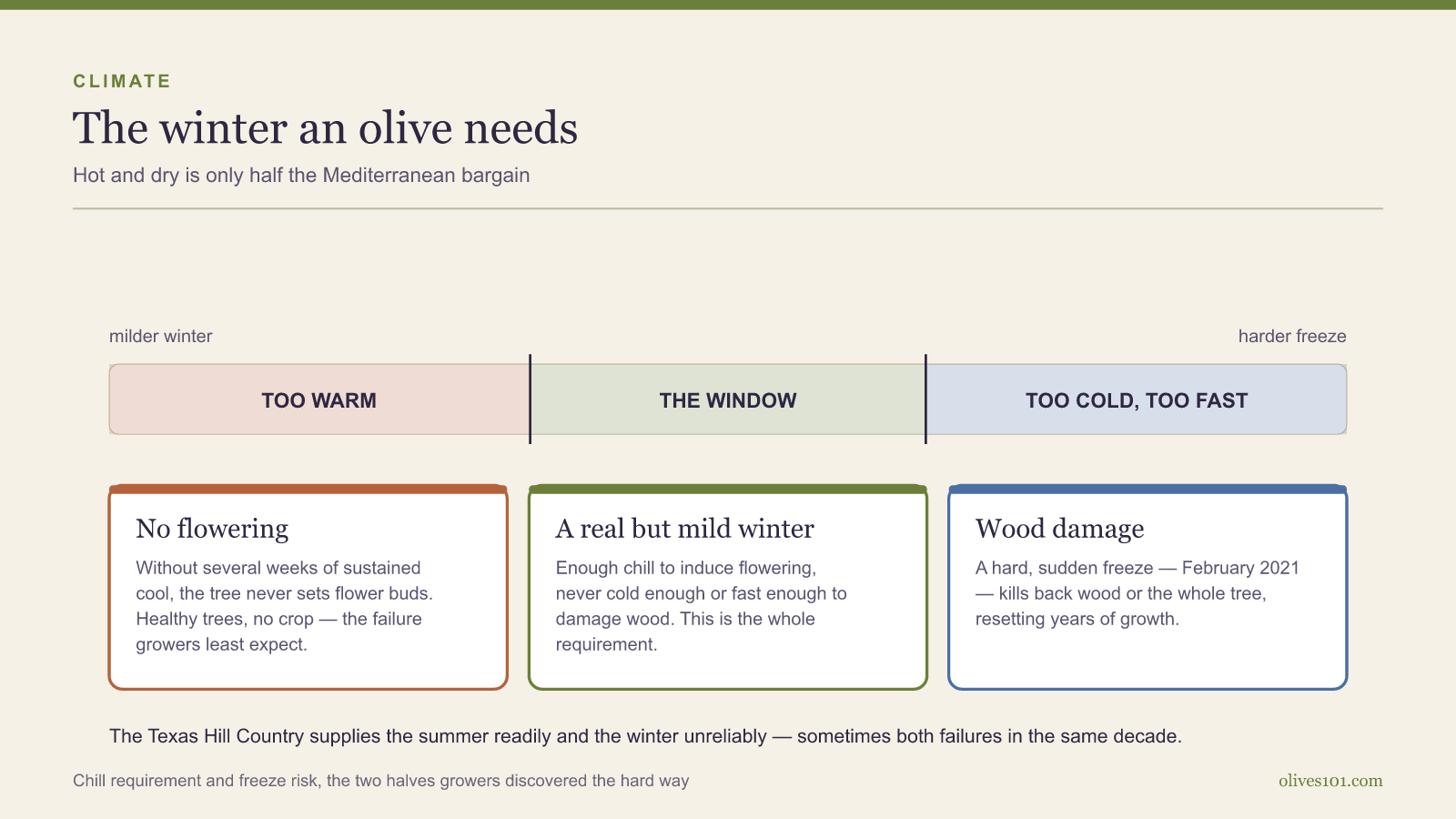
On paper, Texas should grow olives beautifully. Hot dry summers, alkaline limestone soils in the Hill Country, plenty of sun, and a long tradition of finding a crop for every kind of ground. Serious commercial attempts began in the early 1980s and mostly failed, and it took a while for anyone to work out why. The answer turned out to be winter — but not in the way anyone expected.
A warm winter is a problem too
This is the part that surprises people. Olives need cold. Not freezing — but a sustained stretch of cool weather, broadly in the range between a couple of degrees and the mid teens Celsius, over several winter weeks. That period of chill is what triggers floral induction: the process by which buds that could become leaves are committed instead to becoming flowers.
Without enough of it, an olive tree stays perfectly healthy and simply does not flower. It grows, it looks magnificent, it produces nothing. In parts of Texas — and in Gulf-influenced country generally — winters can be mild enough and erratic enough that the trees never get a clean run of chill. Growers in the Hill Country identified this early: the winters were not too cold. They were too warm, and too inconsistent.
That is also why so much sub-tropical olive planting around the world underperforms. The olive is not a tropical plant with a taste for heat; it is a temperate Mediterranean tree that requires a real, if mild, winter.
And then the freeze
The obvious response — plant further south, where freezes are rarer — trades one risk for another, and in February 2021 Texas found out how expensive that trade can be. Winter Storm Uri brought days of sub-freezing temperatures across the state. Not a frost: a prolonged, deep freeze reaching parts of Texas that had never planned for one.
The damage was close to total for the industry. Orchards across the state were hit, and in the worst cases trees were killed to the roots, ending any prospect of recovery from the trunk. Crops failed in 2021 and again the following season. Established growers lost trees by the thousand. The state had been growing fast — from a USDA-surveyed figure of around 1,200 acres in 2017 to an estimated three thousand or so by the time of the freeze, second only to California in US olive acreage — and much of that expansion was undone in a week.
The lesson is one every olive grower outside the Mediterranean eventually learns: it is not the average climate that matters, it is the extremes. An olive tolerates cold reasonably well in a gradual, predictable winter. What kills it is a sudden, deep freeze arriving after warm weather has already started the sap moving.
| What an olive needs | Hot dry summers, a mild but real winter, well-drained alkaline soil |
|---|---|
| Chill requirement | Several weeks of sustained cool weather to induce flowering |
| Too warm | Healthy trees that never flower — the original Texas problem |
| Too cold, too fast | Wood damage, dieback, or death to the roots |
| The 2021 event | Days of sub-freezing temperatures statewide; orchards lost, some to the roots |
| Recovery | Suckers from the base can regrow, but years of production are lost |
| US ranking | Texas has been the second olive state after California |
| Harvest | Roughly late summer into autumn |
What growers changed
Three things, mostly. Site selection became far more careful — the difference between a valley floor where cold air pools and a slope thirty metres higher can be the difference between damage and destruction. Variety choice was re-examined: Arbequina dominates new planting worldwide because it is small, early-bearing and suits hedgerows, but it is not the most cold-tolerant olive, and a variety chosen for machine harvesting is not necessarily the one that survives a Texas February.
And most growers diversified. An orchard that also grows something else, or that sells agritourism and a tasting room alongside its oil, survives a lost crop in a way that a monoculture cannot. It is not a romantic conclusion, but it is the honest one: in a marginal climate, resilience is a business structure as much as an agronomic choice.
If you are buying — or planting
- Texas oil is small-batch and fresh. Buy it at the ranch or at a local market, and drink it young.
- Expect to pay more. Low volumes and high risk do not produce cheap oil, and should not.
- If you are planting, check chill, not just heat. A frost-free climate with no winter is as unsuitable as one that freezes hard.
- Look at the coldest night in twenty years, not the average winter. Extremes decide olive orchards.
- Avoid frost pockets. Cold air flows downhill and settles; a modest slope is worth more than a good soil report.
- Choose varieties for your winter, not for the harvester, unless you are planting hundreds of acres.
Growing olives in Texas: common questions
Can olives grow in Texas?
Yes, and commercially — Texas has been the second olive state in the US after California. But it is a marginal climate for the crop, exposed both to winters too warm to induce flowering and to occasional deep freezes.
Why do olive trees need cold weather?
Because a sustained period of cool winter temperatures triggers floral induction, the switch that commits buds to becoming flowers rather than leaves. Without enough chill, a tree stays healthy and simply does not flower.
What happened to Texas olives in 2021?
Winter Storm Uri brought days of sub-freezing temperatures statewide in February 2021. Orchards were damaged everywhere and in the worst cases killed to the roots, and crops failed that season and the next.
Do olive trees recover from a hard freeze?
Sometimes. If the roots survive, suckers can regrow from the base and a tree can be rebuilt over several years. If the freeze reaches the roots, the tree is gone and the orchard must be replanted.
Is Texas olive oil worth buying?
If it is fresh, yes — it is made in small quantities, usually sold locally, and often with an unusually short gap between harvest and bottle. Expect a higher price, and treat it as a young oil to be used quickly.
The story people take from Texas is a freeze story, and it misses the more useful half. The reason those early orchards failed had nothing to do with cold : the trees were happy, green and barren, because a Gulf winter never gave them the chill they needed to set flowers. That is the mistake I have watched repeated on three continents by people who assume the olive is a hot-weather plant. It is not. It is a temperate tree that tolerates heat, and it wants a proper if gentle winter. Plant it where the winter is real but never violent, and it will pay you back for a century.
Freeze impact and acreage figures from Texas agricultural extension and regional reporting; chill and flowering requirements from standard olive physiology references.