Olive Oil Eases Ride For Bypass Patients
Olive oil turns up in cardiology headlines more than any other food. Some of that reflects genuine, replicated evidence. Some of it is a small study inflated into advice. Separating the two is more useful than any single finding.
Search any archive of health reporting and you will find a steady stream of olive oil and heart stories, often with a specific clinical hook: patients recovering from bypass surgery, people with existing heart disease, post-operative complications. The headlines are confident. The underlying studies are frequently small, short and preliminary.
That does not mean the general picture is wrong. It means the general picture and the specific clinical claim are two different things, and only one of them is well supported. This is general information, not medical advice — anyone facing surgery or managing heart disease should take direction from their own clinical team, not from a food article.
What is genuinely well supported
Three things stand on reasonably solid ground.
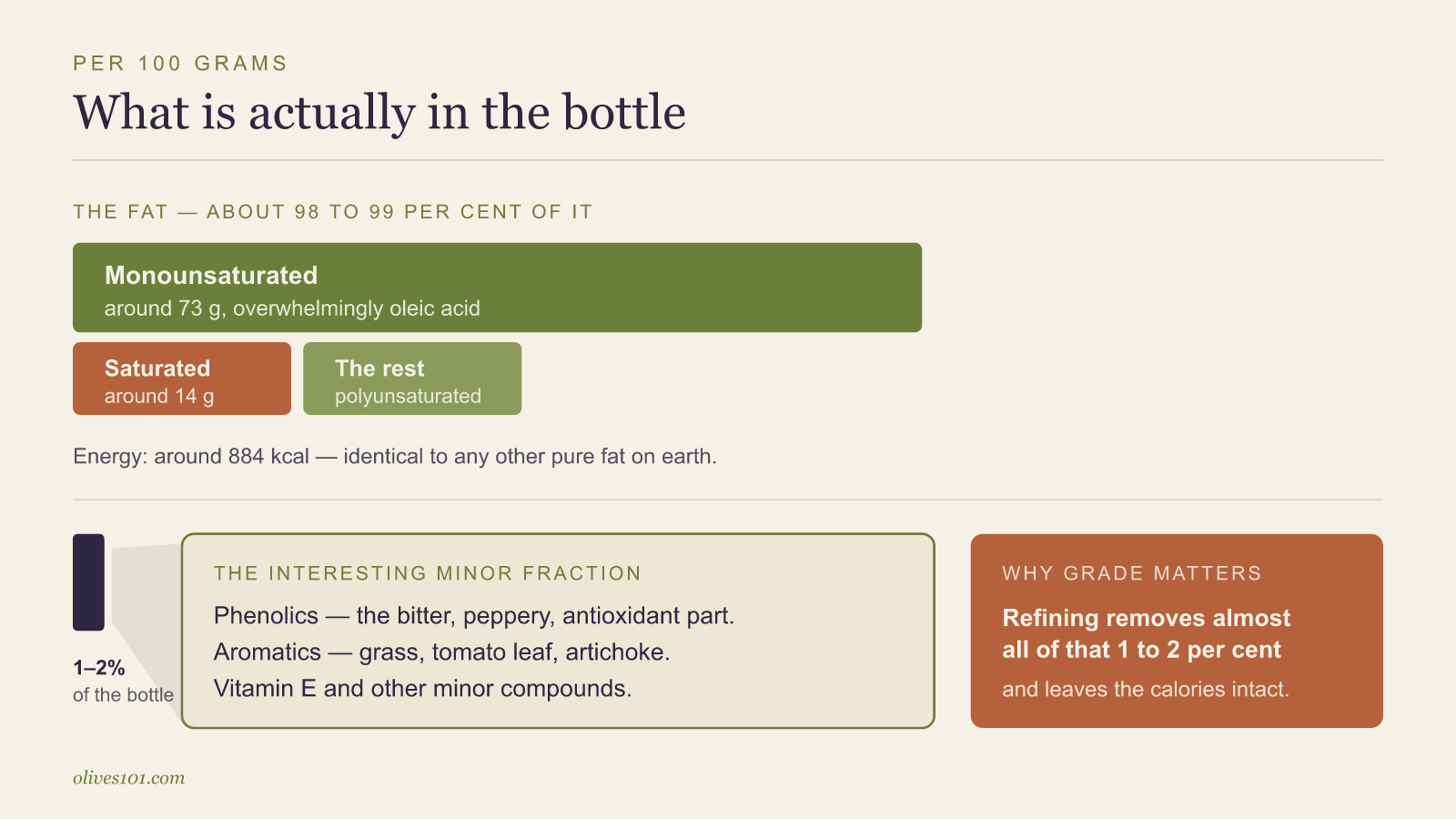
First, fat substitution. Replacing saturated fat with monounsaturated fat improves blood lipid profiles. Olive oil is overwhelmingly monounsaturated, mostly oleic acid, so using it in place of butter, lard or heavily saturated fats is a change with a measurable effect. Note the word replacing: this is substitution evidence, not a case for adding oil to an unchanged diet.
Second, the polyphenols. European food regulators have authorised a specific, narrow claim: that olive oil polyphenols contribute to protecting blood lipids from oxidative stress. It applies only to oils containing at least 5 mg of hydroxytyrosol and its derivatives per 20 g of oil, and the stated benefit is tied to a daily intake of about 20 g. That is a real regulatory threshold, and it is much narrower than the way the word antioxidant gets used in marketing. It also quietly excludes most refined oil, which loses those compounds in processing.
Third, the dietary pattern. Large trials of Mediterranean-style eating — high in vegetables, legumes, nuts, fish and olive oil, low in processed meat and refined sugar — have found lower rates of cardiovascular events than control diets. The intervention was a whole pattern, with olive oil as a central component, not olive oil alone.
| Energy | About 119 kcal per tablespoon (13.5 g) |
|---|---|
| Total fat | About 13.5 g per tablespoon |
| Monounsaturated | Roughly 10 g per tablespoon, mostly oleic acid |
| Saturated | Roughly 1.9 g per tablespoon |
| Polyunsaturated | Roughly 1.4 g per tablespoon |
| Vitamin E | About 1.9 mg per tablespoon |
| Polyphenols | Highly variable; present in virgin grades, largely removed by refining |
| Cholesterol | None — it is a plant oil |
Where the story gets shakier
The landmark Mediterranean diet trial is a case study in reading carefully. It was published to enormous attention, then withdrawn and republished in 2018 after irregularities were found in how some participants had been randomised. The re-analysis still showed a benefit for the Mediterranean pattern, but the authors had to reframe the result more cautiously, and the episode is a permanent reminder that even the best-known nutrition trial required correction.
Claims about specific surgical settings are weaker still. Studies looking at olive oil or Mediterranean eating around cardiac surgery tend to be small, single-centre and short-term, and they measure surrogate outcomes rather than survival. A promising small trial is a reason to run a bigger one, not a reason to change what you eat before an operation. There is also a practical caution: patients around surgery are often on anticoagulants and other medication, and dietary changes in that window belong to the surgical team, not to a newspaper.
| Claim you will see | Evidence status | Fair summary |
|---|---|---|
| Olive oil lowers cholesterol | Partly supported | Replacing saturated fat with monounsaturated fat improves lipid profiles. Adding oil to an unchanged diet is not the same intervention. |
| Olive oil polyphenols protect blood lipids | Authorised, with conditions | Permitted in the EU only for oils above a defined polyphenol threshold, at about 20 g a day. |
| A Mediterranean diet reduces cardiovascular events | Reasonably supported | Shown in large trials — but the intervention is a whole dietary pattern, not one ingredient. |
| Olive oil helps recovery after heart surgery | Weak | Based on small, short, single-centre studies with surrogate endpoints. Not established. |
| Olive oil prevents or cures heart disease | Not supported | No food prevents or cures cardiovascular disease. Treat any such claim as marketing. |
What a sensible person actually does
- Use olive oil instead of, not in addition to, other fats. Substitution is where the evidence lives.
- Choose a virgin grade for raw use if polyphenols matter to you — refining removes them.
- Remember the calories. Olive oil has the same energy density as every other fat, and the health halo makes people stop counting.
- Treat single studies as news, not instruction, particularly small ones with dramatic framing.
- Do not change your diet around surgery on the basis of an article. Ask your clinical team.
This is general information, not medical advice.
Olive oil and the heart: common questions
Does olive oil protect the heart?
The evidence supports a Mediterranean dietary pattern in which olive oil is a central component, and supports replacing saturated fat with monounsaturated fat. It does not support olive oil alone as a protective agent. This is general information, not medical advice.
Is there an official health claim for olive oil?
Yes, a narrow one in the EU: olive oil polyphenols contribute to the protection of blood lipids from oxidative stress, permitted only for oils containing at least 5 mg of hydroxytyrosol and derivatives per 20 g, at a daily intake of about 20 g.
Does extra virgin matter for health, or is any olive oil the same?
For the polyphenol claim it matters a great deal — refining strips those compounds out. For the monounsaturated fat profile, refined and virgin oils are broadly similar.
What happened with the famous Mediterranean diet trial?
It was withdrawn and republished in 2018 after problems were identified in the randomisation of some participants. The re-analysis still showed benefit, but the conclusions were stated more cautiously.
Should someone having heart surgery eat more olive oil?
That is a question for their surgical and medical team. Evidence in that specific setting is limited and preliminary, and dietary changes around an operation can interact with medication.
I sell no supplements and I have no stake in the health story, so let me be blunt about how it is used. Olive oil marketing leans on the word antioxidant while most of the oil actually sold — the plain refined blends — has had precisely those compounds stripped out in processing. The regulators drew a genuine line, at a measurable polyphenol content, and virtually no supermarket bottle tells you where it falls relative to that line. If the health argument is why you are buying, buy a virgin grade, buy it fresh, use it raw, and treat the bottle that promises health on the front but declares nothing measurable on the back as what it is: a picture, not a fact.
Composition figures are standard food-composition values; the polyphenol claim follows the authorised EU health claim and its conditions of use; trial history from the published record.