Aegean City’s Olive Oil In Europe
A producer in the Aegean builds a bottling plant a thousand miles away in Romania, to sell oil made from Turkish fruit to European shoppers. It sounds odd until you price a pallet of full glass bottles — and then it is the only sensible move on the board.
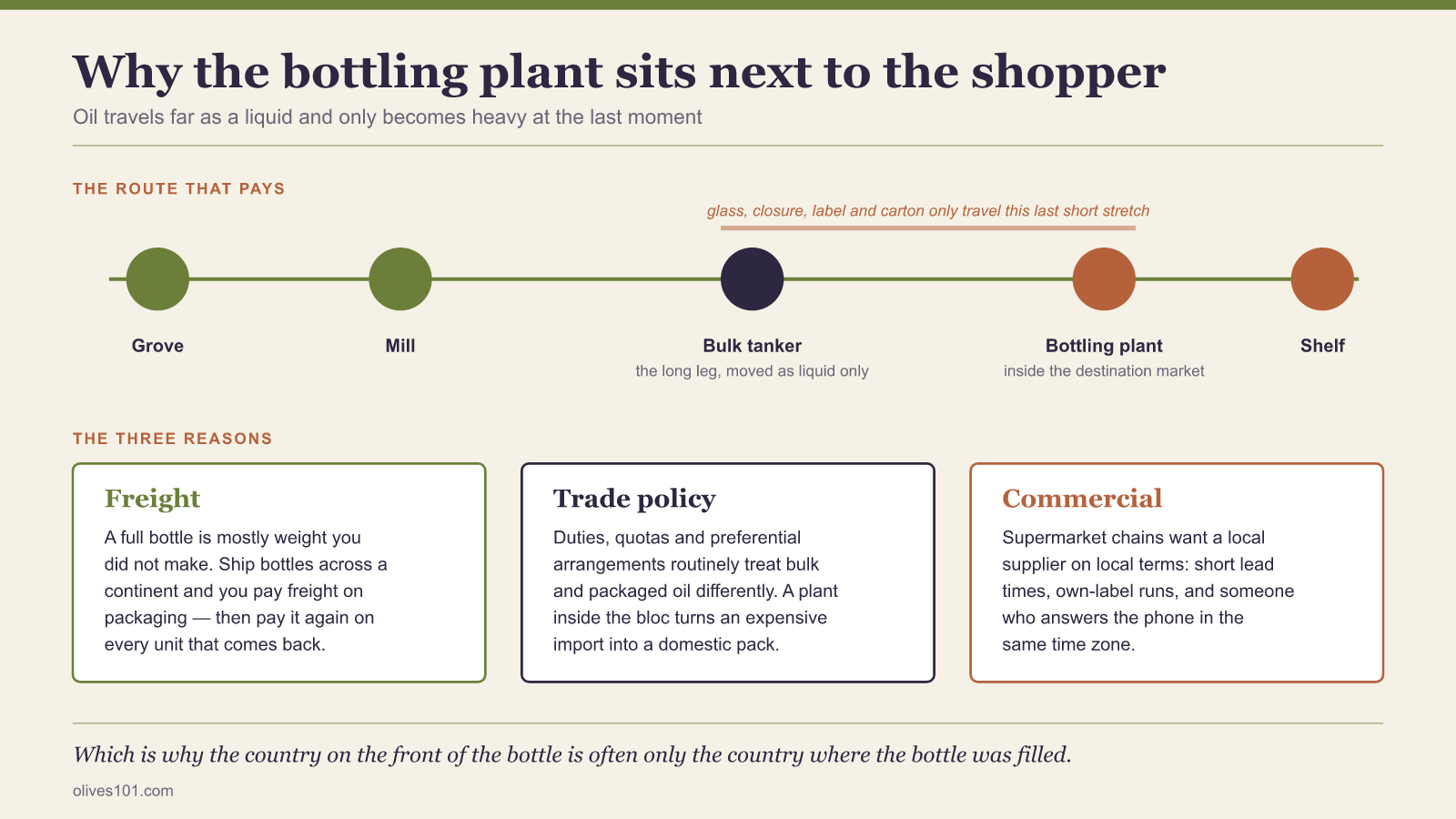
Every so often a story surfaces that reads strangely to anyone outside the trade: an olive oil company in a producing country invests in a filling plant somewhere with no olive trees at all. Turkish oil bottled in Romania, Spanish oil bottled in northern Europe, Mediterranean oil bottled in the United States. It looks like a shell game. It is nothing of the kind — it is the single most predictable move in the whole business, and once you see the arithmetic behind it you will read the labels in your own cupboard differently.
Why bottling happens near the customer
The first reason is brutally physical. A full bottle is mostly weight you did not make: glass, closure, label, carton and pallet. Shipping finished bottles across a continent means paying freight on packaging, and paying it again on every unsold unit that eventually comes back or gets discounted. Bulk oil, by contrast, is a liquid you can move by tanker at a fraction of the cost per litre. Move it in bulk, bottle it at the far end, and the packaging only travels the last short leg.
The second reason is trade policy. Import duties, quotas and preferential arrangements routinely treat bulk oil and packaged oil differently, and a plant inside a trading bloc can turn an expensive import into a domestically packed product. The third is commercial: supermarket chains want a local supplier who can deliver on their terms, respond to a promotion, print their labels and take back what does not sell. A filling line inside the market is what makes that possible.
What actually happens at a bottling plant
Bottling is not a neutral pause in the journey. The oil is typically settled or filtered, sometimes blended with lots from other origins to hit a house style and a price, sometimes topped with inert gas to slow oxidation, then filled, capped, labelled and coded. Done well, with clean tanks, cool storage, minimal light and nitrogen protection, it takes very little out of the oil. Done indifferently — warm warehouse, oxygen in the headspace, oil sitting months in a holding tank before filling — it quietly ages a product that left the mill in good condition.
Blending deserves a plain word here, because people react to it as if it were adulteration. It is not. Blending is a legitimate and skilled part of the industry; nearly every consistent supermarket brand is a blend, and it is how a bottler delivers the same taste in a poor harvest year as in a good one. What matters is that the blend is declared honestly on the origin statement, and that nobody pretends a multi-origin oil is a single estate.
What it costs the oil, and what it costs the country
Every transfer is a small tax on quality. Pumping, tanker time, temperature swings, a partly full tank with air above the oil — none of these are catastrophes on their own, and all of them are cumulative. An oil pressed in November, tanked in January, shipped in March and bottled in June has had six months of chances to lose something before it ever meets you. That is why the most useful thing on a label is a harvest date, and why an oil that names its mill is telling you the chain was short.
There is a national cost too, and producing countries feel it keenly. Selling in bulk is easy money and it builds nothing: no brand, no shelf presence, no margin, no relationship with the person who eats the oil. Countries that ship bulk for a generation find their fruit inside somebody else’s famous label, and discover that the value was never in growing the olives. Building a bottling and branding operation — even one located in the customer’s country — is how a producer stops being an anonymous supplier. It is expensive, slow, and it is the only route out.
| Stage | What it adds | What it costs |
|---|---|---|
| Milling near the grove | Freshness — the single biggest quality factor | Nothing, if done fast |
| Bulk tanking and shipping | Cheap movement of large volumes | Temperature swings, headspace oxygen, time |
| Blending at the bottler | Consistency, price control, year-to-year stability | Loss of single-origin identity if not declared |
| Filling in the destination market | Lower freight, tariff advantage, retailer service | Another handling step; oil may wait before filling |
| Retail shelf | Availability and price the shopper will accept | Light and warmth, the last enemies of good oil |
Reading a bottle with this in mind
- Bottled in is not from. It names a filling line, not a grove. The origin statement is the line that matters.
- Look for the harvest date. The longer the supply chain, the more that date tells you.
- A declared blend is honest; an implied origin is not. Multi-country blends are legal and common — the problem is only ever the pretence.
- Named mill or estate means a short chain. Fewer transfers, less time, less to go wrong.
- Dark glass or tin beats clear glass. Especially for an oil that has already travelled a long way.
Bulk oil and bottling: common questions
Why is olive oil bottled in a country that grows no olives?
Because shipping bulk oil is far cheaper than shipping full glass bottles, trade rules often favour packaged goods made inside the market, and retailers prefer a local supplier who can service them directly.
Does bottling far away make the oil worse?
Not automatically. It adds handling, time and temperature exposure, all of which can degrade oil. A careful bottler with clean tanks and inert-gas protection can minimise it.
Is blending oils from several countries legal?
Yes, and it is very common. It must be declared in the origin statement on the label, which is why you will often find small print naming a blend of EU or non-EU oils.
Does bottled in Italy mean Italian olives?
No. It describes where the oil was packed. The olives may have been grown and pressed elsewhere entirely, and the origin statement will say so if you look.
Why do producing countries export in bulk at all?
Because it is immediate, low-risk income that requires no brand, no marketing and no distribution. The long-term cost is that the value and the customer relationship stay with the bottler.
I have watched more than one ambitious producer decide to build a plant in the market they wanted to sell into, and I have seen it work and fail for the same reason. It works when the oil is genuinely good and the company treats the plant as a way to get closer to the customer. It fails when the plant becomes a place to blend down to a price, because the moment you are competing on price with the giants you have chosen a fight you cannot win. If you grow good fruit, the only durable strategy is to be the one whose name is on the bottle. Bulk pays this year’s bills and hands somebody else your customer forever.
Drawn from standard olive oil trade practice in bulk shipping and destination-market bottling, and EU olive oil labelling and origin rules.