Unilever mulls €600m sale of Bertolli olive oil
In 2008 the world’s leading olive oil brand was sold for about €630 million. What changed hands was a licence, a factory and a place on the shelf. Understanding that transaction is the fastest way to learn how to read a bottle.
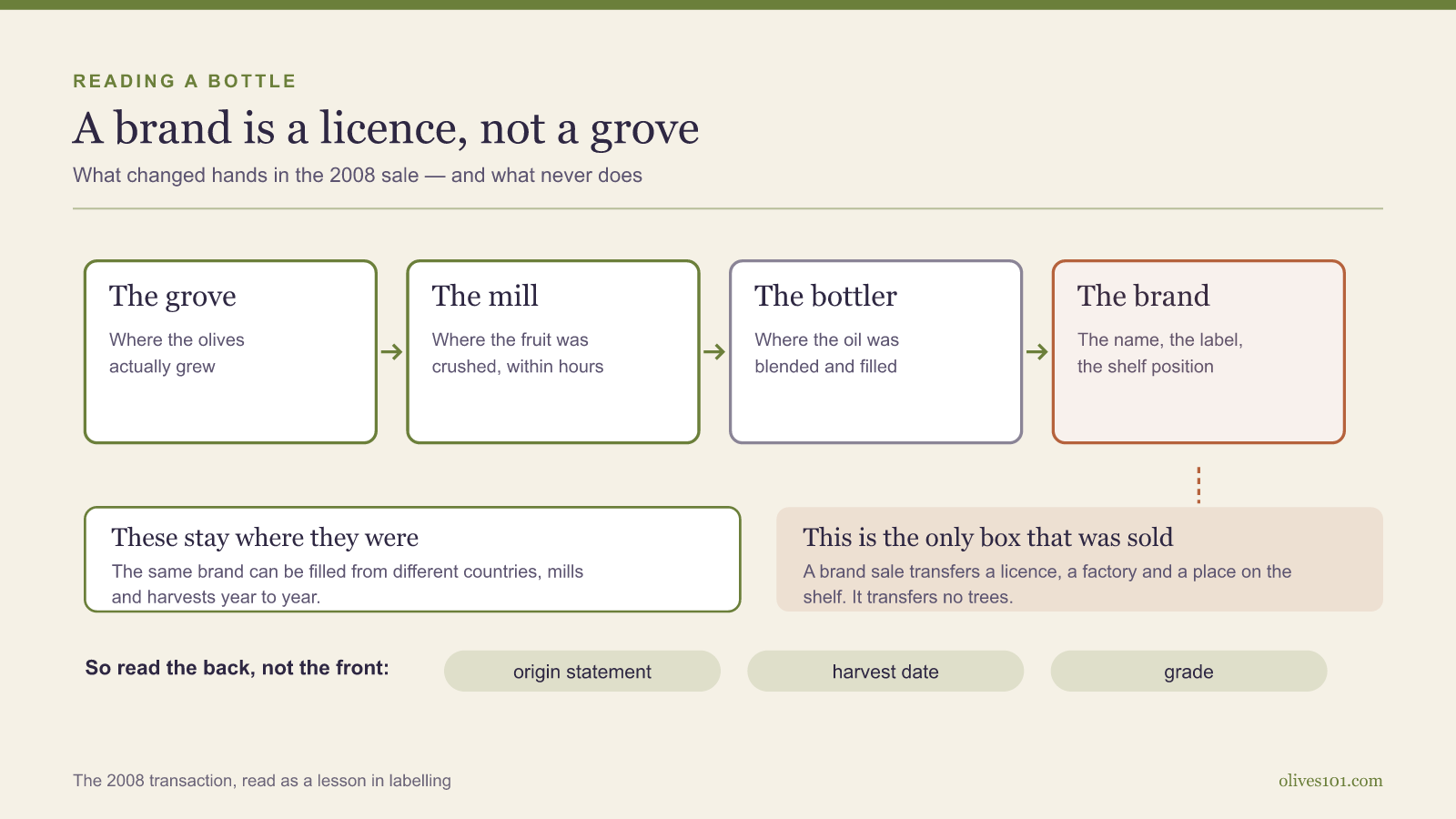
Every so often a headline announces that a famous olive oil brand is up for sale, and the figure attached to it is startling. It is worth sitting with that number for a moment, because it explains something that confuses shoppers constantly: how a name synonymous with Tuscany can end up owned in Madrid, filled with oil from four countries, and still be, legally and commercially, exactly what it says it is.
The brand in question began in the most romantic way possible. In 1865 Francesco Bertolli and his wife Caterina opened a grocery shop in Lucca, in Tuscany, selling local wine, cheese, olives and oil. Within a decade they were shipping oil to Italian emigrants in the United States — arguably the first great olive oil export business — and by the end of the century they were sending it to Australia, South America and Africa. For most of the twentieth century it was the best-selling olive oil brand in the world.
| 1865 | Francesco and Caterina Bertolli open a grocery in Lucca, Tuscany |
|---|---|
| From 1875 | Oil shipped to Italian emigrants in the United States |
| By 1890 | Exports reach Australia, South America and Africa |
| 20th century | The name becomes a global grocery brand under multinational ownership |
| 2008 | Unilever sells the olive oil business to Spain’s Grupo SOS for about €630 million |
| The deal | A worldwide perpetual licence for oil, premium vinegar and olives, a plant at Inveruno, and the Dante, Maya and San Giorgio brands |
| Retained | Unilever kept the name for spreads, pasta sauces and frozen meals |
| 2011 | Grupo SOS renames itself Deoleo |
A brand is a licence, not a grove
Read the terms of that 2008 sale carefully and the modern olive oil business falls into place. What was bought was a worldwide, perpetual licence to use a name on oil, vinegar and olives; a bottling plant in Lombardy; and a set of sister brands. What was not bought — because it did not exist — was land, trees, or a single harvest.
This is not a scandal. It is how nearly all large consumer food brands work. The producer of the raw material and the owner of the name have been separate businesses for over a century. But it means that a brand name tells you about a marketing organisation, not about a place, a variety or a harvest. It answers the question ‘who sold me this?’ and not one of the questions you actually care about.
Why the same name can mean two different companies
The 2008 deal produced an oddity that still catches people out. The buyer got the name for olive oil, vinegar and olives; the seller kept it for margarine, pasta sauces and frozen meals. So two entirely unrelated companies have, for years, been selling different products under one famous Italian surname, in the same supermarkets, side by side.
If you were assuming that the quality of one told you anything about the other — or that either told you anything about a farm in Tuscany — this is the moment to stop. And it is worth knowing that the olive oil name now sits in a portfolio alongside several other large Spanish and Italian labels, so that brands presented to shoppers as rivals on the shelf can share an owner, a buyer and sometimes a tanker.
| What is on the bottle | What it actually tells you | What it does not tell you |
|---|---|---|
| The brand name | Who markets and sells it | Where the olives grew, or who milled them |
| An Italian-sounding name | Usually nothing at all | Nationality of the fruit or the company |
| ‘Bottled in Italy’ | Where the filling line is | Where a single olive was harvested |
| ‘Extra virgin’ | A legal grade, set by chemistry and a taste panel | How long ago, or how well it has been stored |
| The origin statement (back label) | In the EU, the required country or countries of harvest | The specific region, mill or variety |
| A harvest date | The single most useful fact on the label | Nothing — this is the one to hunt for |
| ‘Blend of EU and non-EU olive oils’ | That the oil is a multi-country blend | Which countries, and in what proportion |
What to read instead of the brand
Turn the bottle around. In the European Union, extra virgin and virgin olive oil must carry a designation of origin — the country or countries where the olives were harvested, and a specific form of words when the milling happened somewhere else. That sentence, in small type on the back, contains more information than everything on the front label combined. See what ‘bottled in Italy’ really means for how the two get confused on purpose.
Then look for a harvest date. It is not compulsory, which is exactly why it is informative: a producer who prints one is telling you they are not ashamed of it. Then check the grade, and understand that extra virgin is a chemical and sensory standard, not a promise of excellence — a barely-compliant oil and a magnificent one carry the same two words.
How to buy in a branded world
- Treat the front label as advertising and the back label as information. They are written by different people for different reasons.
- Prefer a named region to a named country, and a named mill or estate to either.
- Hunt for the harvest date. Its absence is itself a message.
- Do not assume rival brands are rivals. Large portfolios own several labels at different price points.
- Judge the oil, not the story. Taste for fruit, bitterness and a peppery catch at the back of the throat.
- Buy a size you can finish. A famous name on a big tin ages exactly as fast as an unknown one.
Olive oil brands and ownership: common questions
Does an Italian brand name mean Italian olives?
No. A brand is a name, and names are bought and sold. In the EU the back label must state where the olives were harvested for extra virgin and virgin oil — that sentence, not the brand, is what tells you the origin.
Why was the Bertolli olive oil business sold separately from Bertolli sauces?
Because a brand can be licensed by category. The 2008 sale transferred a worldwide perpetual licence for olive oil, premium vinegar and olives, while the seller kept the same name for spreads, pasta sauces and frozen meals. Two companies, one name, different aisles.
Does big-brand olive oil mean bad olive oil?
Not automatically. Large blenders have serious laboratories and consistent standards, and consistency is genuinely hard. What you give up is specificity — a big blend is engineered to taste the same every year, which means it cannot taste of one place or one harvest.
What is the most useful thing on an olive oil label?
The harvest date, and after that the origin statement on the back. Everything else is either a legal minimum or marketing.
Are competing supermarket brands really competitors?
Often less than they look. Consolidation means several familiar labels can sit inside one portfolio, sourced by the same buyers. It is another reason to read origin and dates rather than trusting the name.
I have never met a shopper who was not slightly deflated to learn that the famous name on their bottle owns no trees. But there is a liberating side to it. Once you accept that the brand is a marketing asset with a price tag, you stop paying for the surname and start paying for the facts : a harvest date, a stated origin, a dark bottle, a grade you understand. The best oil I buy most years comes from producers whose names would mean nothing to you. That is not snobbery — it is simply what happens when you start reading the back of the bottle instead of the front.
Transaction details from contemporaneous business reporting on the 2008 sale to Grupo SOS and the group’s 2011 renaming; labelling rules from EU olive oil marketing standards.