Olive oil is voted best in Australia
A small producing country decided it could not win on volume, so it competed on proof instead: a published standard, sensory testing, and the one structural advantage nobody can copy — a southern-hemisphere harvest.
Australia produces a small fraction of the world’s olive oil and will never produce much more. What it did instead, over about fifteen years, was more interesting than tonnage: it built a set of rules strict enough that a bottle of Australian extra virgin is one of the more reliable purchases in the aisle, and then failed to explain to anybody why that matters. This is an attempt to explain it.
Why a small country wrote its own rulebook
The industry association published a code of practice in 2008, and in 2011 the Australian Standard for olive oils and olive-pomace oils, AS 5264-2011, was published. It defines the grades, sets chemical composition and quality parameters for each, establishes labelling and packing requirements, and lists the analytical methods to be used. Extra virgin must meet chemical limits — free fatty acidity not above 0.8 per cent, along with peroxide value and ultraviolet absorbance criteria — and must also pass sensory assessment with no perceptible defect.
Two features make it unusually useful. First, the sensory requirement is not optional decoration: an oil that fails a trained panel is not extra virgin, whatever the chemistry says. Second, the standard provides a technical basis for best-before claims, which addresses the thing that ruins most olive oil — not fraud but age. Certification under the industry code involves testing after each harvest rather than once, forever.
The advantage nobody can copy
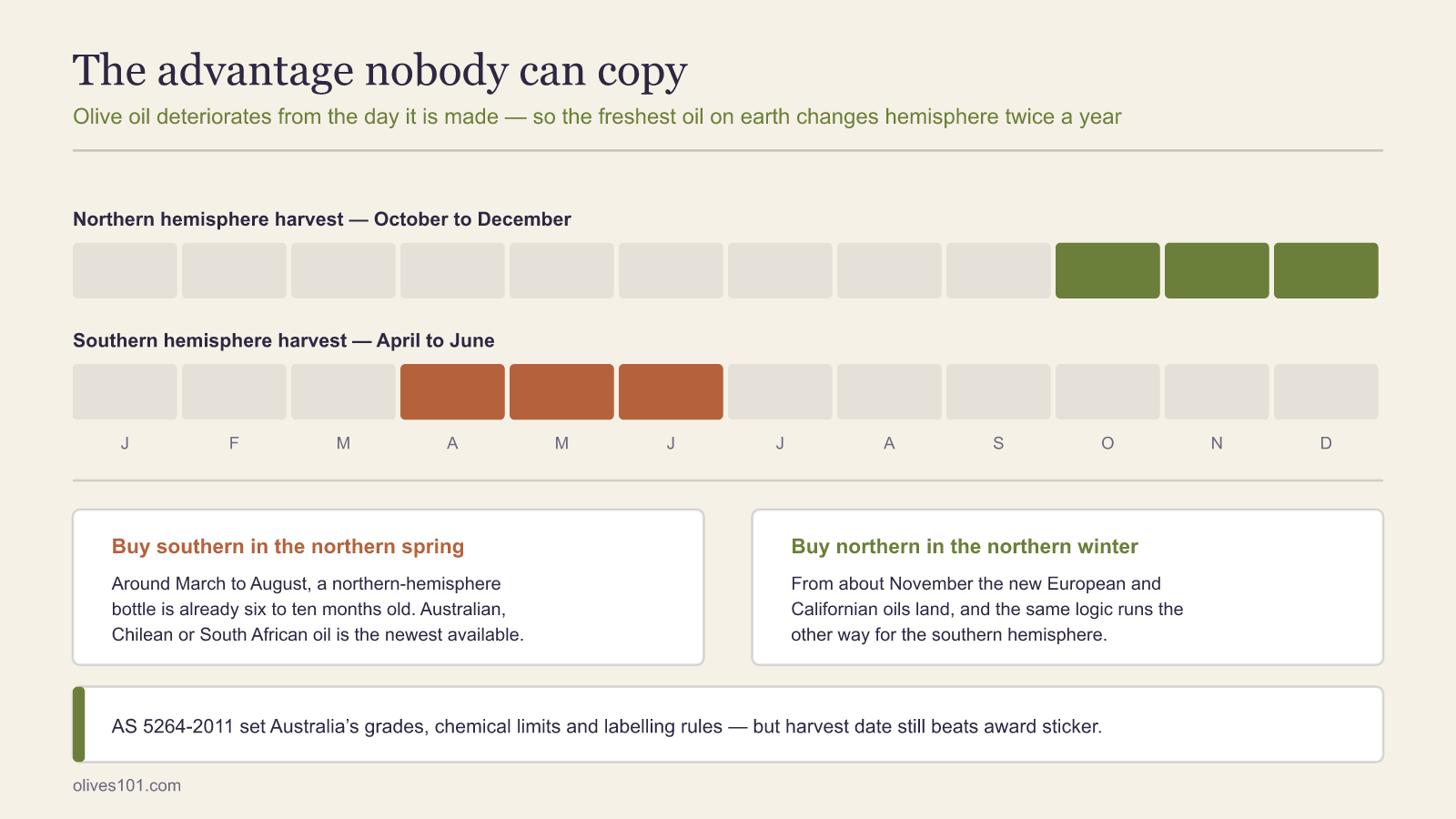
Here is the argument Australian producers should make far more loudly than they do. Olive oil deteriorates from the day it is made. Northern-hemisphere fruit is harvested roughly October to December; Australian fruit is harvested roughly April to June. That means for a large part of the year, the freshest oil physically available in the world is southern-hemisphere oil, and vice versa.
Work it through and the practical advice is simple. Around the northern spring and summer — when European oil from the previous autumn is six to twelve months old and has spent that time in warehouses, containers and shop windows — Australian, Chilean, South African and Argentinian oils are the new season. Around the northern winter, the position reverses. For anyone who takes freshness seriously, hemisphere is a more useful buying variable than country, and almost nobody uses it.
| Southern hemisphere | Northern hemisphere | |
|---|---|---|
| Typical harvest | April to June | October to December |
| New oil in shops | From about June | From about November |
| Freshest in Jan–Mar | 6–9 months old | New season, at its best |
| Freshest in Jul–Sep | New season, at its best | 7–11 months old |
| Producers | Australia, Chile, Argentina, South Africa, New Zealand | Spain, Italy, Greece, Türkiye, Tunisia, Morocco, Portugal, California |
| Practical rule | Buy it in the northern spring and summer | Buy it in the northern winter |
What the standard does not fix
Two honest limits. First, a domestic standard governs what is made and labelled under it — it does not rewrite the rules for every imported bottle on the same shelf, and imported oil makes up the bulk of what Australians actually buy. A shopper still has to look for the mark rather than assume the aisle is uniformly governed.
Second, no standard can make a small high-cost producer cheap. Australian oil competes against enormous, heavily mechanised Mediterranean supply, and it wins on freshness, traceability and testing rather than price. That is a perfectly good position, but it requires the buyer to understand what they are paying for — which brings us back to the awards. Medals are enjoyable and they sell bottles. The standard is what actually changed the average quality of what leaves the country.
Buying Australian oil well
- Look for certification under the industry code, which involves chemical and sensory testing after each harvest.
- Buy southern-hemisphere oil in the northern spring and summer, when it is the newest oil on earth.
- Harvest date beats award sticker, every time. A medal from three seasons ago tells you about a lot you cannot buy.
- Expect the styles to be varied — Australian plantings include Frantoio, Picual, Coratina, Barnea, Koroneiki and Arbequina, so there is no single Australian flavour.
- Buy from the region if you travel; farm-gate oil weeks off the mill is a different experience entirely.
- Read the grade language carefully on any bottle, anywhere — see what extra virgin really means.
Australian olive oil: common questions
What is AS 5264-2011?
The Australian Standard for olive oils and olive-pomace oils, published in 2011. It defines the grades, sets chemical and quality parameters, establishes labelling and packing requirements, and specifies acceptable methods of analysis.
Is Australian olive oil held to a stricter standard?
It is held to a standard that combines chemical limits with mandatory sensory assessment and provides a technical basis for best-before claims. Certified oils are tested after each harvest rather than once.
When is Australian olive oil freshest?
Harvest runs roughly April to June, so new-season Australian oil reaches shops from about mid-year. Through the northern spring and summer it is among the freshest oil available anywhere.
Why does hemisphere matter when buying olive oil?
Because olive oil ages from the moment it is made and the two hemispheres harvest six months apart. Whichever hemisphere has most recently harvested is the one selling genuinely new-season oil.
What do Australian olive oils taste like?
There is no single style. Plantings include Frantoio, Picual, Coratina, Barnea, Koroneiki and Arbequina, so Australian oils range from delicate and buttery to grassy and fiercely peppery.
Australians won a genuine argument and then talked about the wrong thing. Every awards night gets the coverage, and the awards are the least interesting part of the story. The real achievement is a published standard with a sensory panel behind it and testing after every harvest — boring, unglamorous, and the reason the average bottle got better. And the freshness argument is simply sitting there unused: for half the year, southern-hemisphere oil is the newest on the planet. If I were selling Australian oil into Europe I would print the harvest month on the front in large type and let the Mediterranean explain its own.
Drawn from the Australian Standard AS 5264-2011 and the industry code of practice, and from the harvest calendars of the northern and southern hemispheres.