A Grower’s Map of Spain
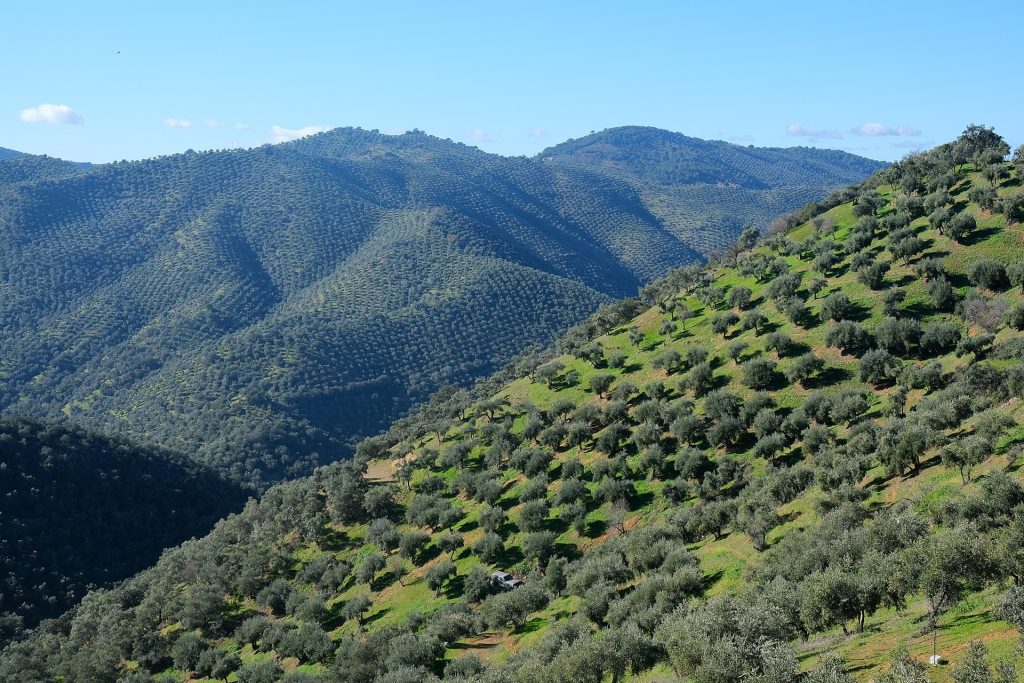
Spain makes more olive oil than anyone alive — close to 40% of world supply in a normal year. The real map is simpler than it sounds: a few great varieties, one province that sets the price, and a quiet truth about whose name ends up on the bottle.
If you only learn one country’s olive geography, make it Spain. No other producer comes close on volume, and no other producer’s weather is felt so widely on shelves thousands of miles away. When people talk about the “world price” of olive oil, they are very often talking about what happened to one stretch of southern Spanish countryside. Understand that, and a great deal of the global trade stops being mysterious.
Andalucía, and the rest
The heart is Andalucía in the south, an inland sea of olive trees that runs to the horizon in every direction. Within it, the province of Jaén holds an astonishing concentration of Spain’s groves — it is the realm of Picual, the country’s dominant oil olive and one of the most planted cultivars in the world. North-east, in Catalonia and Aragón, the elegant, gentle Arbequina rules. Extremadura and the wider south add Hojiblanca and Cornicabra, plus the great green table olives of Seville. It is not a mosaic the way Italy is; it is a handful of giants, each grown on a scale nowhere else can match.
| Region | Signature variety | Style |
|---|---|---|
| Jaén / Andalucía | Picual | Robust, peppery, stable; the global workhorse |
| Catalonia / Aragón | Arbequina | Soft, ripe, almondy; gentle and approachable |
| Extremadura | Hojiblanca, Cornicabra | Balanced to grassy; good table fruit too |
| Seville (Andalucía) | Manzanilla, Gordal | The great green table olives, not oil |
Why Jaén moves the world
Here is the part most shoppers never register. So much of the planet’s oil comes from this one Andalusian province that its weather is everyone’s price. When drought hits Jaén, shelves the world over feel it within months — the same concentration that drove the record prices of recent bad-harvest years. A dry winter in one corner of Spain can make a Greek or Californian bottle dearer, simply because the bulk Spanish oil that quietly fills so many blends suddenly costs more. Picual’s robustness and long shelf life are exactly why it is the workhorse behind countless blends sold under other flags.
The giant that bottles for everyone
This is Spain’s least-advertised role and the one worth understanding. Spain is not only the world’s biggest grower; it is also a vast supplier of bulk oil that gets bottled somewhere else. A great deal of what reaches a shopper as “Italian” oil began life in a Spanish co-operative’s tanks, shipped north, blended and dressed in another country’s label — the trade we pull apart in bottled in Italy. None of that is illegal, and a competently blended oil can be perfectly good. But it means the “origin” on a front label often describes where the bottle was filled, not where the fruit grew. Spain bottles for everyone, frequently without taking the credit.
- Much Spanish oil leaves the country in bulk, not in branded bottles.
- It reappears on shelves inside blends flagged to other nations.
- The Spanish name, ironically, carries less marketing shine than the oil deserves — which is the buyer’s opportunity.
- A named, single-variety Spanish bottle cuts out the middle-man story entirely.
| Heartland | Andalucía (esp. Jaén, Córdoba) |
|---|---|
| Lead oil variety | Picual |
| Soft alternative | Arbequina (Catalonia, Aragón) |
| Table olives | Manzanilla, Gordal (Seville) |
| Harvest | October–February |
| Global rank | Largest producer and exporter |
Spanish olive oil: common questions
Is Spanish olive oil good quality, or just cheap?
Both can be true, which is the confusion. Spain produces enormous volumes of sound, everyday oil and some of the finest single-estate extra virgins in the world. The trick is to read past the price: a fresh, named-variety Picual or Arbequina with a harvest date is reliably excellent value. Anonymous, dateless bulk oil is exactly that — anonymous.
What is Picual, and why is it everywhere?
Picual is Spain’s dominant oil olive, grown above all in Jaén. It gives a robust, peppery oil that is unusually stable and slow to go rancid, which is why it underpins countless blends — including many sold under other countries’ names. On its own, fresh, it is bold and savoury.
Why does Spanish weather affect olive oil prices everywhere?
Because Spain supplies so much of the world’s oil that a poor Spanish harvest shrinks global supply on its own. When Jaén suffers drought, the bulk oil that fills blends worldwide gets scarce and dear, and prices rise on shelves far from Spain.
Is ‘Italian’ oil sometimes really Spanish?
Often, yes. Italy imports large volumes of bulk oil — much of it Spanish — to blend and bottle. The result can carry an Italian front label while much of the fruit grew elsewhere. We cover the practice in bottled in Italy. It is legal; it just means the flag is not always the farm.
Picual or Arbequina — which should I buy?
For an everyday, robust oil with great value and long life, fresh Picual is hard to beat. For something softer, rounder and more delicate, choose Arbequina. Both reward you for picking a named variety, a region and a recent harvest over a generic “product of Spain” label.
Here is the trade truth: Spain is simultaneously the best-value and the most under-credited origin on the shelf. Its name does less marketing work than “Tuscan” or “Italian,” even though a huge share of the oil sold under those flags began in Spanish tanks. Use that. Buy a fresh, single-variety Spanish oil — a Picual for boldness, an Arbequina for softness — with a clear harvest date and a named region, and you are paying for the oil itself rather than someone else’s flag. That is the cleanest deal in the whole business.
Part of the olives101 country guides; drawn from International Olive Council figures and Spanish sector data.