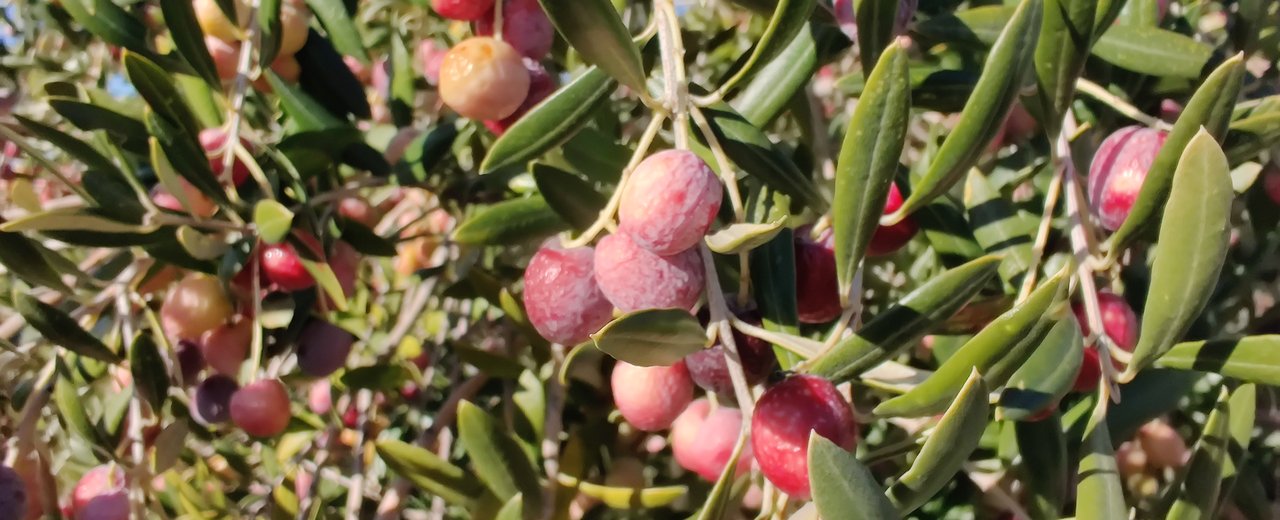

Arbequina olives
The small Catalan olive behind a huge share of the world’s everyday extra virgin oil.
Tiny, round, and brown-green, the Arbequina is not much to look at on the table: its fame is liquid. Originally from Catalonia in north-eastern Spain, it presses into a soft, fruity, almost buttery oil with gentle bitterness, and it has been planted across the world’s super-high-density oil orchards because it crops young and heavily. If you own a bottle of mild supermarket EVOO, there is a fair chance it is mostly Arbequina.
- Origin
- Catalonia · Spain
- Type
- Oil olive (mainly)
- Colour
- Brown-green
- Size
- Small
- Flavour (oil)
- Soft, fruity, mild
- Pressed for
- Everyday extra virgin oil
- Best for
- Pressing, all-purpose oil
Arbequina olives are small, round, brown-green olives from Catalonia, grown mainly for a soft, fruity oil but pleasant to eat too, and the Arbequina olive tree is the easiest olive a home gardener can plant: compact, quick to fruit and one of the more cold-tolerant varieties. This page covers the olive, the oil, why it took over the world’s modern groves, how it compares with Arbosana and Koroneiki, and how to grow one.
What Arbequina olives are
The Arbequina takes its name from Arbeca, a village in the Les Garrigues district of Lleida, in western Catalonia. Local lore says the Duke of Medinaceli brought it from Palestine in the 18th century; nobody can prove it, and it makes a better story than a history. What is certain is its weight at home: the International Olive Council’s variety catalogue calls it the most important variety in Catalonia, on more than 55,000 hectares, and the base of the Les Garrigues and Siurana protected designations of origin for oil.
The fruit is tiny, typically under 2 grams, round and symmetrical. It ripens from green through brown and purple toward near-black, and harvest runs from October in the earliest areas to December in the latest. Say it ar-beh-KEE-nah.
Eating Arbequina olives
Most Arbequinas are pressed, but they make a good little table olive, and in Catalonia a small bowl of them with the aperitif is standard. Jarred Arbequina olives are usually cured simply in salt brine rather than with lye, which suits a fruit this mild. Expect a firm, nutty, faintly buttery olive with gentle salt and very little bitterness, often in a mix of greens, browns and purples in the same jar.
The one thing to know: the stone is a big share of each olive. That makes them perfect for grazing and useless for cooking, because nobody wants to pit two hundred of them for a stew. Put them out with salted almonds, cured ham or a hard sheep’s cheese, and a dish for the stones. For a recipe that needs chopped olives, a bigger olive is far less work.
Arbequina olive oil: flavor and shelf life
This is what the olive is famous for. Good Arbequina oil is soft and fruity, with notes of green apple, almond and ripe fruit, sometimes a little artichoke, and low bitterness and pepper. It is the friendliest extra virgin there is, which makes it the right bottle for people new to good oil, for baking, for mayonnaise and for delicate food that a peppery oil would bully.
The catch is freshness. The IOC catalogue rates Arbequina oil excellent but notes that its stability is low: it carries fewer of the polyphenols that protect oil and more polyunsaturated fat than robust oils like Picual or Koroneiki, so it goes stale sooner. And a tired Arbequina does not turn harsh, it goes flat and greasy, which is harder to notice. Mild is fine; flat is not. Even a soft oil should smell of fresh fruit and leave a faint tickle at the back of the throat. In practice:
- Buy the most recent harvest, and look for a harvest date, not just a best-before.
- Choose dark glass or a tin, never a clear bottle under shop lights.
- Open it and use it within a couple of months; this is not an oil to stockpile.
- Keep a bottle of something fierce, a Picual or a Coratina, for when you want the oil to be heard.
For a closer look at the oil itself, its Catalan designations and how to buy it, see In Focus: the Arbequina olive.
Why Arbequina took over the world’s modern groves
Arbequina changed the economics of olive oil. The tree is naturally low in vigor, starts cropping young and, in the IOC’s words, gives “high and constant” yields. That made it the ideal olive for super-high-density hedgerows: small trees planted in continuous rows and harvested by a straddle machine, like wine grapes. From Spain it spread to Chile, Argentina, California, Australia and beyond. A UC Davis Olive Center survey published in 2009 found Arbequina on 78 percent of California’s super-high-density olive acreage.
That success is also why a bottle labeled simply “Arbequina” tells you the grape, so to speak, and not the place. Catalan Arbequina from an old terraced grove and New World hedgerow Arbequina are both honest oils, and they do not taste the same. If origin matters to you, read past the variety name to the country and the harvest date.
Arbequina vs Arbosana vs Koroneiki
These three are the backbone of the world’s hedgerow groves and are often planted side by side. Here is how they differ, for the kitchen and for the garden:
| Arbequina | Arbosana | Koroneiki | |
|---|---|---|---|
| From | Catalonia, Spain | Catalonia, Spain | Crete and the Peloponnese, Greece |
| Fruit weight* | 1.71 g | 1.43 g | 1.07 g |
| Ripens | First of the three | About 3 weeks after Arbequina | About 2 weeks after Arbequina |
| Oil style | Soft, fruity, low bitterness and pepper | Greener, more bitter and peppery | Intense, green, bitter and peppery |
| Polyphenols* | 270 ppm | 297 ppm | 384 ppm |
| Oxidative stability* | 7.9 hours | 15.8 hours | 12.8 hours |
| Cold | Among the hardiest olives | Moderately hardy | Sensitive |
| For a home garden | The best all-rounder | A good pollination partner | Only where winters are mild |
*From one Spanish nursery group’s published lab tests of a single harvest (polyphenols as caffeic acid; stability in hours at 120°C). Climate and ripeness move these numbers a lot, so read them as a ranking, not a promise. Cold ratings follow the IOC catalogue, UF/IFAS Extension and nursery data.
The ranking is the useful part: Arbequina has the gentlest oil and the shortest shelf life of the three, which is exactly why growers so often blend it with one of the others.
Growing an Arbequina olive tree
If you want one olive tree, this is usually the one to buy. The Arbequina olive tree is low in vigor, so it stays manageable. It fruits young: nurseries commonly quote two to three years for a nursery-grown tree, and University of Florida IFAS Extension says to expect fruit after about three. It is one of the more cold-tolerant olives, and it is handsome all year, with narrow gray-green leaves.
How big does an Arbequina olive tree get? Nursery descriptions for a tree in the ground range from about 8 to 20 feet, which tells you it depends on climate, soil and pruning more than on the label. Because it is a low-vigor variety, it is among the easier olives to keep small with an annual prune, and in a pot the container sets the limit.
It also needs a proper winter. Olives need a spell of winter cold to form flower buds, so a tree kept in a warm living room all winter will stay green and rarely fruit.
Almost every nursery tag says “self-fertile”, and the IOC catalogue lists Arbequina as self-compatible. But UF/IFAS Extension’s olive publication notes that recent research in Spain has shown Arbequina to be self-incompatible, lists it as not self-fertile, and suggests Arbosana, Koroneiki or Picual as partners. A lone tree may still set some fruit, especially if other olives grow nearby, since olive pollen travels on the wind. If you want a real crop rather than an ornament, plant a second variety. Buying a second Arbequina, as some sellers suggest, does nothing for pollination: it is the same clone. More in self-fertile vs cross-pollinated olive varieties.
Arbequina olive tree care: cold, pots and the basics
How cold can it go? UF/IFAS says olives in general can be grown where winter lows stay above about 12°F (-11°C), advises protecting trees below 20°F (-7°C), and notes that green fruit can be damaged at about 28°F (-2°C). Nursery ratings for Arbequina specifically run all the way from 22°F (-6°C) down to 5°F (-15°C), depending on who is selling. I would plan around the cautious end: treat the lowest figures as the limit for an established tree in a dry, sheltered spot, not a target. Young trees and potted roots are more tender than old trunks in the ground. Most US nurseries sell it for zones 8 to 10 outdoors, with some stretching to zone 7 against a warm wall.
Pots or the ground? Where winters stay mild, plant it in the ground: the roots are better insulated and the tree can reach its full size. In colder areas, grow it in a large pot, leave it outside through ordinary cold (that chill is what makes it flower), and move it to a bright, unheated but frost-free shelter such as a porch, garage with a window or cold greenhouse when a hard freeze is forecast. Pot size, compost mix and winter wrapping are covered in growing olive trees in pots.
The basics, in the ground or in a container:
- Sun: full sun, six hours at the very least and eight or more if you can.
- Drainage: free-draining, gritty or sandy soil. Olives get root rot in wet ground, and wet feet in winter are a common killer.
- Soil to avoid: very chalky ground, where the IOC notes Arbequina is prone to iron chlorosis (yellowing leaves), and ground with a history of Verticillium wilt, to which it is susceptible.
- Water: soak it, then let the top of the soil dry out. Established trees in the ground are drought-tolerant; pots dry out fast in summer.
- Feeding: light, from spring to late summer, then stop so you are not pushing soft growth into the cold.
- Pruning: in spring once frost risk has passed. Thin the center to let light in, and do not shear the whole tree, because olives fruit on the previous year’s wood.
For watering, feeding and pruning in more depth, see the olive tree care guide. When the fruit comes, pick it green to purple for brine-curing. The olives are small, so curing a batch is fiddly, and pressing oil from one or two garden trees is rarely realistic, but a jar of your own Arbequinas is well worth the effort.
Frequently asked questions
Are Arbequina olives good to eat?
Yes. Most are pressed for oil, but brine-cured Arbequinas are a mild, nutty little table olive, popular with the aperitif in Catalonia. The stone is large for the size of the fruit, so they are better for snacking than for cooking.
What does Arbequina olive oil taste like?
Soft and fruity, with notes of green apple, almond and ripe fruit, and low bitterness and pepper. It is one of the mildest extra virgin oils, and it is best used fresh because it keeps less well than robust oils.
Is the Arbequina olive tree self-fertile?
Nurseries sell it as self-fertile, but University of Florida IFAS Extension notes that research in Spain has shown it to be self-incompatible. A lone tree may set some fruit, but for a reliable crop plant a different variety nearby, such as Arbosana or Koroneiki.
How cold can an Arbequina olive tree tolerate?
It is one of the hardier olives, but nursery ratings range widely, from 22°F to 5°F. UF/IFAS advises protecting olives below 20°F, and young or potted trees need protection sooner than established trees in the ground.
Can you grow an Arbequina olive tree in a pot or indoors?
In a pot, yes, and it is one of the best olives for it. Keep it outdoors in full sun for most of the year and shelter it somewhere bright and cold but frost-free in hard freezes, because a tree kept warm indoors all winter rarely flowers.
How long until an Arbequina olive tree bears fruit?
Nurseries commonly quote two to three years for a nursery-grown tree, and UF/IFAS Extension says to expect fruit after about three years. Enough winter chill, full sun and a pollination partner all help.