Indo-Spanish Joint venture olive oil extraction unit proposed in Himachal Pradesh
Building an olive industry from scratch is a twenty-year project disguised as a five-year one. The agronomy is the easy part. The mill, the market and the patience are what decide whether a new olive region exists in 2050.
Every few years a government somewhere announces an olive project: a joint venture with a Mediterranean partner, an extraction unit, a demonstration orchard, a plan to substitute imports and give farmers a high-value crop. Indian states have done it, as have several central Asian countries, parts of China, Pakistan and a string of others. The announcements are sincere and the agronomy is often sound. Very few of them turn into industries, and the reasons are consistent enough to be worth setting out plainly.
The two hard climatic limits
An olive tree will grow almost anywhere warm. Making it fruit reliably is a different matter, and two conditions decide it. The first is winter chilling: olives need a spell of cool weather to induce flower buds. Too mild a winter and the tree stays healthy, green and barren. This alone rules out most tropical and subtropical land and pushes new projects towards higher altitudes or higher latitudes.
The second is humidity and rain at the wrong time. Olives evolved for wet winters and dry summers. Warm, humid conditions during flowering interfere with pollination, and humid summers encourage fungal disease and favour the olive fruit fly, which becomes far harder to manage than in a dry climate. A monsoon arriving during fruit development is a serious structural obstacle, not a bad year.
Which is why Indian olive efforts concentrated in the cooler, drier north and north-west, and why the cultivars planted are usually imported Mediterranean selections chosen for low chilling requirement and heat tolerance rather than for flavour.
| Requirement | Why it matters | What goes wrong |
|---|---|---|
| Winter chilling | Cool winter weather is needed to induce flower buds | Healthy trees that flower poorly or not at all |
| Dry spring | Humidity and rain during bloom disrupt pollination | Flowers set little fruit despite a good bloom |
| Dry summer | Humidity favours fungal disease and the olive fruit fly | Pest control costs overwhelm a young operation |
| Water for establishment | Young trees need reliable water for several years | Losses in year two or three from irrigation failure |
| A mill within reach | Fruit must be milled within hours of picking | Fruit trucked for a day arrives already spoiling |
| A market | Local consumers must want and afford the oil | Oil produced with no buyer at a price that covers cost |
| Patience and capital | Five to ten years to a meaningful crop | Political and financial attention moves on before the trees do |
The mill trap
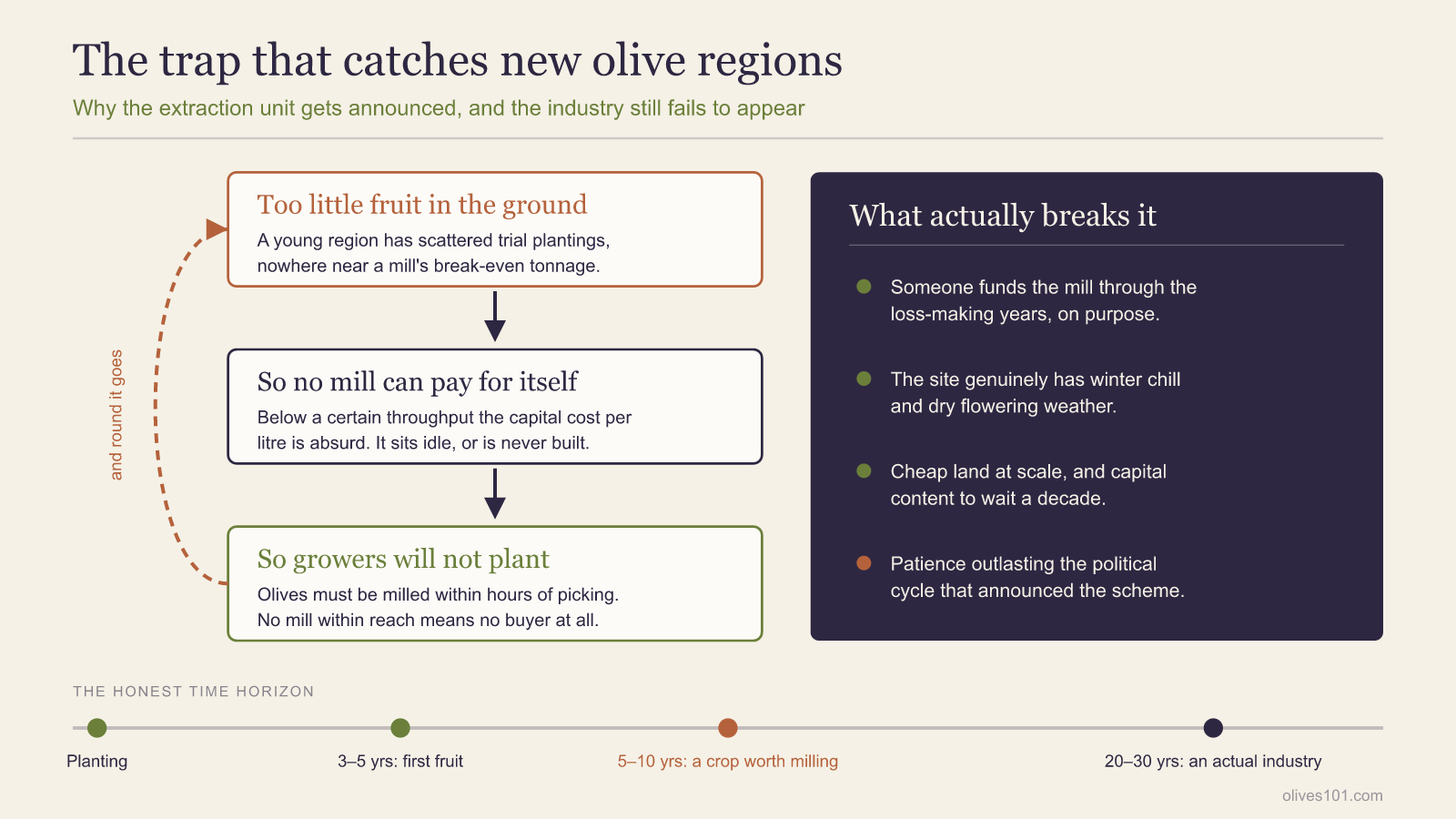
Here is the structural problem that catches nearly every new olive region, and the one that press releases about extraction units never acknowledge. A mill only makes sense above a certain throughput; below it, the capital cost per litre is absurd. But fruit must be milled within hours of picking, so growers will only plant if they know a mill will exist nearby. Each side is waiting for the other.
The usual answer is a state-funded or cooperatively owned mill built ahead of demand and run at a loss for years, which is exactly why these projects are announced by governments rather than companies. Where that subsidy is sustained long enough for orchards to mature, an industry can emerge. Where the political cycle turns first, the mill sits idle and the orchards are grubbed out or abandoned. The equipment sale is the easy part of the deal — foreign partners are always happy to sell a mill. Nobody sells you a market.
How the successful newcomers actually did it
Argentina, Chile, Australia and California all built substantial olive industries from small bases within living memory, and they share a pattern that is worth being honest about. They had cheap land at scale, Mediterranean-type climates that genuinely suited olives, access to capital willing to wait, and — crucially — an export orientation from the start. They did not rely on a domestic market learning to love olive oil. They planted for the world market and competed on freshness, price or counter-seasonality.
They also, almost without exception, went to high-density hedgerow planting with a short list of cultivars, because that is the only model that gets a new region to competitive costs quickly. It produces a certain sameness of style, and it works.
A country whose olive plan depends on convincing its own consumers to switch from a familiar cooking fat to an expensive imported taste is attempting something much harder than planting trees. That is a marketing and price problem, and it usually takes a generation.
What to watch when a new olive project is announced
- Ask about winter chilling first. If the site cannot induce flowering, nothing else matters.
- Ask where the mill is and who is funding it through the loss-making years.
- Ask who buys the oil, at what price, and whether that price covers production.
- Check the time horizon against the political cycle. Trees take longer than terms of office.
- Look for extension and training, not just equipment. Machinery without agronomists is scrap in waiting.
- Judge a new olive region after fifteen years, not after the ribbon-cutting.
New olive regions: common questions
Can olives grow outside the Mediterranean?
Yes. Argentina, Chile, Australia, California, South Africa and others produce substantial quantities. What they share is a Mediterranean-type climate with cool winters and dry summers, not a Mediterranean location.
Why do olives need cold winters?
Because a period of cool weather is required to induce flower buds. Without sufficient chilling the tree grows well but flowers poorly or not at all, so it never crops reliably.
Why is monsoon climate difficult for olives?
Humidity and rain during flowering disrupt pollination, and humid summers favour fungal diseases and the olive fruit fly, making pest management far more expensive than in a dry climate.
How long before a new olive region produces commercially?
Five to ten years for meaningful fruit depending on planting density, and typically twenty to thirty years before a genuine industry with mills, expertise and markets exists.
Why do governments rather than companies start these projects?
Because the mill must usually be built ahead of the orchards and run below capacity for years. That gap between investment and return is more easily borne by a state than by a private investor.
I have watched several of these schemes from the trade side, and there is one question that separates the serious ones from the photo opportunities. Not the variety, not the hectares, not the joint venture partner. Ask who will buy the oil, at what price, in year eight. If the answer is a strategy, a subsidy or an aspiration rather than a customer, the trees are being planted into a press release. The foreign partner will deliver an excellent mill and go home. The mill is the easy part; it always was.
Drawn from published olive agronomy on chilling requirement and climatic suitability, and from the documented development histories of new-world olive industries.