The true cost of an olive
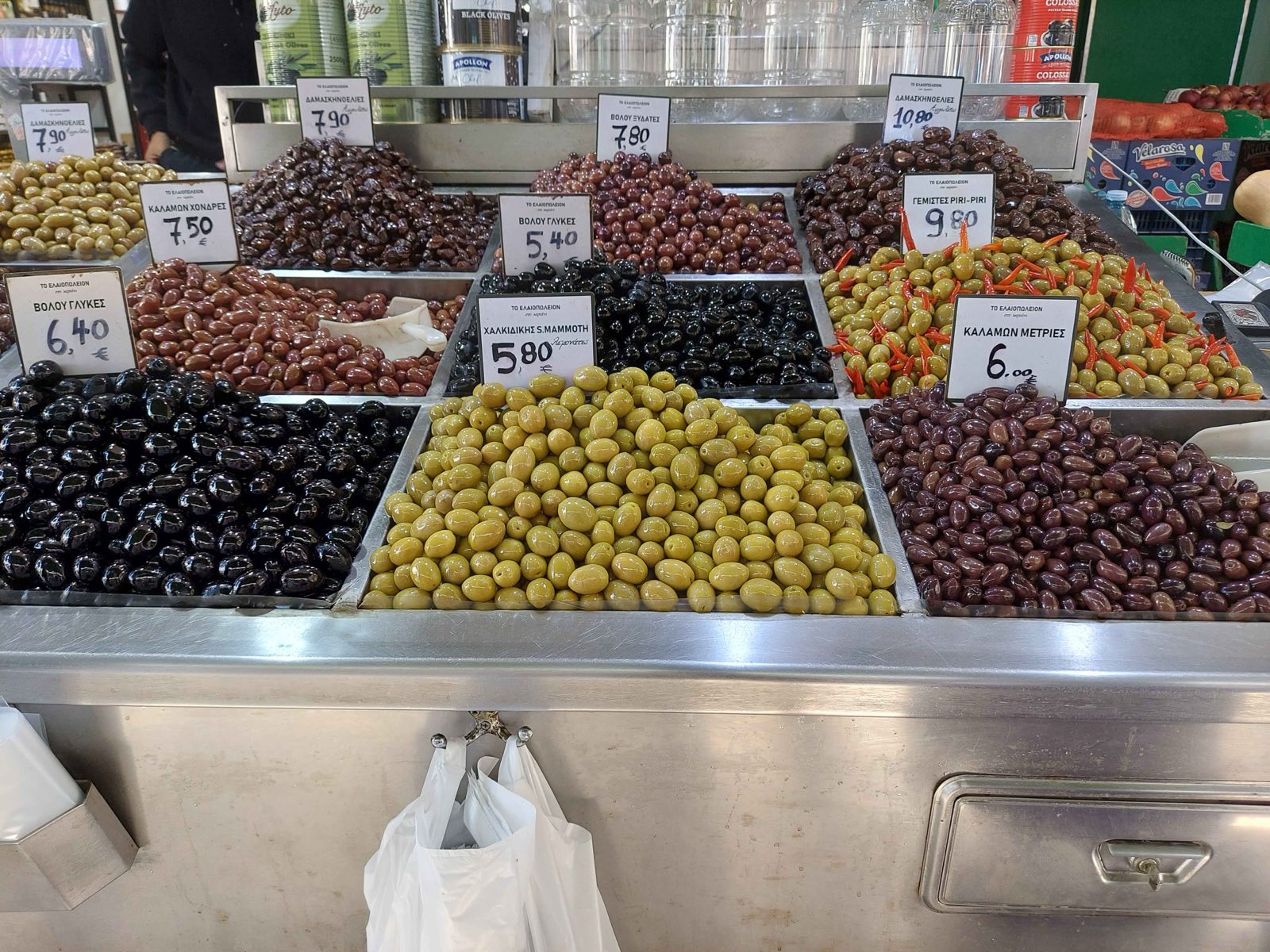
One counter in Thessaloniki. Nine different prices, all handwritten, all per kilo, and the dearest bin costs exactly twice the cheapest. Nothing about that spread is random, and almost none of it is about flavour.
The photograph above is a real olive counter at Kapani market in Thessaloniki, photographed on 30 September 2025. I have stood behind counters like it, and I have sold into them for twenty years. Look at the cards: €5.40, €5.80, €6.00, €6.40, €7.50, €7.80, €7.90, €9.80, €10.80. Same shop, same morning, same brine-wet fruit scooped from the same kind of stainless bin.
Customers assume that spread is quality, or provenance, or some secret about the variety. It is mostly none of those. It is size, curing method, whether somebody pushed a chilli into the fruit, and above all where in the chain the money got taken. This page follows that money in actual currency, from what the grower was paid to what the counter charges. Every figure below carries its source and its date. Where I could not source something, I say so instead of guessing, and there is more of that at the end than you might expect.
The chain, in real money
Here is the whole thing on one unit: one kilogram of olives, at each rung. A caution before you read it, because it matters. These are not one consignment tracked from a single farm to a single counter. Nobody publishes that, and anybody who claims to has built a model and called it a measurement. What follows is the real, published price at each rung of the trade in roughly the same period. Read it as a ladder, not as a receipt.
| Rung | What is being priced | Money | Source and date |
|---|---|---|---|
| Farm gate | Hojiblanca for the table, paid to the grower | €0.97/kg | Junta de Andalucía price observatory, week 42 (13–19 Oct 2025) |
| Cost to produce | What that kilo cost the grower to grow | €1.10/kg | Unión Extremadura, 4 Aug 2025 |
| Bulk | Olives in brine, in drums, crossing a border | €1.30/kg | Eurostat Comext, HS 0711.20, EU27 from outside the EU, 2025 |
| Packed | Prepared and preserved, ready for a shelf | €2.00/kg | Eurostat Comext, HS 2005.70, EU27 from outside the EU, 2025 |
| Supermarket | Pitted green olives in a jar, drained basis | €5.37/kg | Carrefour.fr, observed 19 Jul 2026 |
| The counter | Loose olives, weighed wet, nine bins | €5.40–10.80/kg | Kapani market, Thessaloniki, 30 Sep 2025 |
Bars to scale against the dearest bin on the Kapani counter. Different countries, different products, same unit: one kilogram.
Andalucía, week 42 of 2025
Extremadura, August 2025
EU27 imports, HS 0711.20, 2025
EU27 imports, HS 2005.70, 2025
Carrefour.fr, drained basis
Kapani, Thessaloniki
Kapani, Thessaloniki
The terracotta bar is the only one that is not a price. It is what the fruit cost to produce, and it sits above what the grower was paid.
Two things jump out of that ladder once it is drawn to scale. The first is how compressed the bottom is. Farm gate to packed goods, which is the part of the chain involving all of the growing, all of the harvesting, all of the curing and all of the packing, spans €0.97 to €2.00. The second is how much room is above it. The dearest bin on that Greek counter is €10.80 ÷ €0.97 = 11.1 times the farm gate price of the fruit.
The single cleanest number in the whole table is the gap between the two Eurostat rows, because both come from the same dataset, the same reporter and the same year, and differ only in what was done to the olives. Bulk olives in brine arrived at €11,386,786 ÷ 8,747,971 kg = €1.30 a kilo. Prepared and packed olives arrived at €301,896,368 ÷ 150,854,418 kg = €2.00 a kilo. That 70-cent difference is the packing step, priced by the market, with no modelling on my part.
The grower is underwater
Set two sourced figures side by side. In week 42 of 2025, Hojiblanca for the table was being paid at €0.97 a kilo at the farm gate in Andalucía. In August 2025, growers in Extremadura put the cost of producing a kilo of table olives at €1.10, and said they needed €1.32 to make it worth doing.
The fruit sold for €0.97. It cost €1.10 to grow. That is a loss of thirteen cents on every kilo, before it has been cured, before it has been packed, before anybody has shipped it anywhere. Same country, same year, both figures published by people with no reason to agree with each other.
This is not a freak week. The Andalusian observatory’s own weekly series through that autumn has Hojiblanca moving between €0.84 and €0.90 across weeks 39 to 46, and the regional harvest report for the same week 42 records that board prices were struggling to exceed €0.90 a kilo, with only scarcity contracts closing at €0.95 and €1.00. The €0.97 I used in the table is therefore near the top of that autumn’s range, not a low outlier. Use the lower end and the hole gets deeper.
Two things stop this from being a simple story about greed. One is that the cost of growing is not a single number: it swings enormously with how the fruit is picked. Spanish ministry survey work on table-olive groves puts labour at around €560 a hectare where the harvest is mechanised with an umbrella shaker, and as high as €3,860 a hectare, some 75% of operating costs, where irrigated groves are still picked by hand. Andalusian value-chain work found manual harvesting takes 38.8 to 45.3 worker-days a hectare against 10.5 to 14.5 mechanised, with the harvest alone accounting for 77.5% of labour days in the manual case and 35.7% in the mechanised one. A grower who mechanises can produce for €0.47 to €0.58 a kilo where a manual manzanilla operation needs €0.74 to €0.96.
The other thing is that not every variety is in trouble. On the same Andalusian price sheet in the same week, Gordal was paid €2.33 a kilo, Aloreña €1.59 and Manzanilla €1.33, against Hojiblanca’s €0.97 and Carrasqueña’s €0.85. Gordal is a large-calibre fruit and it is paid like one. Which brings us to the thing the counter is really selling.
You are paying for calibre, not for the variety
Go back to the photograph and find the two Kalamon cards. One reads metries, medium, at €6.00 a kilo. The other reads chondres, large, at €7.50 a kilo. Same variety, same stall, same morning, same brine. The large fruit costs €7.50 ÷ €6.00 = 25% more per kilo, purely for being bigger.
This happens twice more on that one counter. Volos sweet-cured appears in two bins at €5.40 and €6.40. The wrinkled damaskinoelies appear at €7.90 and €10.80, a 37% spread on fruit sold under an identical name. A shopper reading only the names would conclude the shop had made a mistake. It had not. It had graded.
Grading is the pricing lever of the entire table-olive trade and it is largely invisible to the person buying. Codex grades table olives by count per kilogram, in bands running from 60/70 fruits per kilo at the giant Gordal end down through 381/410, and onward above 410 in steps of fifty. The International Olive Council’s variety catalogue treats medium fruit as 3 to 5 grams and large fruit as above 5 grams, and wants a flesh-to-stone ratio above 5:1 before a variety is considered fit for the table at all. Every one of those thresholds is a price break. Fruit that falls one band short of the size the buyer specified does not get a slightly lower price; it gets sold into a different product entirely.
The most expensive thing on that Greek counter is not the rarest olive. It is the one somebody worked on. The piri-piri stuffed green at €9.80 a kilo outprices every plain green bin on the stall, and the fruit underneath the chilli is ordinary green olive. Stuffing is a margin product: it adds a cheap ingredient and a labour step to a mid-grade fruit and re-prices the result at the top of the board. The same logic runs through the whole category, from pimiento to garlic to almond. When you buy stuffed, you are buying the stuffing operation more than you are buying the olive.
The brine question, which is where the real money hides
Everything above is priced per kilo. The obvious question is: a kilo of what?
Codex Standard 66-1981 answers it, and the answer surprises people. The minimum drained weight for whole table olives is 50% of the container’s water capacity. For pitted or stuffed olives it drops to 40%. In other words, half of a legally compliant jar of whole olives may be brine, and 60% of a legally compliant jar of stuffed olives may be brine. There is even a footnote releasing very large fruit, below 110 units per kilo, from the minimum drained weight requirement altogether. The Australian production manual puts the practical packing geometry at roughly 67% olives to 33% brine for whole fruit, which is a reminder that the legal floor is a floor, not a description of normal practice.
None of that is scandalous by itself. Olives need brine; it is not padding, it is the preservation medium and it is what stops the fruit turning to mush. The scandal, such as it is, lies in how retailers convert that jar into the price-per-kilo figure printed on the shelf edge, because they do not all do it the same way, and the difference is enormous.
Carrefour prices the olives
Carrefour France computes its unit price on drained weight. You can prove it from the shelf data without asking anyone. A jar of pitted green olives on Carrefour.fr sells at €2.55 for 820 g and displays €5.37 a kilo. Divide: €2.55 ÷ €5.37 = 0.475 kg. That is exactly the 475 g drained weight in the product name, and it is 57.9% of the 820 g jar. The smaller Carrefour Classic’ jar checks out the same way: €0.95 for a 320 g jar with 160 g drained gives €0.95 ÷ 0.160 kg = €5.94 a kilo, which is the figure shown, and 160 g of 320 g is exactly the Codex 50% floor.
Sainsbury’s prices the jar, except when it does not
Now the same exercise on a British shelf, on the same day, in one retailer. Sainsbury’s own-label pitted green olives, 340 g with 150 g drained, sell at £1.35 and display £3.97 a kilo. Divide: £1.35 ÷ 0.340 kg = £3.97. The basis is the gross jar, brine included. The 800 g jar and the Queen olives behave identically.
Two shelves along, in the same aisle, two Odysea lines are priced the other way. Odysea Big Gordal, 290 g with 120 g drained, sells at £3.10 and displays £25.83 a kilo. Divide: £3.10 ÷ 0.120 kg = £25.83. That is the drained basis. Odysea Kalamata and Halkidiki, 290 g with 160 g drained, at £2.80, displays £17.50, and £2.80 ÷ 0.160 kg = £17.50. Drained again.
Follow that through to what it does to a shopper comparing two products. On the shelf edge, the Odysea Gordal at £25.83 a kilo looks £25.83 ÷ £3.97 = 6.5 times as expensive as the own-label. Put both on the same drained basis and the real gap is £25.83 ÷ £9.00 = 2.9 times. The premium brand is genuinely dearer, and it is dearer for defensible reasons, but the shelf makes it look more than twice as dear as it is. The retailer being more honest about drained weight is the one that looks worse.
This is not a British quirk. In the United States I found the identical inconsistency inside a single Walmart store, where a Mezzetta Kalamata was priced per drained ounce at 51.8 cents while a Great Value stuffed green sat on the same shelf priced per net ounce at 47.7 cents. The two figures cannot be compared and nothing on the shelf says so. Even the trade does it: one large food-service distributor lists a 20 lb pail of pitted Kalamata per ounce as displayed, and a gallon of pitted Manzanilla per drained ounce, in the same catalogue.
And notice what this means for the photograph at the top of this page. Every price on that counter is per kilo of wet fruit, scooped dripping from the bin. There is no drained weight on an open counter. Whatever brine clings to the olives, you are buying by weight.
So what does one olive cost?
This is the question in the title, and it has a real answer, but only if you go through calibre. Codex grades in fruits per kilogram, so any price per kilo divides straight into a price per olive once you fix the band. Here is the arithmetic, in full, with the band stated every time.
| Price used | Codex band | Arithmetic | Per olive |
|---|---|---|---|
| €0.97/kg farm gate | 60/70 per kg (giant) | 0.97 ÷ 70 and 0.97 ÷ 60 | 1.39–1.62c |
| €0.97/kg farm gate | 381/410 per kg (small) | 0.97 ÷ 410 and 0.97 ÷ 381 | 0.24–0.25c |
| €6.00/kg Kalamon medium | 60/70 per kg | 6.00 ÷ 70 and 6.00 ÷ 60 | 8.57–10.00c |
| €7.50/kg Kalamon large | 60/70 per kg | 7.50 ÷ 70 and 7.50 ÷ 60 | 10.71–12.50c |
| €9.80/kg piri-piri stuffed | 60/70 per kg | 9.80 ÷ 70 and 9.80 ÷ 60 | 14.00–16.33c |
| €5.40/kg cheapest bin | 381/410 per kg | 5.40 ÷ 410 and 5.40 ÷ 381 | 1.32–1.42c |
The two farm-gate rows are the point of the table. The same kilo price, at €0.97, produces a per-olive cost of 1.39 to 1.62 cents in the largest Codex band and 0.24 to 0.25 of a cent in a small one. A factor of six, from nothing but size. This is why asking what an olive costs without stating the calibre is like asking what a piece of timber costs without saying how long it is.
At the top of the counter, a single large Kalamon at €7.50 a kilo costs the shopper between 10.71 and 12.50 cents, and a single stuffed piri-piri olive between 14.00 and 16.33 cents. Those are the honest headline answers to the question in the title, and they are worth holding next to the 1.39 to 1.62 cents the Andalusian grower received for a giant-calibre olive in the same season.
What nobody publishes
Now the uncomfortable part, and the reason this page took far longer to write than it should have.
There is no published raw-to-finished yield for table olives. The single most obvious question in the whole chain, how many kilos of fresh fruit off the tree it takes to make one kilo of finished brined olives on a shelf, is not stated by the FAO, the International Olive Council, Codex, the Australian production manual, the Andalusian regional observatory, the Spanish agriculture ministry, or a full processing-plant design study. I went looking for it specifically and came back empty-handed. Every confident figure you will find for this online is somebody’s estimate wearing a citation it does not have. Fruit certainly loses weight during curing, and the Australian manual notes darkening losses alone may reach 20%, but a single loss figure is not a yield ratio and I will not dress one up as the other.
There is no published weight loss for pitting either. Spain has a legal pitting coefficient of 0.75, set by ministerial order in 1977, and it is widely misquoted online as “olives lose 25% of their weight when pitted”. It says no such thing. It is a count coefficient: multiply the count per kilo of pitted olives by 0.75 to recover the whole-fruit calibre. It exists so that graders can talk to each other about size across pitted and unpitted lots. It is not a weight. Neither Codex nor the IOC sets a universal pitting coefficient at all; producing countries set their own.
Pit percentage by variety is not reliably published. The one citable general figure is the Australian manual’s statement that most olives are about 80% flesh and 20% stone, with a worked example of 670 g of olives yielding 134 g of stone and 536 g of flesh. The per-variety tables circulating online trace back, when you follow them, to sources that are not sources.
I could not source a single American olive-bar price. I tried. The figures that circulate for US supermarket olive bars trace to AI-written summaries and lifestyle listicles with no retailer page behind them, so there is no US olive-bar price on this page. Similarly, and this one surprised me: the International Olive Council publishes no table-olive prices at all. Its price tables are olive oil. Any article quoting “IOC producer prices” for table olives is quoting oil figures with the label swapped, which is why this page leans on Spanish regional data and customs statistics instead.
I would rather hand you four honest gaps than one invented ratio. If you have seen a real, published, retrievable figure for any of them, I would genuinely like to see it.
What the counter does not tell you
Three things I know from the trade rather than from a document, offered as exactly that.
The first is the bucket. Olives on an open counter feel artisanal and are usually not. They arrive at the shop in the same food-service pails and drums that supply restaurants, from the same graders that fill the jars, and get tipped into a stainless bin. That is not a criticism; the fruit is often excellent and you can inspect it before you buy, which you cannot do through glass. But the bin is a presentation format, not a quality tier, and it is priced as though it were the second thing.
The second is provenance. A great deal of fruit sold in a Greek or Provençal style was grown neither in Greece nor in Provence. The customs data makes the incentive plain: in 2025 the EU imported 50.2 million kilos of prepared olives from Morocco at €2.13 a kilo and 36.2 million kilos from Egypt at €1.28. Trade analysis of French imports for 2023 shows Greek fruit landing at €3,650 a tonne against Moroccan at €1,757, a gap of €3,650 ÷ €1,757 = 2.1 times. When two fruits can be cured to look similar and one costs less than half as much, the market finds that out quickly. “Style” on a label is a description of a cure, not a country.
The third is that the counter’s spread is mostly labour and presentation. Sweet-cured, vinegar-cured, lemon-cured, wrinkled, stuffed: each of those is a process applied after the fruit is graded, and each one is re-priced. The fruit is the cheapest part of almost everything on that board.
Companion: the other olive economy
Everything above is about table olives, the fruit you eat. That is a different business from olive oil, and the two get confused constantly, including in the earlier version of this page. Since most people arrive at the subject through oil, here is how the oil side compares, clearly labelled as the separate thing it is.
The best evidence I have that these are two different economies comes from California, where the same crop in the same state in the same year is sold both ways and the government prices both. In 2025, olives for canning were paid at 1,200 US dollars a short ton, while olives crushed for oil were paid 855. That is 1,200 ÷ 855 = a 40% premium for going to the table rather than the mill. Converted, the canning price is 1,200 ÷ 907.185 = 1.32 US dollars a kilo, which sits in the same territory as the Spanish table-olive figures above.
And yet: of California’s 2025 olive crop, 33,180 short tons went for canning against 99,810 crushed for oil, so only 33,180 ÷ 132,990 = 24.9% of the fruit took the better-paid route. Oil absorbs the bulk of the crop because table use is far more demanding. Table fruit must be the right calibre, unbruised, picked at the right moment and handled like fruit rather than like raw material. Oil olives can be smaller, riper, and knocked out of the tree by a machine. Most fruit simply cannot meet the table specification, which is another way of saying that the grading discussed earlier reaches all the way back to the tree.
The economics of a bottle then diverge from the economics of a jar. An olive tree planted today gives almost nothing for five years and does not hit full stride for fifteen, which is the first hidden cost of oil and of table fruit alike: patience. Then comes a year of pruning, watching the weather and fighting the olive fly for one autumn harvest, followed by milling within hours, before the fruit spoils. Then glass, which is heavy and often costs more than people expect relative to what is inside it, and then shipping a heavy liquid across the world while keeping it away from light and heat, and then a retailer’s margin.
I am not going to give you a percentage breakdown of where the money in a bottle goes, because I cannot source one, and the previous version of this page did exactly that: it printed a table of stage-by-stage percentages and then admitted underneath that the numbers were illustrative. That is not information. What I can tell you, with the customs data above to support it, is the shape: the fruit is a small part of the price of a finished consumer product, and the further along the chain you look, the more of the price is being created by processes and by packaging rather than by farming.
Why the cheapest oil is cheap comes down to three things stacked: machine harvesting instead of hands, buying in bulk from wherever the harvest was cheapest that year and blending it, and, at the bottom of the market, quietly cutting real oil with refined oil that costs a fraction to produce. The first is efficiency and there is nothing wrong with it. The last is a different story, and I tell it in how olive oil gets cut and in extra virgin that isn’t.
What I would do with this
Not “always buy the expensive one”. Four practical things instead.
Check the drained weight before you compare prices. It is on the label, usually in brackets, often with an asterisk. Divide the price by the drained weight yourself. On the British examples above that one step changed the apparent price by 2.27 times and reversed which product looked better value.
Buy on calibre, not on the name. The variety on the card tells you less about what you will pay than the size grade does. If a stall has the same variety in two bins at two prices, the difference between them is size, and you should decide whether you want the size.
Treat stuffed olives as a prepared food. You are paying for the stuffing operation. That may well be worth it, but price it against other prepared foods rather than against plain olives.
Remember who is at the bottom of the ladder. When Hojiblanca sells at €0.97 against a €1.10 cost of production, the loss does not vanish; somebody absorbs it, and it is not the supermarket. If you have the choice between two similar jars and one comes from a named producer or a cooperative, that choice reaches further back down the chain than anything else you can do at a shelf.
Questions people actually ask
Why do two bins of the same olive cost different prices on the same counter?
Because you are paying for size, not for the name. On the Kapani counter, Kalamon marked metries (medium) sold at €6.00 a kilo and Kalamon marked chondres (large) at €7.50 a kilo, on the same day, from the same stall: 25% more for the identical variety, sorted bigger. The same thing happens twice more on that counter, with two bins of Volos sweet-cured at €5.40 and €6.40, and two of the wrinkled damaskinoelies at €7.90 and €10.80.
How much of a jar of olives is actually brine?
Legally, up to half of it. Codex Standard 66-1981 sets the minimum drained weight at 50% of the container’s water capacity for whole olives, and 40% for pitted or stuffed olives. So a compliant jar of stuffed olives can be 60% liquid. In practice Sainsbury’s own published drained weights across its range run from 41.4% to 55.2% of the pack.
What does one single olive cost?
It depends almost entirely on calibre, because Codex grades olives by count per kilogram. Take the Hojiblanca farmgate price of €0.97 a kilo. In the largest Codex band, 60 to 70 fruits per kilo, that is €0.97 ÷ 70 = 1.39 cents to €0.97 ÷ 60 = 1.62 cents per olive. In a small band of 381 to 410 fruits per kilo, the same kilo price works out at about a quarter of a cent per olive. At the retail end, a large Kalamon at €7.50 a kilo is 10.71 to 12.50 cents each.
Do olive growers actually make money at these prices?
Not always, and in 2025 frequently not. Hojiblanca destined for the table was quoted at €0.97 a kilo at the farm gate in Andalucía in week 42 of 2025. Growers’ organisations in Extremadura put the cost of producing that fruit at €1.10 a kilo, and the price needed for a real margin at €1.32. The grower was 13 cents a kilo underwater before anyone downstream had done anything at all.
How many kilos of fresh olives does it take to make one kilo of finished olives?
Nobody publishes it. I looked through the FAO, the International Olive Council, Codex, the Australian production manual, the Andalusian regional observatory and the Spanish agriculture ministry, and none of them state a raw-to-finished conversion ratio for table olives. Anyone who gives you a confident number for this has made it up. Fruit does lose weight in curing, and the Australian manual notes that darkening losses alone may reach 20%, but that is not the same thing as a yield ratio.
Are olives from the open counter better than olives from a jar?
Not inherently. The bins at a market counter are usually filled from the same food-service pails and drums that supply restaurants, and the fruit inside them came off the same graders as the jarred fruit. What the counter genuinely gives you is the ability to see the calibre and the condition before you buy, and to buy the exact quantity you want. What it takes away is the drained weight on the label: the counter weighs the olives wet, brine and all.
Where these figures come from
Retail counter prices read directly from the photograph above (Kapani market, Thessaloniki, 30 September 2025). Farm-gate prices: Junta de Andalucía, Observatorio de Precios y Mercados, week 42 of 2025, and Informe de campaña de verdeo 2025, week 42. Cost of production: Unión Extremadura, 4 August 2025. Labour: Spanish Ministry of Agriculture, Redes TECO, Olivar de Mesa results for the 2024–25 campaign, and Junta de Andalucía, Cadena de valor de la aceituna de mesa. Cross-border unit values: Eurostat Comext dataset DS-045409, HS 0711.20 and HS 2005.70, EU27 imports from outside the EU, 2024 and 2025. French import prices by origin: CBI, Netherlands Ministry of Foreign Affairs, February 2025, sourced to ITC Trade Map. Drained weight and calibre rules: Codex Standard 66-1981 for table olives, sections 3.2.2 and 7.1.4. Flesh-to-stone and packing ratios: RIRDC Table Olive Production Manual, publication 12/100, and the International Olive Council World Catalogue of Olive Varieties. Pitting coefficient: Spanish ministerial order of 29 December 1977. Retail shelf data: Carrefour.fr and Sainsbury’s, both observed 19 July 2026. US grower prices and utilisation: USDA National Agricultural Statistics Service, Noncitrus Fruits and Nuts, 2025 Summary.