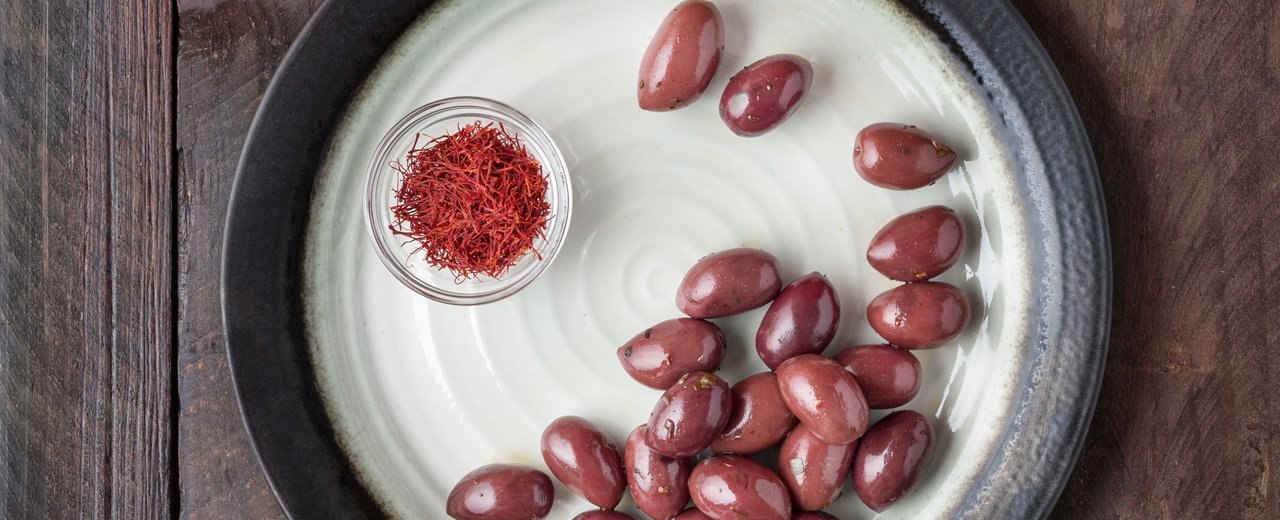

Kalamata olives
The almond-shaped purple-black olive of the Peloponnese — Greece’s most famous table olive.
Deep aubergine, almond-shaped, and split with a glossy sheen, the Kalamata is what most of the world pictures when it hears “Greek olive.” It is grown around the city of Kalamata in the southern Peloponnese and carries a protected designation of origin there. Rich, fruity, a little winey from its brine — this is an olive with an opinion.
- Origin
- Kalamata, Peloponnese · Greece
- Type
- Table olive
- Colour
- Dark aubergine / black
- Shape
- Almond, pointed
- Flavour
- Rich, fruity, winey
- Cured in
- Red-wine vinegar brine
- Best for
- Salads, tapenade, baking
The full guide: for how Kalamata olives are grown, cured, labelled and cooked, read Kalamata Olives: What They Are, How They Are Made, How to Use Them.
What makes a true Kalamata
A real Kalamata is tree-ripened to that dark purple-black, then cured in a brine often sharpened with red-wine vinegar, which gives it the characteristic tang. The flesh is firm and meaty and clings to a fairly large pit. Because of the protected designation, an olive can only be sold as “Kalamata” in the EU if it actually comes from that region — elsewhere you will see the dodge “Kalamata-style” on olives grown far away.
Watch for dyed black olives sold as Kalamata. A true Kalamata is naturally dark from ripening; a cheaper green olive can be oxidised black and stabilised with ferrous gluconate to imitate it. And “Kalamata-style” on the label is a quiet admission that the olive never saw the Peloponnese. If the price looks too good for an imported PDO olive, it usually is.