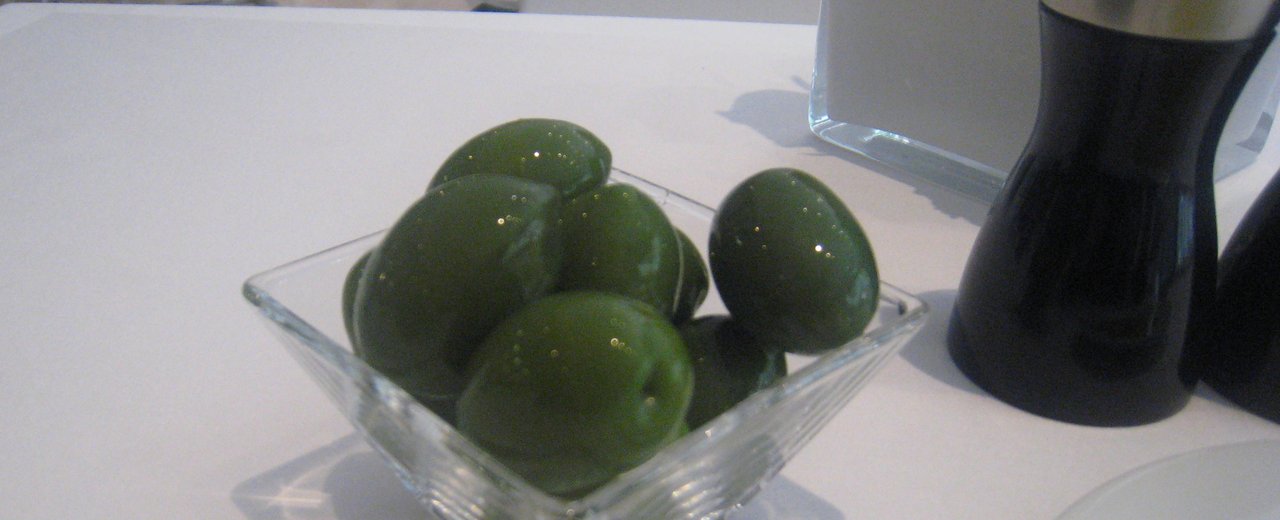

Cerignola olives
The giant green table olive of Puglia: Bella di Cerignola, the “beauty of Cerignola.”
If you have ever seen an olive the size of a small plum sitting in a deli case and wondered whether it was real, you were almost certainly looking at a Cerignola. They are among the largest table olives in the world, grown around the town of Cerignola in the province of Foggia, in northern Puglia, the heel of Italy. Mild, buttery, more crisp than briny: the olive for people who think they don’t like olives.
- Origin
- Cerignola, Puglia · Italy
- Also called
- Bella di Cerignola
- Say it
- cheh-ree-NYOH-lah
- Type
- Table olive
- Size
- Very large (jumbo)
- Color
- Green, black, or dyed red
- Flavor
- Mild, buttery, crisp
- Cured in
- Lye, then brine
- Protected name
- La Bella della Daunia DOP
- Best for
- Snacking, antipasti, martinis
What can you substitute for Cerignola olives?
This is the question I get asked most, so let’s answer it first. You want a Cerignola substitute when a recipe calls for a large, mild, meaty green olive and your shop doesn’t carry them. The closest matches, in order:
If all you need is the size, for stuffing or a showpiece on a board, reach for Gordal. If you need the mildness, for the “I don’t usually like olives” crowd, reach for Castelvetrano. Avoid swapping in Kalamata or any oil-cured black olive: those are intense and salty, the opposite of what a Cerignola brings to a dish. In a martini, any large, firm, pitted green olive will do the job.
Those striking black Cerignola olives, glossy and uniform, are almost never naturally black. Even under the protected La Bella della Daunia name, the black version is made the Californian way: green fruit darkened with air in an alkaline bath, then stabilized with ferrous gluconate, the same iron salt that makes canned “black ripe” olives black. Perfectly safe, and the texture is softer and pleasant. But a naturally tree-ripened black Cerignola is a different, rarer thing. I bought these by the barrel for years, and uniformity is always the tell.
What exactly is a Cerignola olive?
Cerignola is the place; Bella di Cerignola is the cultivar. It is grown almost entirely for the table, valued for its flesh rather than its oil. The fruit is prized for one thing above all: size. A single olive can weigh several times what a typical Spanish Manzanilla does, with a high flesh-to-pit ratio that makes it satisfying to eat and easy to stuff.

What does Cerignola mean, and how do you say it?
Cerignola is simply the name of the town, an agricultural center on the Tavoliere plain of northern Puglia. Bella di Cerignola means “the beauty of Cerignola,” which is what growers there have called the variety for generations. In Italian the “gn” is soft, like the “ny” in canyon, so the name is said cheh-ree-NYOH-lah.
La Bella della Daunia: the protected Cerignola
Since 2000 the genuine article has been protected in the EU as La Bella della Daunia DOP (Daunia is the old name for this corner of Puglia). The rules are worth knowing, because they tell you what a proper Cerignola should be:
- Where: Cerignola, Stornara, Stornarella and Orta Nova in the province of Foggia, plus San Ferdinando di Puglia and Trinitapoli next door.
- What: only the Bella di Cerignola variety, sold green or black, with individual fruit reaching up to 30 grams.
- When: picked by hand from early October, while the green fruit is still firm.
- Green olives: cured by the Sevillian method, a lye bath of 8 to 15 hours to remove the bitterness, then at least 30 days in brine.
- Black olives: cured by the Californian method, brined, then oxidized with air and fixed with ferrous gluconate.
Plenty of good Cerignola olives are sold without the DOP, and plenty of jars say “Cerignola” when they mean “big green olive.” The DOP logo is the only guarantee of variety and place.
Green, red, and black
You will find Cerignola sold in three colors. Green are picked young, firm and crisp: the classic. Black are the same fruit, oxidized (see above), with a softer bite. Red Cerignolas are not a riper stage at all: they are green olives dyed during curing. The traditional dye was erythrosine (FD&C Red No. 3), whose use in food the US FDA has revoked with a compliance deadline of January 2027, and some producers now use plant-based colorings instead. They taste like the green ones, slightly softer. Buy them for the color, if you like the color.
Cerignola vs Castelvetrano vs Gordal
| Cerignola | Castelvetrano | Gordal | |
|---|---|---|---|
| From | Puglia, Italy | Sicily, Italy | Seville, Spain |
| Variety | Bella di Cerignola | Nocellara del Belice | Gordal Sevillana |
| Size | Very large, elongated | Medium to large, round | Very large, plump |
| Flavor | Mild, buttery, low salt | Sweet, buttery, the mildest | Mild, meaty, briny |
| Texture | Crisp, firm | Crisp, then buttery | Firm, meaty |
| Best for | Antipasti, boards, martinis | Snacking, olive-shy guests | Stuffing, tapas |
Cerignola and Castelvetrano are the two olives people most often confuse, because both are big, green, Italian and mild. The Castelvetrano is rounder, a brighter green and sweeter; the Cerignola is longer, larger and slightly more savory. Either will stand in for the other on a board.
How they taste, and how to use them
Mild is the word. Low bitterness, low salt, a clean buttery snap. That makes them the friendliest olive on an antipasto board and a fine olive for a dirty martini where you don’t want the brine to bully the gin. Stuff the large green ones with garlic, almond, or a sliver of provolone. Don’t cook them hard: their charm is the texture, and heat turns them to mush.
Buying and storing Cerignola olives
- Buy them whole. Pitted Cerignolas lose firmness fast, and the pit comes out easily enough at the table.
- Press one. A good green Cerignola is hard and springy. Soft or wrinkled ones have sat too long.
- Look for the DOP logo if you want the protected article, and read “black” as “oxidized” unless the label says otherwise.
- Keep them submerged. Once opened, refrigerate the jar or deli tub with the olives under their brine and eat them within a few weeks.
Frequently asked questions
What can I substitute for Cerignola olives?
Castelvetrano is the best all-round substitute for mild, buttery flavor. Gordal (also sold as Sevillano or Queen) is the best match for size, and Ascolana works well for stuffing and frying.
What are Cerignola olives?
Cerignola olives are very large, mild table olives of the Bella di Cerignola variety, grown around the town of Cerignola in Puglia, southern Italy. They are sold green, black or dyed red.
What does Cerignola mean?
Cerignola is the name of the town in the province of Foggia where the olive is grown. The full variety name, Bella di Cerignola, means “the beauty of Cerignola.”
Are Cerignola and Castelvetrano olives the same?
No. Cerignola is the Bella di Cerignola variety from Puglia; Castelvetrano is the Nocellara del Belice variety from Sicily. Both are large, green and mild, but Castelvetrano is rounder and sweeter, and Cerignola is larger and longer.
Are black Cerignola olives naturally black?
Usually not. Most black Cerignolas, including those sold under the La Bella della Daunia DOP, are green olives darkened by oxidation and fixed with ferrous gluconate, the same process used for canned black olives.
Why are some Cerignola olives red?
Red Cerignolas are green olives colored with a food dye during curing. The color is added, not a sign of ripeness, and they taste much like the green ones.