Spain Widens Olive Insurance and Extends the Deadline
Spain’s agriculture ministry has pushed back the deadline for taking out olive yield insurance for the 2010/11 crop from December 15 to December 23, after farm unions and cooperatives said growers were struggling to get their policies signed in time. The policy itself has been widened for the coming season. This note covers what is now covered, what it costs the grower in a year like this one, and why many growers still do not buy it.
What happened
The state agricultural insurance body, ENESA, extended the subscription period for the olive yield line in the national combined insurance plan to December 23, which is also the last day to pay. Its reasoning, reported this week, is that there have been difficulties in contracting and some delay in formalizing policies, and that farm organizations and cooperatives had asked for more time so that growers who want cover against bad weather can still get it.
The line itself has been improved for 2010/11, as COAG-Jaén was reminding growers last week. Olive yield insurance covers production lost to hail, frost and other weather, compensates for the loss of productive capacity when parts of the tree die from any weather event except drought, and covers fire damage. Three changes matter this season.
- Hail cover now runs to flowering, rather than stopping at the hardening of the stone, which adds about fifty days on average.
- Damage caused by wild animals is covered for the first time, both to the crop and to the trees.
- A new guaranteed level of 60 percent sits between the existing levels, and there are 5 percent discounts both for renewing a policy and for taking one out for the first time.
Why growers hesitate
An olive grower’s objection to insurance is rarely that the risks are imaginary. It is the arithmetic. In a season when oil at origin is selling below the cost of production, a premium is one more bill in a year that already does not add up, and the cover is calculated on yields the farm may not reach. Growers in Córdoba have complained for months that the olive policy is too expensive for what it gives and that too few farms take it out, which in turn makes the risk pool worse.
The counter argument is the one every union repeats after a disaster, and COAG Granada made it again this month: having a policy in force is an indispensable condition for getting the exceptional aid that administrations approve after a catastrophe. That is why the deadline matters. A grower who misses it has no policy and, if the winter turns nasty, no claim on the administration either.
| Olive yield insurance, 2010/11 | Detail |
|---|---|
| New deadline | December 23, 2009, also the payment date |
| Main risks covered | Hail, frost, other weather, fire, loss of productive capacity |
| Not covered | Loss of tree parts caused by drought |
| New this season | Hail cover to flowering, wildlife damage, 60 percent level |
| Discounts | 5 percent for renewals and for first-time policies |
What it means
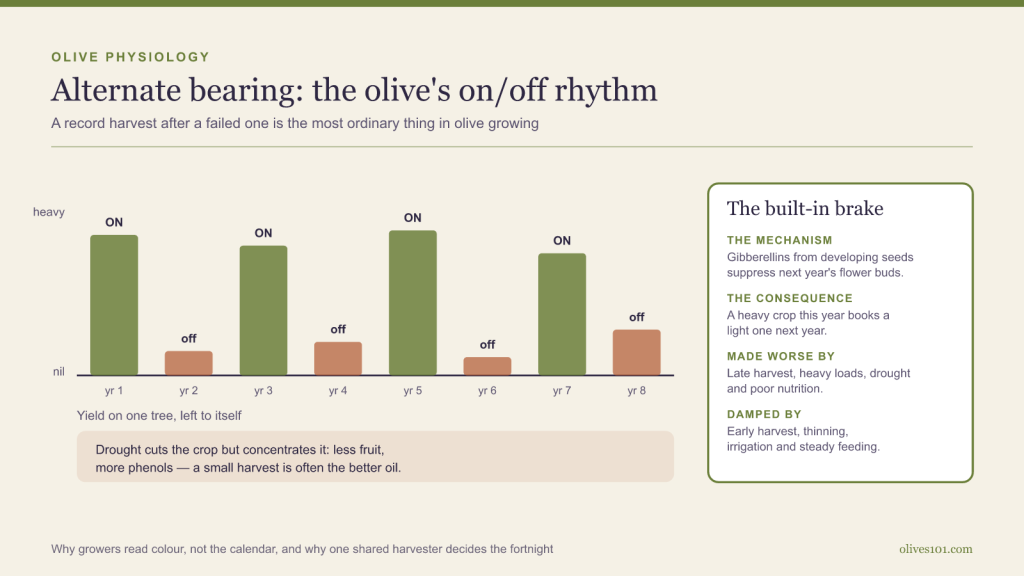
Weather is the one variable an olive farm cannot manage. A hard frost can take the crop and the tree, as growers in Spain and California have both learned in bad years: see our notes on snow in the Spanish groves and on frost damage that only showed up months later in northern California. Even without disaster, yields swing hard from year to year, a pattern we looked at when Australian growers faced low yields.
For buyers, none of this changes the price of a bottle this winter. It does decide how many small growers are still there in five years, which in the end is what decides whether there is any oil worth buying beyond the supermarket blends.
The detail that decides whether olive insurance is worth buying is the yield figure the insurer assigns to your farm, not the headline list of risks. If the assigned yield is lower than what the grove really produces, a claim pays out on the smaller number, and the grower is insured for a crop they do not have. Growers who know what they are doing spend more time arguing about that figure than about the premium.
Sources
- Infoagro, Seguro del olivar: el MARM amplía el plazo hasta el 23 de diciembre (December 17, 2009)
- Infoagro, Mayores coberturas para el olivar (December 14, 2009)
- Infoagro, Mejora de los seguros del olivar (September 17, 2009)
- Infoagro, Rendimientos del olivar: COAG Granada y el seguro (December 10, 2009)