Olive Council Maps 100 Places That Could Earn Protected Names
The International Olive Council has published the papers from its October seminar in Reggio Calabria on geographical indications for olive oil and table olives, including a study that lists more than 100 places around the world whose oils or olives could qualify for protected names. Tunisia tops that list. Here is what the seminar covered, what the speakers disagreed about, and why a protected name on a bottle is worth less, and more, than you might think.
What happened
The seminar took place on October 21 in Reggio Calabria, in the toe of Italy, and the IOC put the documents and presentations online on November 4, as Olive Oil Times reported this week. Opening the day, the IOC’s executive director, Mohammed Ouhmad Sbitri, said olive oil and table olives are key parts of the Mediterranean diet and are traded widely, which makes it essential to protect their attributes, and that geographical indications are “precisely the tools that are being used increasingly to do so”.
At the center of the day was a study the IOC commissioned from Insight Consulting. It looked at the legal frameworks around the world and drew up a list of more than 100 areas that might become geographical indications, most of them outside the European Union, which already has around a hundred for olive oil. The program included experts from the World Trade Organization and the World Intellectual Property Organization, and speakers from Argentina, France, Morocco, Spain, Tunisia, Turkey, Israel, Albania and the European Commission.
| Candidate areas in the IOC study | Number, as reported |
|---|---|
| Tunisia | 21 |
| Morocco | 11 |
| Spain | 9 |
| Croatia | 8 |
| Peru, Chile, United States (non-members) | 4 each |
Where the speakers disagreed
Nobody at the seminar argued that protected names are a bad idea, but several speakers were blunt about their limits. Gabriela Catalani, from Argentina’s Ministry of Agriculture, pointed to the high costs for producers and governments and warned that a designation “raises false hopes in small producers”. On the other side, Pavlos Dimitriou of the European Commission cited figures from a Tuscan firm showing that its oil with a geographical indication sold at a 30 percent premium over the same firm’s ordinary extra virgin.
The French speaker, Marina Testu, brought consumer research that should humble anyone who thinks origin sells itself. In a 2005 survey by the market research firm GfK, shoppers ranked taste first, at 85 percent, followed by the words extra virgin at 70 percent and cold extraction at 60 percent. Price came fourth, and origin only fifth, at 48 percent.
- Designations have to define what makes an oil different: its varieties, its land, its methods.
- Someone has to certify it, and someone has to police misuse of the name, at home and abroad.
- The name only earns a premium if buyers know it, which means years of promotion.
The closing remarks, also published by the IOC, suggested one practical next step: that the Council help the countries where potential designations were found, perhaps with a guide of legal and technical recommendations, and that its advisory committee, meeting the next day, take up the idea.
What it means for buyers
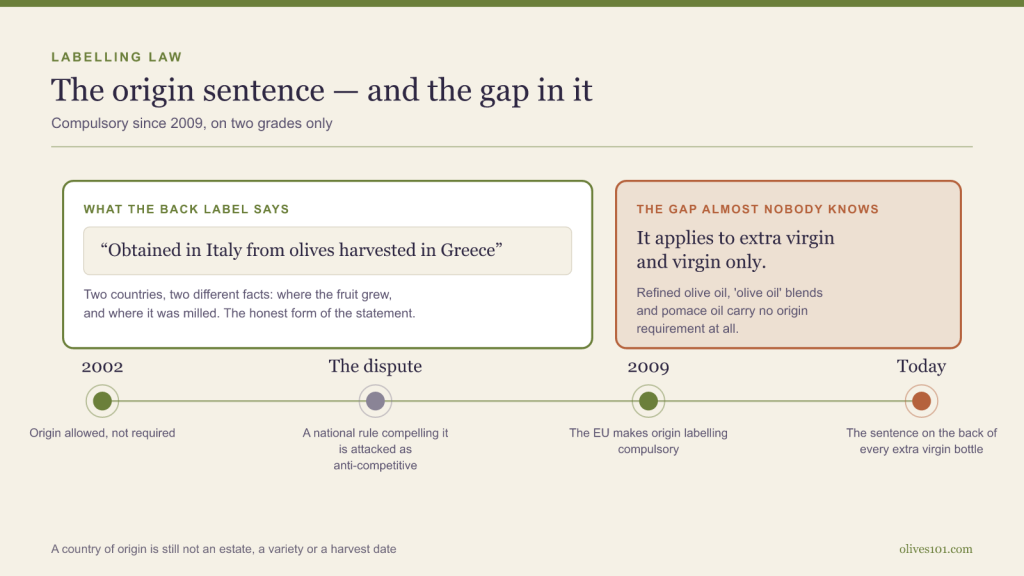
A protected designation on a bottle means the olives came from a defined area and the oil met a written specification checked by a regulatory body. That is a real promise, and it is more than most labels make. It does not mean the oil is better than a good unprotected oil from the next valley, and it does not tell you how fresh it is. Our guide on how to read an olive oil label covers the difference between a protected name and a plain statement of origin. For a sense of how local an origin can be, our profile of Calabria’s Ottobratica olive is a good start, and our piece on Provence shows how a region builds a name over time.
The premium for a protected name mostly goes to regions buyers have already heard of. For a small or unknown area, the costs of certification, inspection and promotion can eat the whole premium for years. The designations that pay are the ones backed by producers who were already making good oil and simply wanted to stop others borrowing their name.
Sources
- Olive Oil Times, “Olive Council Holds Meeting on Geographic Indications” (November 10, 2010)
- International Olive Council, seminar on geographical indications, closing conclusions (October 2010, archived, in French)