How Much Olive Oil Per Day? What the Studies Actually Used
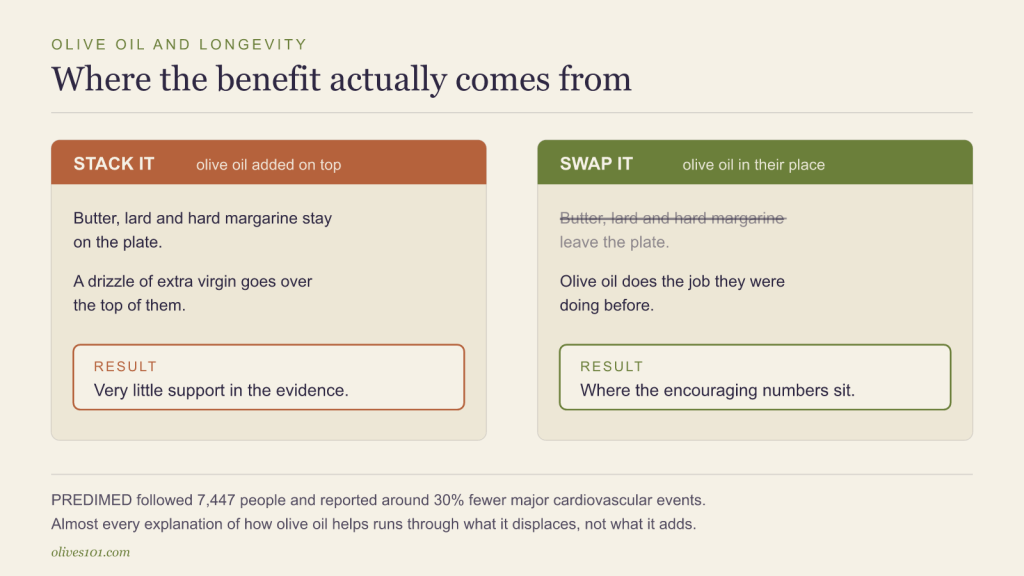
How much olive oil per day makes sense depends on your goal, but for most adults about 1.5 to 2 tablespoons, used in place of butter and other saturated fats, lines up with the FDA’s health claims. The largest studies linked benefits to anything from just over half a tablespoon to about four tablespoons a day. There is no official daily requirement, so below are the actual amounts the big studies and regulators used, what they cost in calories, and a simple table by goal.
How much olive oil per day did the studies use?
The Harvard cohort (2022). Researchers at the Harvard T.H. Chan School of Public Health followed 60,582 women and 31,801 men from 1990 to 2018. The top group consumed more than half a tablespoon (7 grams) a day, and compared with people who rarely used olive oil, they had a 19% lower risk of death from any cause and a 19% lower risk of cardiovascular death. Replacing 10 grams a day of margarine, butter, mayonnaise or dairy fat with olive oil was linked to lower risk. It is observational, and olive oil did not beat other vegetable oils combined, which suggests much of the gain comes from what it replaced. More in the biggest olive-oil health study yet.
PREDIMED (Spain). This is the randomized trial behind most of the excitement: 7,447 people aged 55 to 80 at high cardiovascular risk. The olive oil group followed a Mediterranean diet, participants were given about 1 liter of extra virgin a week at no cost, and the goal was 50 grams a day or more, roughly four tablespoons. They had about 30% fewer heart attacks, strokes and cardiovascular deaths than a group told to cut fat. The trial was republished in 2018 after problems with its randomization were found, and the result held. An observational analysis of the same people found each extra 10 grams a day of extra virgin olive oil linked to a 10% lower risk of cardiovascular disease.
Keep the context in mind: four tablespoons was inside a full Mediterranean diet of vegetables, legumes, fish and little red meat, where the oil replaced other foods. How that pattern works is covered in Olive Oil and the Mediterranean Diet.
The official numbers: FDA and EU
In 2004 the FDA allowed a qualified health claim that limited, not conclusive, evidence suggests about 2 tablespoons (23 grams) of olive oil a day may reduce the risk of coronary heart disease. In 2018 it added a claim for oils high in oleic acid, a group that includes olive oil: supportive but not conclusive evidence for about 20 grams a day, roughly 1½ tablespoons. Both claims come with the same condition: the oil has to replace fats higher in saturated fat and must not raise the total calories you eat.
The European Union has a separate claim for olive oil polyphenols, which help protect blood lipids from oxidative stress. It only applies to oils with at least 5 mg of hydroxytyrosol and related compounds per 20 grams, and the label must say the benefit comes with 20 grams a day. Neither figure is a recommended intake. Both are conditions attached to a label claim: the amount a product has to deliver, and be declared as delivering, before the claim can be made at all.
Olive oil per day by goal
| Goal | Daily amount | Calories | Where the number comes from |
|---|---|---|---|
| Getting some benefit at all | A little over 1/2 tablespoon (7 g or more) | About 60 | Top group in the Harvard cohort (observational) |
| Heart health, swapping out butter | 1.5 to 2 tablespoons (20 to 23 g) | About 175 to 205 | FDA qualified health claims, 2018 and 2004 |
| Polyphenol benefit | 20 g (about 1.5 tablespoons) of a high-polyphenol oil | About 175 | EU health claim, Regulation 432/2012 |
| Full Mediterranean pattern | About 50 g (roughly 4 tablespoons) or more | About 440 or more | PREDIMED trial target |
| Losing weight | 1 to 2 measured tablespoons, replacing other fats | About 120 to 240 | Calorie arithmetic |
Calories decide your personal number
A tablespoon of olive oil is about 119 calories, the same for a supermarket bottle and an estate oil. Four tablespoons is close to 480 calories, roughly a quarter of a 2,000-calorie day. That is why the swap matters so much. In PREDIMED, people told to use olive oil generously, with no calorie limit, showed no significant difference in body weight compared with the low-fat group over about five years, but the oil was replacing other food, not sitting on top of it.
Most people underestimate their pour. A free “glug” from a wide spout is often two or three tablespoons. Measuring for a week is humbling and useful, a point made well in calories, fat and olive oil. If you want the other side of the question, is there such a thing as too much olive oil? covers the upper end.
Practical ways to reach your daily amount
- Cook with it. Sauteing, roasting and eggs all count, and the studies counted cooking oil too. Extra virgin handles normal home heat well; see Olive Oil Smoke Point: The Complete Guide.
- Dress vegetables and salads. The fat helps you absorb the carotenoids in them.
- Swap it for butter on bread, in mashed potatoes and over steamed vegetables.
- Finish soups and beans with a thread of your best oil, where you can taste it.
- Use less, or ask first, if you have a calorie target, gallstones, reflux, or a doctor has prescribed a low-fat diet.
At 1.5 to 2 tablespoons a day, one person gets through roughly a 750 ml bottle a month. Shops push the big tins because the price per liter looks better, but a 3-liter tin lasts a single person three or four months once opened, and the aroma and polyphenols you paid for keep fading the whole time. Buy the size you will finish within a month or two, and keep it away from the stove.
Frequently asked questions
How much olive oil should I have a day?
There is no official requirement. About 1.5 to 2 tablespoons a day used in place of butter or other saturated fats matches the FDA’s qualified health claims, and large studies linked benefits to anything from just over half a tablespoon to about four tablespoons.
Is 2 tablespoons of olive oil a day too much?
Not for most people. It is about 240 calories, so it fits comfortably when it replaces other fats rather than being added on top.
Is 4 tablespoons of olive oil a day too much?
About 50 grams, roughly 4 tablespoons and 440 calories, is what the PREDIMED trial aimed for, inside a Mediterranean diet where the oil replaced other foods. Added to a typical diet, it would be a lot of extra calories.
Does olive oil used in cooking count?
Yes. Oil used for frying, roasting and dressing all counts toward your daily amount, and PREDIMED counted it the same way.
Is extra virgin better than regular olive oil for daily use?
Both have the same fat profile and calories. Extra virgin keeps far more polyphenols, which is why most health research focuses on it, so it is the better daily choice when you can get it.
Sources
- Higher olive oil consumption linked with lower risk of premature death, Harvard T.H. Chan School of Public Health
- FDA Completes Review of Qualified Health Claim Petition for Oleic Acid and the Risk of Coronary Heart Disease, U.S. Food and Drug Administration
- Commission Regulation (EU) No 432/2012, Annex (list of permitted health claims), legislation.gov.uk
- Oil, olive, salad or cooking, USDA FoodData Central
This is general information, not medical advice. If you have heart disease, diabetes, gallbladder or digestive problems, or are working to a calorie target, ask your doctor or a registered dietitian what amount suits you.