Shoppers Call Olive Oil Healthiest, and Cannot Say Why
American shoppers rank olive oil as the healthiest cooking oil on the shelf, and then rank the kind of fat it is made of near the bottom. A nutrition survey commissioned by the United Soybean Board put olive oil first, ahead of flaxseed, canola and soy, while only about a third of respondents considered monounsaturated fats healthy. Roughly eight in ten said the same of polyunsaturated fats. Here is why that contradiction matters for anyone buying oil.
What the surveys found
The soybean board’s survey is consistent with the annual Food & Health Survey run by the International Food Information Council Foundation, which this year found that nearly one in five Americans do not consider any kind of fat healthful, and that only about one in ten rated monounsaturated fat as healthy.
Olive oil is roughly three quarters monounsaturated fat. So the picture is of a product with an excellent reputation and almost no public understanding of what it contains. People have learned a brand of healthiness rather than a fact about food.
| What people said | Share |
|---|---|
| Monounsaturated fats seen as healthy | About a third in the soybean board survey |
| Polyunsaturated fats seen as healthy | About eight in ten |
| No fat at all seen as healthful | Nearly one in five, in the IFIC survey |
Why the gap is dangerous for buyers
A reputation that floats free of any understanding is easy to borrow. If the word olive on a label is what signals health, then every grade in the family gets to trade on it, including refined olive oil and pomace oil, which have been through solvents, heat or deodorising and carry almost none of the minor compounds the research is about.
It also means shoppers cannot tell when they are being sold the opposite of what they want. Blends of olive oil with seed oils, oils labeled light in a way that suggests fewer calories rather than less flavor, and the whole family of oils sold on the strength of a Mediterranean picture, all rely on the same vague good feeling.
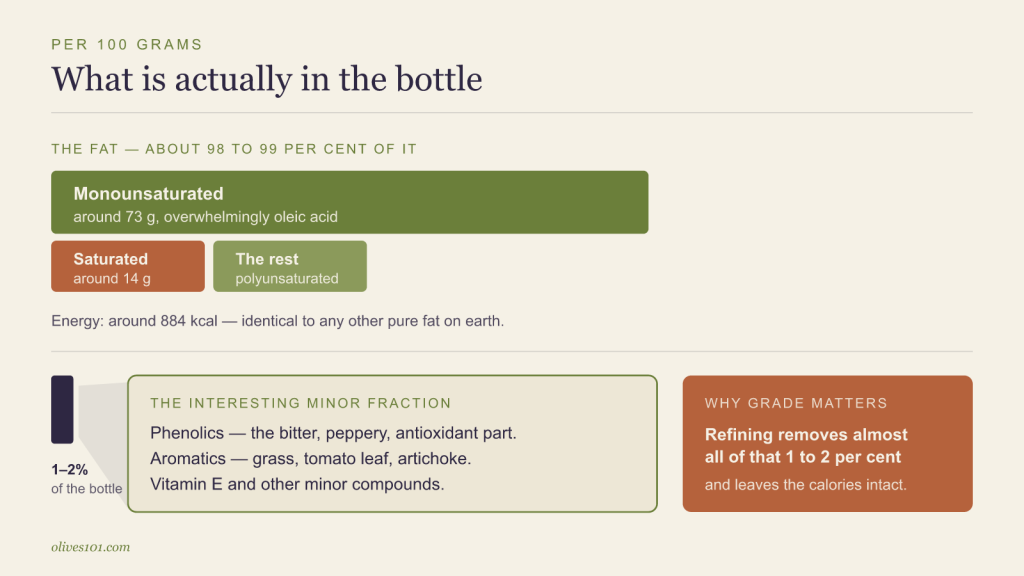
- Olive oil is about 73 percent monounsaturated fat, roughly 14 percent saturated, with a small fraction of minor compounds that includes the polyphenols.
- The health research that made the reputation was done mostly on virgin and extra virgin oil, not on refined grades.
- Light on an olive oil label refers to color and flavor, not to calories. All oils are about the same energy per spoon.
Who paid for the question
It is worth noticing who commissioned the first of these surveys. The United Soybean Board promotes soy, and a survey that finds consumers rate polyunsaturated fats highly while distrusting monounsaturated fat is useful to anyone selling soybean oil. That does not make the numbers wrong, and the independent IFIC survey points the same way, but it explains why the question was asked.
The olive oil trade has the opposite problem and rarely fixes it. Marketing sells the picture of a grove; it almost never teaches the one sentence that would protect a shopper, which is that the fats and the flavor compounds people are paying for only survive in the virgin grades.
Our own attempts at that sentence are here: what light, pure and pomace really mean, how olive oil compares with butter and margarine, and why adding olive oil to a bad diet is not a cure.
Surveys like these get used inside the trade, not just outside it. When research shows that shoppers buy on the word olive rather than on the grade, the commercial conclusion is to put the word olive on as many products as the rules allow. That is how a shelf ends up with five bottles that say olive oil in big letters and differ by a factor of ten in what is actually in them.
This is general information, not medical advice. If you have been told to change the fats in your diet, follow the advice you were given.
Sources
- Olive Oil Times: Consumers Consider Olive Oil Healthiest, But Not Sure Why, 29 August 2011 (archived copy)
- International Food Information Council Foundation: 2011 Food & Health Survey