French Study Links Daily Olive Oil to Fewer Strokes
Older people in France who used olive oil for both cooking and dressing had 41 percent fewer strokes over five years than people who never used it, according to a study published today in the online edition of Neurology. The work comes out of the Three-City Study, a long-running French project on vascular risk. Here is what the researchers measured, what the numbers mean, and why the accompanying editorial is worth reading before anyone changes their shopping list.
What the researchers did
The team, led by Cecilia Samieri of INSERM and the University of Bordeaux, followed 7,625 people aged 65 and over in Bordeaux, Dijon and Montpellier, none of whom had a history of stroke when the study began. Each person was placed in one of three groups: no use of olive oil at all, moderate use (cooking or dressing or on bread), and intensive use (cooking and dressing). The oil in French kitchens is mostly extra virgin, which is worth keeping in mind when the results are carried across to other countries.
Over a median follow-up of just over five years there were 148 strokes. After adjusting for the usual suspects, including body weight, physical activity, the rest of the diet and the standard stroke risk factors, the intensive users had a 41 percent lower risk of stroke than the people who never used olive oil. The confidence interval runs from 6 percent to 63 percent, which tells you the finding is real but not precise.
A second, smaller sample of 1,245 people had their blood tested for oleic acid, the main fatty acid in olive oil and a rough marker of how much of it someone eats. There were 27 strokes in that group. People in the top third for plasma oleic acid had a much lower stroke rate than those in the bottom third. With 27 events, that number carries a very wide margin.
What it does not show
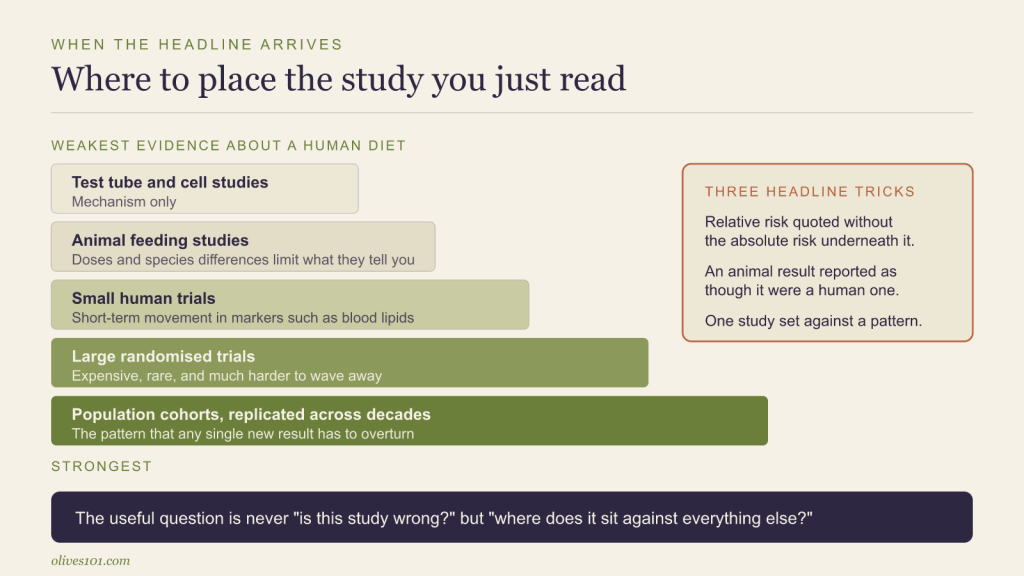
This is an observational study, not a trial. Nobody was handed a bottle of oil and told to use it. People who pour olive oil on everything tend to differ from people who never touch it, in income, in the rest of their diet, in how much they walk, and in a dozen things no questionnaire captures. The authors adjusted for many of those differences, which helps, but adjustment is not the same as randomizing.
In an editorial published alongside the paper, Nikolaos Scarmeas of Columbia University makes the point plainly: it is not clear which part of olive oil would be doing the protecting, and only clinical trials can turn a result like this into advice. That is the honest position. Stroke is the second leading cause of death worldwide, so even a modest effect would matter, which is exactly why the evidence needs to be better than a single cohort.
What a sensible reader takes from it
Nothing here argues for drinking olive oil by the glass. It argues for what the Mediterranean countries have always done: use olive oil instead of butter, margarine or seed oils, in cooking and raw, most days. That is the comparison the study is really making, since the no-use group was cooking with something else.
- The effect showed up in people who used oil both ways, not in the moderate group. Habit matters more than a single drizzle.
- French shoppers buy mostly extra virgin, so the study says little about refined or blended grades.
- Stroke risk is driven by blood pressure, smoking and atrial fibrillation. No oil outranks those.
If you want the longer view on how olive oil research gets reported, we have written before about reading a scary study, and about the point at which the Mediterranean diet caught up with low-fat advice. An earlier piece from 2009 covered the laboratory side of the same question.
Watch what happens to this paper in marketing over the next few months. A 41 percent figure from an observational study will end up on a label or a shelf-talker with the hedging removed, and probably on a bottle of oil nobody in Bordeaux would recognize. The study looked at a habit, not at a brand, and certainly not at a supplement.
This is general information, not medical advice. If you have had a stroke or a mini-stroke, or you are being treated for blood pressure, cholesterol or an irregular heartbeat, talk to your doctor before changing your diet.
Sources
- Samieri C et al., Olive oil consumption, plasma oleic acid, and stroke incidence: the Three-City Study, Neurology, published online 15 June 2011
- Scarmeas N, editorial: Olive oil. Pertinent to neurologic diseases too?, Neurology, 2011
- Olive Oil Times: Plenty of Olive Oil Might Help Prevent Strokes, Researchers Find, 15 June 2011 (archived copy)