Trans Fats and Depression: What the Spanish Study Found
A Spanish study of 12,059 university graduates, published this week, found that people who ate the most industrial trans fats were about 40 percent more likely to be diagnosed with depression over six years, while olive oil and other unsaturated fats showed only a weak association in the opposite direction. The headlines this week say olive oil protects against depression. The paper says something more careful than that, and the difference is worth ten minutes.
What the researchers did
The work comes out of the SUN project at the University of Navarra, a long running cohort of Spanish graduates who fill in questionnaires about what they eat and what happens to them. The 12,059 people in this analysis were free of depression when they joined. At the start they completed a 136 item food frequency questionnaire covering fats and cooking fats, including olive oil, seed oils, butter and margarine.
Over a median of about six years, 657 of them were counted as new cases of depression, either because a doctor diagnosed them or because they started taking antidepressants. The researchers then compared the rate of new cases across five levels of intake for each kind of fat, adjusting for the usual confounders and for how closely people followed a Mediterranean pattern of eating.
What it found
| Fat | Direction | Strength |
|---|---|---|
| Trans fats | More depression | Clear dose response, about 42 percent higher risk in the top fifth |
| Monounsaturated fat | Less depression | Weak, borderline significant |
| Polyunsaturated fat | Less depression | Weak |
| Olive oil | Less depression | Weak |
The trans fat finding is the solid one. Risk rose step by step across the five levels of intake, and it did not go away when the authors adjusted for lifestyle and for the rest of the diet. The authors themselves describe the associations for monounsaturated fat, polyunsaturated fat and olive oil as weak inverse relationships, and they say the results suggest that heart disease and depression may share some dietary determinants.
It is worth noting what a Spanish cohort eats. Trans fat intake in this group was low by American standards, around 0.4 percent of energy. If a modest amount of industrially hardened fat can be picked out in a population that eats very little of it, that is interesting. It also means the olive oil comparison is between people eating a lot of it and people eating a great deal of it, which is not a strong test of anything.
How to read it
This is an observational study. Nobody was told what to eat. People who eat more pastries, packaged snacks and fast food differ from people who cook with olive oil in a hundred ways that no questionnaire fully captures, from income to exercise to whether they eat with other people. The authors adjusted for what they could, which helps and does not settle it.
Depression was also self reported, through a doctor’s diagnosis or a prescription. That is a reasonable proxy and a rough one. And a cohort of university graduates is not the general population.
What survives all that is a sensible and rather old message, sharpened a little: industrial trans fats look bad for more than your arteries, and the fat you cook with is a reasonable place to start changing. If you already cook in olive oil, this paper is not a reason to drink more of it.
This is general information, not medical advice. If you are dealing with low mood that lasts, see a doctor rather than a bottle.
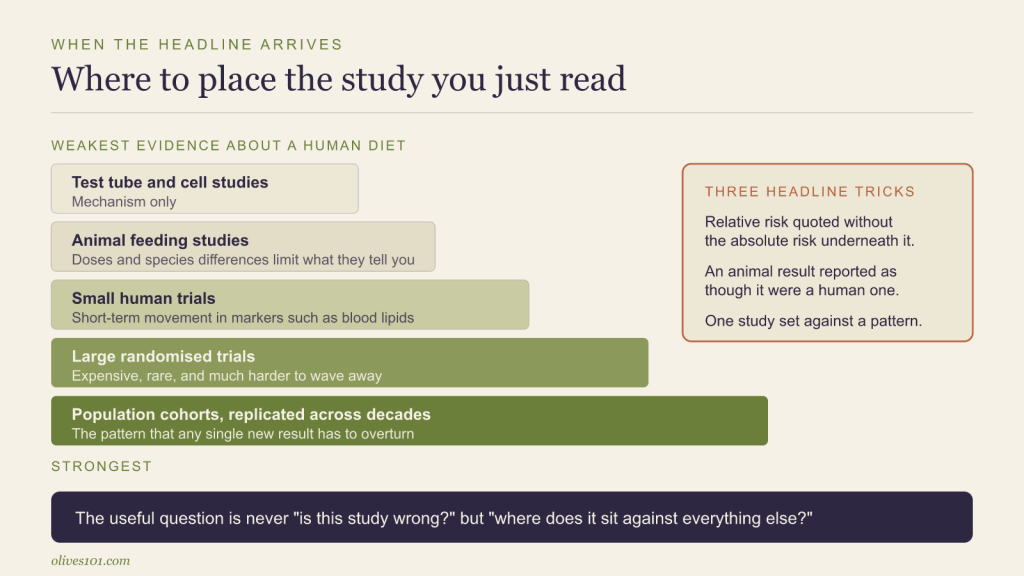
Watch how a study travels. The paper’s own conclusion puts trans fats first and calls the olive oil link weak. By the time it reaches a press release it is an olive oil story, because olive oil has a marketing budget and margarine does not. When a health claim reaches you through people who sell the food, read the abstract: it is free, it is four paragraphs, and it usually says less than the headline.