One Olive Oil Health Claim Survives Europe’s Cull
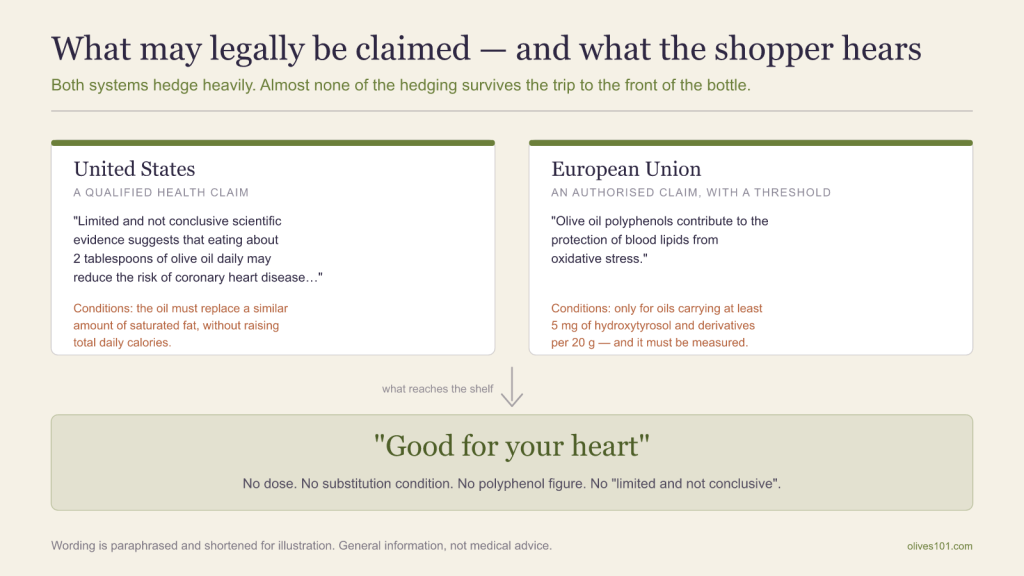
Europe is preparing to sweep thousands of unproven health claims off food labels, and olive oil will lose most of the ones it has been using. One claim survives: that the polyphenols in olive oil protect LDL particles from oxidative damage, and even that comes with a condition attached. Here is what was approved, what was thrown out, and what it will look like on a bottle.
What the panel decided
Since 2008 the European Food Safety Authority’s panel on dietetic products, nutrition and allergies has worked through 2,758 general function health claims submitted by member states. About 22 percent were accepted. The final batch of opinions was published last month, and the European Commission is due to turn them into an official list by the end of the year, with a transition period for the food industry.
For olive oil the important opinion came in April. The panel accepted that there is a cause and effect relationship between olive oil polyphenols, standardized by their content of hydroxytyrosol and its derivatives, and the protection of LDL particles from oxidative damage. It rejected the claims that olive polyphenols help maintain normal HDL cholesterol or normal blood pressure, saying the evidence did not establish cause and effect.
Three further claims, on upper respiratory tract health, on maintaining normal gastrointestinal function and on the body’s defenses against external agents, were dismissed as general and non-specific. The anti-inflammatory claim went the same way: reducing inflammation in a disease such as osteoarthritis is treatment, and a food label is not allowed to promise treatment.
The condition nobody is advertising
The approved claim is not a free pass. To carry it, a daily intake of 5 mg of hydroxytyrosol and its derivatives has to be provided, an amount the panel says can come from moderate amounts of olive oil in a normal diet. It then adds the sentence that matters: the concentration in some olive oils is too low for that amount to be reached at any sensible level of consumption.
In plain terms, plenty of oil on supermarket shelves cannot honestly carry the claim. Refining strips polyphenols out, so anything labeled simply olive oil is out. Among extra virgins, the level depends on variety, ripeness, milling and age, and it falls as the bottle sits.
| Claim | Outcome |
|---|---|
| Protects LDL particles from oxidative damage | Accepted, with a 5 mg daily condition |
| Maintains normal HDL cholesterol | Rejected |
| Maintains normal blood pressure | Rejected |
| Anti-inflammatory properties | Rejected as a treatment claim |
How the trade is reacting
Consultants advising food companies have called the antioxidant approval a surprise, since the authority had until then granted antioxidant claims only for vitamins and minerals. Their advice to clients with rejected claims is the predictable one: start now on other ways to talk about the product. Others in the industry argue that the standard of proof, significant scientific agreement, is set too high for food.
From where I sit, the cull is good news for anyone selling honest oil. The claims being removed were mostly borrowed from press coverage of small studies, and they were available to every bottler equally, including those whose oil contains almost none of the compounds involved. The surviving claim is the opposite: it can only be used by oil that can prove it has the polyphenols.
- Refined and blended grades lose the argument automatically. There is nothing left in them to claim.
- Any producer wanting the claim will need laboratory numbers for hydroxytyrosol and its derivatives.
- Polyphenol levels fall with time and heat, so a claim made at bottling is a promise about storage too.
We wrote about the two phenols behind this claim last year, and about why polyphenols make the difference between two oils that look identical. The clinical background to the LDL work is in this earlier study on high-polyphenol virgin oil.
Ask any brand that starts printing the new claim for its hydroxytyrosol figure and the date it was measured. The compounds degrade in the bottle, so a result from the mill in November says little about a bottle bought the following autumn. A producer who tests each lot will send you the number. A bottler who bought the oil on the open market usually cannot.
This is general information, not medical advice. If you are being treated for cholesterol or blood pressure, follow your doctor’s advice rather than a label.
Sources
- EFSA Panel on Dietetic Products, Nutrition and Allergies: Scientific Opinion on health claims related to polyphenols in olive, EFSA Journal 2011 (archived copy)
- Olive Oil Times: European Commission Prepares to Ban Thousands of Unproved Health Claims, 6 August 2011 (archived copy)