Olive Oil Fraud, Explained
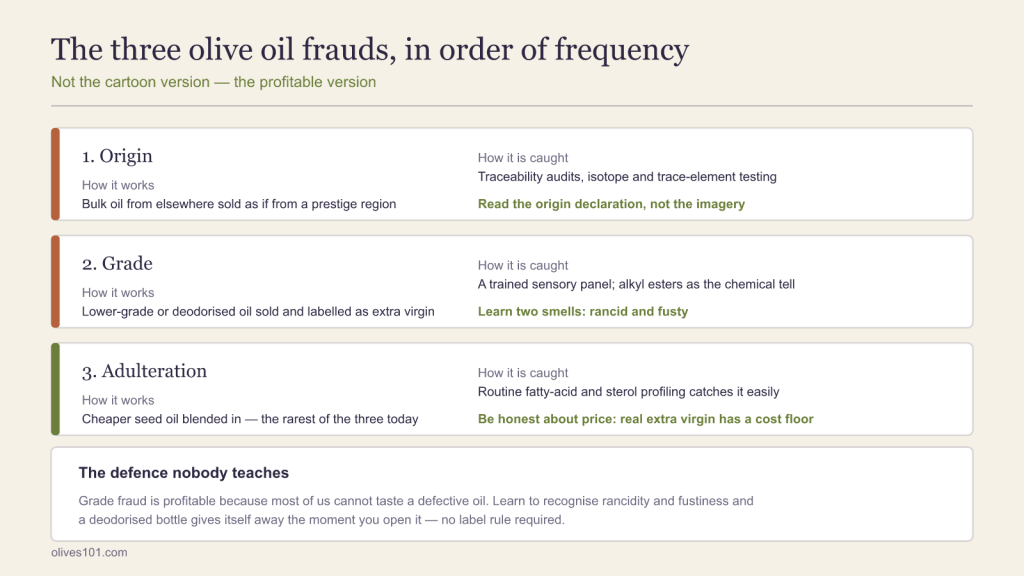
Olive oil fraud is real, it is old, and most of it is mundane rather than sinister: the commonest trick is not poison but paperwork. A bottle labelled “extra virgin” may have been cut with cheaper refined oil, blended with oil from a different country than the flag on the front suggests, or simply be a lower grade that has quietly degraded on a warm shelf. Outright adulteration with other vegetable oils still happens, but for the everyday shopper the bigger risk is buying something that is genuinely olive oil yet not the grade or origin you paid for. The good news: a handful of habits will steer you right most of the time.
A short, unflattering history
People have watered down olive oil for about as long as they have sold it. Roman writers grumbled about doctored oil, and the amphorae unearthed at Monte Testaccio in Rome carry inspection marks precisely because the trade needed policing even then. Fraud has always followed the money, and olive oil has always been worth good money.
The modern reference point is the Spanish “toxic oil syndrome” of 1981, when industrial rapeseed oil that had been dyed and diverted into the food chain caused a mass poisoning. Strictly speaking that was a fraud involving oil sold as olive oil rather than adulterated bottles on a shelf, but it hardened Europe’s resolve to regulate the category. More recently, Italian investigators have run repeated operations against blending scams, and a well-known US university study in 2010 reported that a large share of imported samples labelled “extra virgin” failed the sensory or chemical tests for that grade. The figure is often quoted loosely, so treat “a substantial minority failed” as the honest takeaway rather than any precise percentage.
Two things are worth keeping straight. First, “fraud” spans a spectrum from criminal adulteration to soft mislabelling that is really about grade slippage. Second, a variety’s name is not a country of origin: Koroneiki, Arbequina, Picual and Frantoio are grown well beyond their home regions, so a Spanish-grown Frantoio is not mislabelled just because the variety is Italian by heritage. Origin claims are about where the fruit was pressed, not where the cultivar was born.
The main types of olive oil fraud
Understanding the categories helps you know what you are actually guarding against. The table below sorts the usual suspects by how common and how serious each tends to be.
| Type of fraud | What it means | How common | How to spot it |
|---|---|---|---|
| Grade inflation | A lower grade (e.g. refined or “virgin”) sold as “extra virgin” | Very common | Flat, greasy taste; no pepper or bitterness; suspiciously low price |
| Origin mislabelling | Oil blended from several countries but sold as single-country | Common | Read the small print: “packed in” is not “grown in”; look for PDO/PGI seals |
| Cutting with other oils | Olive oil bulked out with sunflower, soybean or other seed oils | Less common today, but the classic scam | Hard to detect at home; needs lab testing (fatty-acid profile) |
| Old oil, fresh label | Rancid or tired oil passed off as current-harvest | Common | Check harvest/best-before dates; smell for crayon or stale-nut notes |
| Fake premium claims | “Cold-pressed”, “pure”, “light” used as marketing, not grade | Widespread wording games | Know that “pure” and “light” usually mean refined, not better |
Notice how much of this is legal-ish greyness rather than gangsterism. “Light” olive oil, for instance, is not lying exactly, but it trades on the hope that you will read “light” as healthier when it really signals a milder, refined oil. Likewise “pure olive oil” is typically a blend of refined and a little virgin, a perfectly legal product that is simply not extra virgin.
How to avoid being fooled
You do not need a chemistry set. A few sensible moves cover most of the risk:
- Buy on harvest date, not best-before. A recent harvest date is the single most reassuring thing on a label. Olive oil is a fruit juice and it does not improve with age.
- Prefer dark glass or tins. Light and heat are the enemies of freshness, so oils sold in clear bottles under bright shop lights are already at a disadvantage.
- Read the origin line, not the flag. An Italian scene on the front means nothing; the words “product of” and the country list on the back mean everything.
- Look for PDO, PGI or a named estate. These protected-origin schemes and single-estate bottlings carry traceability that anonymous blends do not.
- Learn the taste of the real thing. Good extra virgin should smell fresh and green, taste a little bitter, and give a peppery catch at the back of the throat. That pepper is the polyphenols talking. Flat and buttery-smooth with no kick is a warning sign.
- Be sceptical of bargains. Genuine extra virgin is expensive to make. A litre priced like a cheap seed oil is telling you something.
If you want to go deeper on grades and what the words legally mean, our guide to olive oil grades breaks down extra virgin, virgin, refined and the rest, and the olive encyclopedia covers the varieties and regions behind the labels. None of this is medical or dietary advice; if you buy olive oil for specific health reasons, talk that through with a qualified professional rather than a bottle’s marketing.
The reassuring truth is that fraud thrives on inattention. Slow down for ten seconds at the shelf, read the back label, and buy from producers who tell you when and where the olives were picked. Do that and you will drink well, honestly, and for years.
Olive oil fraud: common questions
Is most olive oil fake?
No. “Fake” is the wrong word for most problems. Genuine adulteration with other oils is now relatively uncommon in well-regulated markets. The everyday issue is grade and origin slippage: real olive oil that is a lower grade, older, or from a different country than the label implies.
Does refrigerating olive oil prove it is real?
No, and this is a stubborn myth. The old “fridge test” (claiming real oil solidifies in the cold) is unreliable, because whether an oil clouds or thickens depends on its fatty-acid mix and the fridge temperature, not on authenticity. Skip it.
What does “cold-pressed” actually guarantee?
Less than you might hope. Modern extra virgin is made by mechanical extraction at controlled temperatures, so “cold” processing is largely the norm for the grade. The phrase is reassuring shorthand but not a legal seal of quality on its own; the grade word (extra virgin) and the harvest date tell you more.
How can I tell good extra virgin at home?
Taste it. Fresh extra virgin smells green and lively, carries a genuine bitterness, and delivers a peppery sting at the back of the throat. If it tastes flat, waxy or vaguely stale, it is either a poor grade or past its best, whatever the label says.