Cobram and Sciabica Win the Los Angeles Competition
The 2011 Los Angeles International Extra Virgin Olive Oil Competition announced its winners this week: Australia’s Cobram Estate took two Best of Show awards and three Best of Class, and California’s Sciabica took two Best of Show awards of its own, with further Best of Show honors going to Riebli Point Ranch and to Oro Bailen from Spain. The entry list is the real news. Here is how big this competition has become, how the judging works, and what a medal is worth to a buyer.
The numbers behind the medals
The competition received 599 oils from 374 producers in 23 countries, up from 514 oils and 20 countries last year. The first edition, in 2000, had 27 entries, all domestic, and eight judges. Twenty two judges took part this time, and the organizer Mary Ellen Cole puts the competition’s standing down to its international field, which few American competitions have.
| Year | Entries | Countries |
|---|---|---|
| 2000 | 27, all from the United States | 1 |
| 2010 | 514 | 20 |
| 2011 | 599 from 374 producers | 23 |
Judging is blind, on a 100 point scale for aroma, taste and harmony, with oils split into domestic and international classes and then by region and intensity. Oils scoring 94 or more take Best of Class, and those are tasted again at the end for Best of Show.
An Australian winning in California
Cobram Estate is the brand of Boundary Bend, the largest olive company in Australia, and its oils are made in the modern hedgerow system, picked at optimum ripeness and milled within hours. Winning two of the three international Best of Show awards in Los Angeles, in the medium and delicate intensity classes, is the kind of result that gets quoted in standards arguments for years, and it will be.
The Californian side of the result is older and more domestic. Nick Sciabica and Sons have been making olive oil in Modesto for seventy five years, and they took a tie for Best of Show among flavored oils with their basil and jalapeno oils, judged blind, from the same producer. Jonathan Sciabica says the family has taken a Best of Show in every year it has entered.
Best of Class and gold medal oils will be shown and sold at the Los Angeles County Fair’s wine and spirits marketplace from early September, where, according to the organizers, people turn up specifically to buy olive oil and the winners tend to sell out.
What a medal is worth
More than it used to be and less than the label implies. A blind panel of twenty two judges scoring nearly 600 oils is a serious exercise, and an oil that scores 94 in that room was fresh, clean and well made when it was sent in. That is a genuine signal, and for a small producer it is the cheapest marketing there is.
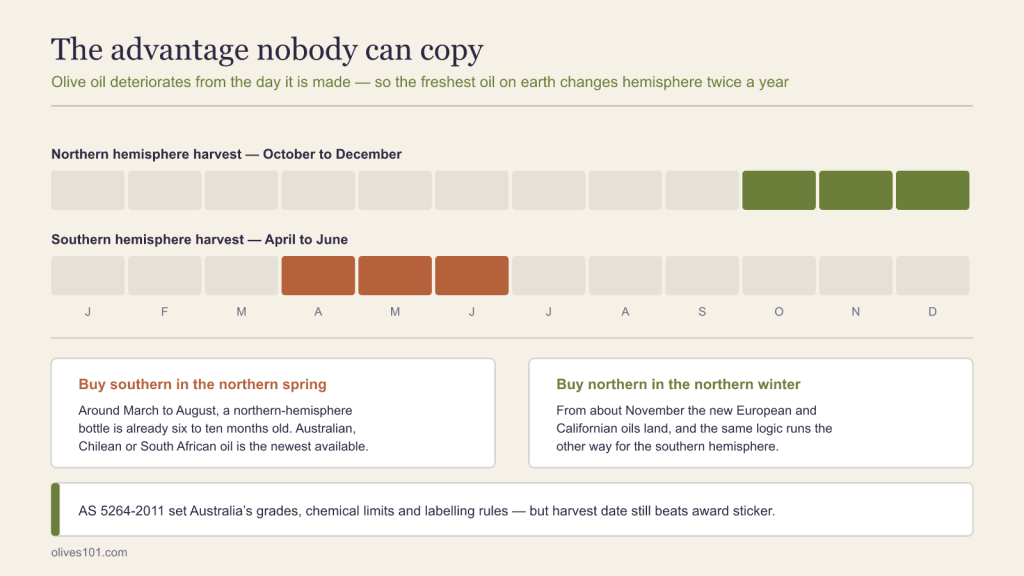
The limits are worth knowing too. Competitions judge the sample the producer chose to send, not the bottle you buy, and they judge it in spring, when the oil is at its best. Medals are also awarded generously: with hundreds of entries and dozens of classes, a great many oils go home with something. The useful medal is a Best of Class or better, from a competition that publishes its scoring method, on a bottle that also carries a harvest date.
In the trade, a gold medal sticker sells a bottle to a retailer, not to a drinker. Buyers use them as a shortlist and then taste, because they know how many medals are handed out. What you can do at home is the same thing in miniature: buy one award winning oil and one supermarket bottle, taste them side by side out of small glasses, and decide whether the difference is worth the money to you. Sometimes it is not, and that is a useful thing to learn with your own palate rather than from a sticker.