Olive Oil and Memory: Spanish Study Links It to Better Recall
Olive oil and memory are linked in a new Spanish study: older people at high cardiovascular risk who ate more olive oil, especially virgin olive oil, scored better on verbal memory tests. The work comes from a Barcelona team in the PREDIMED Mediterranean diet trial and was covered in the Spanish and trade press this week. Here is what it found, what it cannot show, and what it sensibly means for your kitchen.
What the study found
Researchers at the Lipid Clinic of the Hospital Clínic in Barcelona, including Dr Emili Ros, looked at 447 people aged 55 to 80, just over half of them women, who were enrolled in PREDIMED, the large Spanish trial testing the Mediterranean diet against heart disease. None had heart disease when they joined, but all were at high cardiovascular risk. The team recorded what they usually ate, measured their cardiovascular profile, checked a gene linked to Alzheimer’s risk and gave them a set of standard memory and thinking tests. They also measured polyphenols in urine, an objective marker of how many polyphenol-rich foods a person really eats.
The paper, published in the Journal of Alzheimer’s Disease, reports several links that held after adjusting for other factors:
| Food or marker | Linked with better |
|---|---|
| Total olive oil | Immediate verbal memory |
| Virgin olive oil | Delayed verbal memory |
| Coffee | Delayed verbal memory |
| Walnuts | Working memory |
| Wine | A standard screening test for cognitive decline |
| Polyphenols in urine | Immediate verbal memory |
The authors conclude that eating more antioxidant-rich foods, and polyphenols in particular, is associated with better cognitive performance in this group, and that parts of the Mediterranean diet might help counter age-related decline.
What it does not show
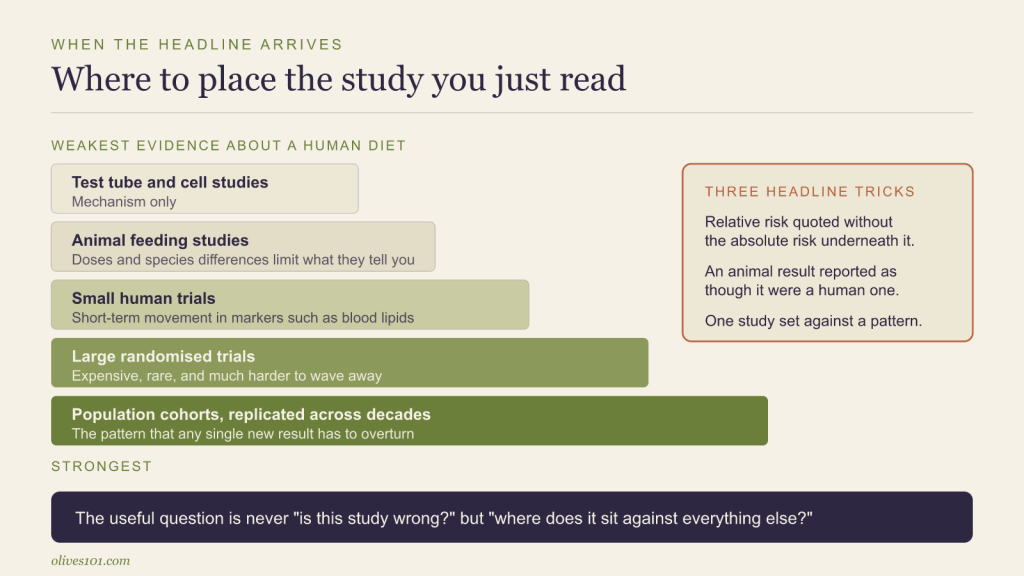
This is an association, not proof. The analysis compares what people ate with how they scored, rather than testing what happens when you change someone’s diet, so it cannot rule out that people who eat this way differ in other ways that protect memory. It covers one group of older Spaniards at high heart risk, and the associations are modest in size. The main PREDIMED results, from the part of the trial that assigned people to different diets, have not been published yet, and stronger answers on the brain will have to come from that kind of evidence.
- Good news: the olive oil result fits a wider body of work on Mediterranean eating and healthy aging.
- Caution: no single food here is a treatment for memory loss or dementia.
- On wine: a link with wine is not a reason to start drinking. Health bodies do not advise it.
What it means in practice
If you already cook with olive oil, the study is a reason to keep going and to prefer virgin and extra virgin grades, which keep the polyphenols that refining removes. Using it in place of butter and other solid fats, rather than on top of them, is where the evidence for olive oil is strongest.
Studies like this have a habit of turning into a slogan on a bottle. The study behind any “good for your brain” claim measured virgin olive oil in ordinary kitchen amounts, not capsules or special brands. The polyphenols fade as oil ages, so the most useful thing a label can tell you is the harvest date, not a health slogan.
This is general information, not medical advice. If you or someone close to you notices memory problems that are getting worse or affect daily life, see a doctor.
For background, see Mediterranean diet helps against Alzheimer’s, The Mediterranean Diet, Explained (and Why Olive Oil Is at Its Heart) and It’s the Polyphenols that Make the Difference.
Sources
- PubMed: Valls-Pedret et al., Polyphenol-rich foods in the Mediterranean diet are associated with better cognitive function in elderly subjects at high cardiovascular risk, J Alzheimers Dis 2012
- Olive Oil Times: Olive Oil May Help Prevent Neurodegenerative Diseases