Chemists Doubt India’s Olive Pomace Oil Claim
India’s biggest olive oil seller has written to the International Olive Council claiming a “discovery” of micro-nutrients in olive pomace oil, backed by lab reports showing more tocopherol in one pomace sample than in nine extra virgin oils. Chemists who have seen the reports do not believe them. Here is the claim, the response, and why this argument matters far beyond India.
What happened
V N Dalmia, chairman of Dalmia Continental, which sells the Leonardo brand, and president of the Indian Olive Association, sent the council laboratory reports last week. They show a sample of olive pomace oil with higher alpha and beta tocopherol, a family of vitamin E compounds, than nine Italian extra virgin oils tested in 2012, among them Colavita, Colonna and Monini. Dalmia noted that the pomace sample had no virgin oil added to it.
The council’s executive director, Jean-Louis Barjol, asked for a sample so that an IOC laboratory could run its own analysis, along with a full certificate of analysis. He also made the standard point: pomace oils do generally start with more tocopherol than oil from the pulp, but refining destroys a lot of it.
Why chemists are unconvinced
Selina Wang, research director at the UC Davis Olive Center, said tocopherol is sensitive to refining and breaks down easily, spending itself fighting oxidation at every stage of the process. Asked whether she would be surprised to see higher tocopherol in a pomace oil than in extra virgin, her answer was one word: absolutely. She also noted that tocopherol can be added artificially after processing, and that a laboratory can usually tell from its structure whether it was.
The olive oil chemist Gino Celletti was blunter. He said the figure quoted for the pomace sample, 370 mg per kg of alpha tocopherols, would make any authority laugh, and he found oddities in the extra virgin reports too: one sample had a peroxide value so high that tasters should have found it rancid, yet the report recorded no defects. He also asked why nine extra virgin oils were tested against a single pomace sample.
The argument underneath
Dalmia is not arguing in a vacuum. India is a huge, price-sensitive market where cooking usually starts by dropping oil into a hot pan, which is exactly the treatment that wastes what is special about extra virgin. Pomace oil costs far less. Speaking at a seminar in New York in April, Dalmia made the case that pomace oil is the lowest hurdle to getting Indian households off cheap seed oils and onto a monounsaturated fat.
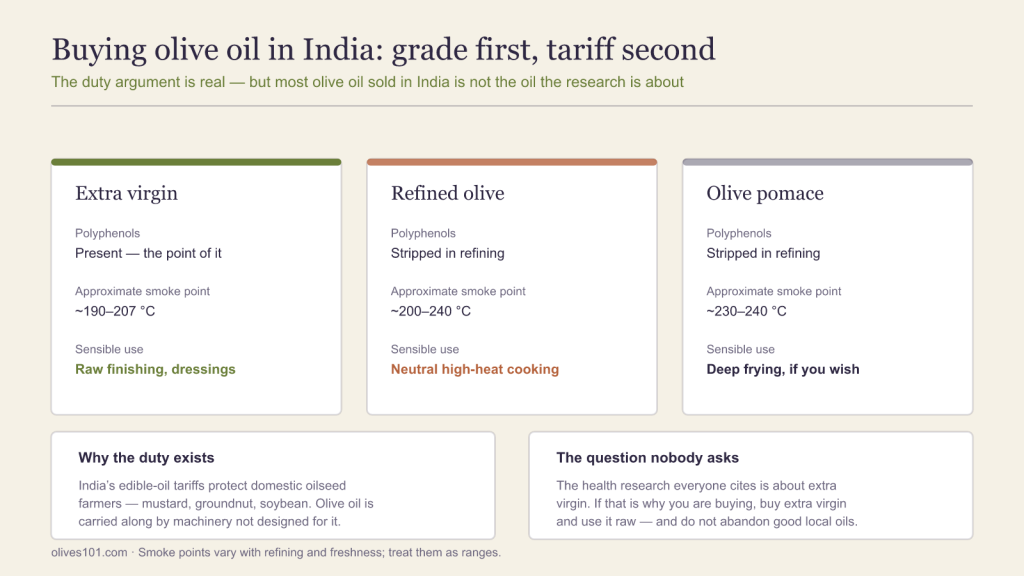
The counter-argument is the grade itself. Olive pomace oil is extracted with solvents from the paste left after the oil has been pressed out, then refined, and under international rules it cannot be sold simply as “olive oil”. Last September the Advertising Standards Council of India upheld a complaint against Leonardo pomace advertising which claimed the product fights cholesterol and heart disease, lowers blood pressure, controls and prevents diabetes and fights cancer. The council said the claims were unsubstantiated, noting that pomace oil is solvent extracted and that the health benefits associated with olive oil come from the antioxidants in extra virgin.
| Grade | How it is made | What it can be called |
|---|---|---|
| Extra virgin | Mechanical extraction from the fruit, no refining | Extra virgin olive oil |
| Olive oil | Refined olive oil with some virgin blended back in | Olive oil |
| Olive pomace oil | Solvent extracted from the leftover paste, then refined | Olive pomace oil, never plain olive oil |
Pomace oil is a perfectly usable frying oil at a fair price, and nobody in the trade pretends otherwise in private. The trouble starts when it is sold wearing extra virgin’s health halo. In several growing markets the bottle that says “olive” on the front and pomace in small type on the back is the volume leader, because it is cheap and the word does the selling. If you want the compounds the studies are about, you have to buy the grade the studies used.
Sources
- Olive Oil Times: Experts Skeptical of Dalmia’s Pomace Oil ‘Discovery’ (August 9, 2013)
- Campaign India: ASCI’s consumer complaints council upholds complaints, including against Leonardo Olive Pomace Oil (September 2012, archived)