Olive Oil Tops a European Parliament Food Fraud List
Olive oil is at the top of a European Parliament committee’s list of the foods most at risk of fraud, ahead of fish and organic food. The draft report, written in the wake of this year’s horsemeat scandal, says food fraud in the EU is lucrative, rarely caught and apparently growing, and it wants penalties of at least double the fraudster’s gain. Here is what the report says, what it does not explain, and why olive oil keeps landing in first place.
What the draft report says
The report, on “the food crisis, fraud in the food chain and the control thereof”, comes from the Parliament’s Committee on the Environment, Public Health and Food Safety after a four-month inquiry. Its author, the Dutch member Esther de Lange, explained it to reporters on Friday. Members can table amendments until October 28, and the committee is due to vote next month.
The top ten list is based on academic studies, police records and consultations with industry, traders, retailers, consumers, scientists, national authorities, the Commission and Europol. De Lange said she was surprised that meat did not make the top ten at all, after a year in which horsemeat was sold as beef across the continent.
| Rank | Foods most at risk of fraud, draft report |
|---|---|
| 1 | Olive oil |
| 2 | Fish |
| 3 | Organic foods |
| 4 to 10 | Milk; grains; honey and maple syrup; coffee and tea; spices such as saffron and chili powder; wine; certain fruit juices |
What it wants done
The report defines food fraud as breaking food law or misleading the consumer, on purpose, for money. It finds that EU law is built around food safety, so fraud that does not make anyone ill tends to go undetected, and that cases crossing borders are hard to prosecute. It is especially worried by signs that organized crime is moving in. Among its recommendations:
- Systematic collection of data on fraud cases across the EU.
- Official controls aimed at preventing fraud, not only at food safety.
- A shift from an administrative approach to policing based on risk profiles, citing Denmark’s food “flying squad” and Italy’s Carabinieri and Guardia di Finanza.
- A legal duty on food businesses to report fraud they discover, and support for whistle-blowers.
- Sanctions of at least double the economic advantage sought.
Why olive oil comes first
The draft does not say why olive oil heads the list. Its main academic reference, according to Olive Oil Times, is a 2011 paper by John Spink and Douglas Moyer defining the public health threat of food fraud. Whatever the method, olive oil has one of the longest records of fraud cases of any food. Italy alone has run police operations against fake extra virgin for decades, and it passed its “Salva Olio” law this year. Spain had Operation Lucerna last year. Brussels itself ordered risk-based checks on olive oil grades in the spring.
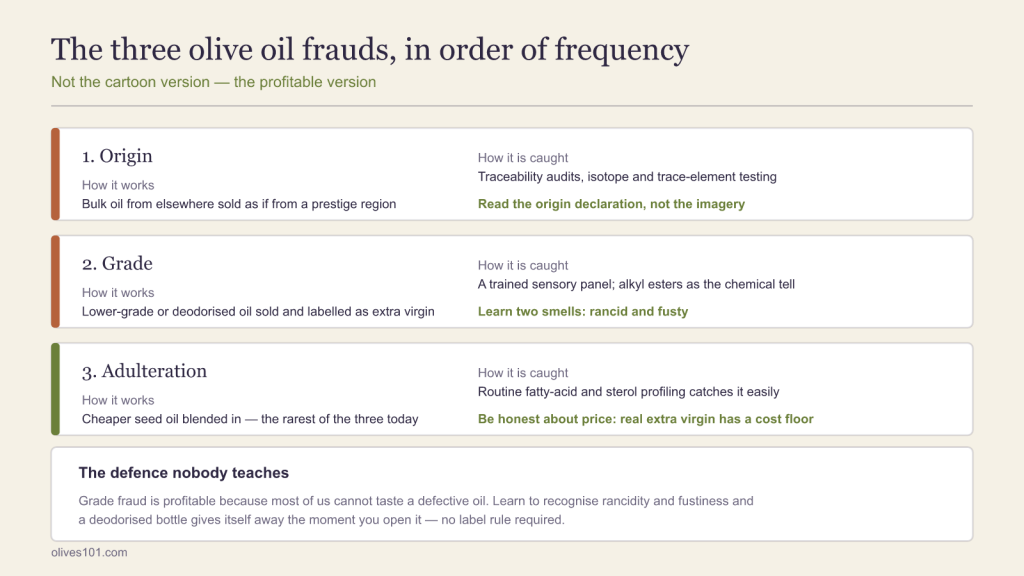
The economics explain the rest. The price gap between extra virgin and lower grades is large, the products look alike in a bottle, and most of the fraud is not seed oil at all but a grade swap: lower-grade olive oil, sometimes gently refined, sold as extra virgin. That is harder to prove than horse DNA in a burger, because the oil really is olive oil.
A list is not a measure of how much fraud there is, and the industry will point that out. But being ranked first by the European Parliament is the kind of headline that sticks, and it adds weight to the case for more testing of what is actually on the shelves.
The fraud a shopper is most likely to meet is not the dramatic kind. It is ordinary oil sold one grade too high, or oil that was extra virgin a year ago and no longer is. Neither needs a criminal gang, only a lot of bottles and not many inspectors. That is why the report’s call for controls aimed at fraud, and fines that hurt, matters more than the ranking. Read up on how adulteration really works and you will see why.
Sources
- Olive Oil Times: Olive Oil Tops E.U. List of Foods at Most Risk of Fraud (October 21, 2013)
- Associated Press via ABC News: Olive Oil, Fish Top EU Food Fraud List (October 18, 2013, archived)
- Esther de Lange: Aanpak voedselfraude over andere boeg gooien (October 18, 2013, archived, in Dutch)