Operation Lucerna: Spain Busts an Alleged Olive Oil Fraud Ring
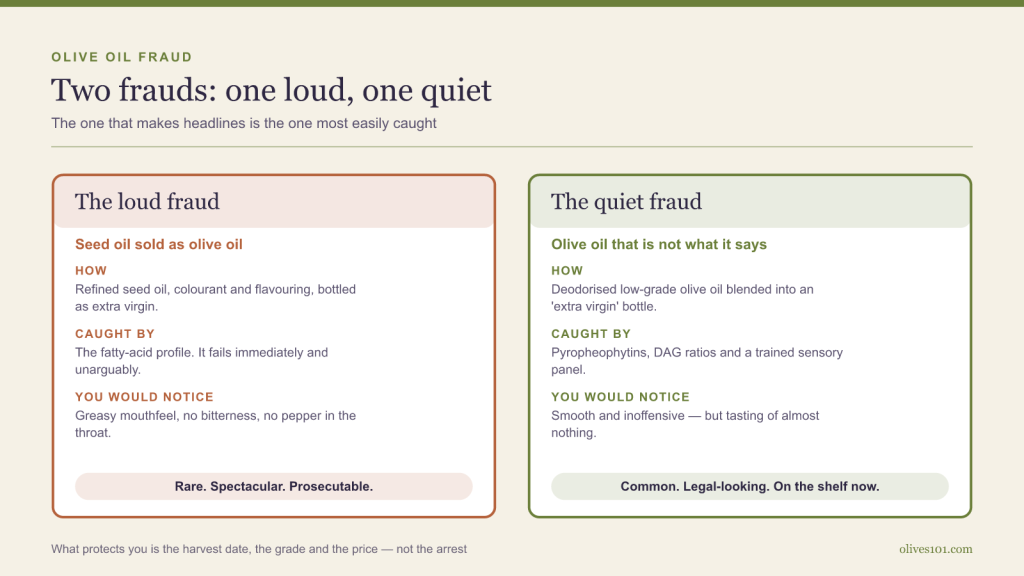
Spanish police say a network based in Jaén blended palm, avocado, sunflower and other cheaper oils, disguised them, and sold the result as olive oil. Nineteen people were arrested last week in what the Guardia Civil calls Operation Lucerna, and yesterday the police released the first details of how the alleged olive oil fraud worked. Here is what we know, why it matters for Spain’s biggest olive province, and what it tells buyers.
What happened
On Wednesday, February 8, officers from the Guardia Civil, working with the Spanish tax agency, arrested 19 people after a year-long investigation centered on the provinces of Jaén and Córdoba. According to the regional paper Diario Jaén, as reported by Olive Oil Times, most of those detained are owners or managers of olive mills in Jaén, among them a well-known local businessman who already faces prosecution in a separate case. All have been charged and released pending trial. Nobody has been convicted of anything.
Yesterday, February 14, the police statement filled in the picture. Investigators allege that cheaper vegetable oils were blended in an industrial biodiesel plant and treated so as to hide the chemical markers that would have given them away. The product was then sold for human consumption in two ways: in bulk to other businesses that did not know what they were buying, and in bottles labeled as olive oil. Police also allege a web of shell companies and front men, and large-scale evasion of Spain’s value added tax.
The Guardia Civil stressed that the oils were not toxic and posed no health risk. The consumer group FACUA, reporting the same statement, repeated that reassurance, along with the police view that the scheme amounted to very serious unfair competition against honest firms.
| Operation Lucerna, as described by police | Figure |
|---|---|
| People arrested | 19 (15 Spanish, 2 Ecuadorian, 1 Colombian, 1 Italian) |
| Companies in the alleged network | About 30, with front men in Spain, Italy and Portugal |
| Estimated VAT fraud | €3 million or more |
| Business premises searched | 4, all in Jaén |
| Oils allegedly used | Palm, avocado, sunflower and others |
| Length of investigation | About one year |
Why it matters
Jaén is the single most important olive province on earth, and its reputation is its main asset. A fraud case there lands at the worst possible moment. Farm-gate prices in Spain are so low that the European Commission has just agreed to pay for 100,000 tons of extra virgin and virgin oil to be held off the market, and growers are selling below their costs.
That is not a coincidence. When genuine oil is cheap, the only way to undercut it is to sell something that is not olive oil at all, or to skip the tax. If the police account is right, this network did both. Every liter of cut oil sold into the bulk market pushes down the price that honest mills can get, which is why Spain’s own producers will be the angriest people reading these reports.
The choice of oils is also telling. Sunflower is the classic cut and relatively easy for a laboratory to spot. Avocado oil is less obvious, because it is rich in oleic acid, the same fatty acid that dominates olive oil. Palm oil is cheap and plentiful. The biodiesel plant detail matters most: treating oils to remove their fingerprints is a deliberate attempt to beat the tests, not an accident at a careless mill.
How fraud like this gets caught
Olive oil has a chemical signature that other oils find hard to fake completely. The sterol profile in particular differs from seed oils, and it is one of the tests regulators lean on, as we explained in Sterols: the fingerprint that catches fake olive oil. Refining and deodorizing can scrub away some markers, but they leave others behind, which is why official labs run a battery of tests rather than one.
Spain has been here before. See From the Archive: A Spanish Olive-Oil Adulteration Scare (2008), and for the same trick found at the import end, Canada: Olive oil imports were half sunflower.
What it means for buyers
- The police say there was no health risk, so nobody needs to empty their cupboard.
- Police say part of the oil was sold in bulk to other companies. That is where testing every tanker on arrival matters most.
- At the shelf, the best protection is still traceable oil with a named producer, a clear origin and a harvest date.
In the bulk trade the warning sign is nearly always the price. When a tanker of “extra virgin” is offered for less than the mill could have paid for the olives, there is no honest explanation, and any experienced buyer knows it. The businesses that get caught out are usually the ones that did not want to ask why the deal was so good. A laboratory test on arrival costs very little compared with a load of oil that is not what the paperwork says.
Sources
- Olive Oil Times: Nineteen Arrested Over Alleged Olive Oil Fraud
- Olive Oil Times: Spanish Police Say Palm, Avocado, Sunflower Was Passed Off as Olive Oil
- FACUA: Desarticulada una red que mezclaba aceites de baja calidad y los vendía como aceite de oliva (in Spanish)
- Olive Oil Times: EU Offers Olive Oil Storage Aid Amid Tumbling Prices