Extra Virginity: Tom Mueller’s Book Takes On Olive Oil Fraud
Tom Mueller’s Extra Virginity: The Sublime and Scandalous World of Olive Oil came out from W. W. Norton on December 5, and it is the most direct attack on the olive oil trade’s habits that a mainstream publisher has ever put in the bookshops. Here is what the book argues, how it has been received in its first two weeks, and what it changes for anyone buying a bottle this Christmas.
What the book says
Mueller is an American journalist who lives among the olive groves of Liguria, and the book grew out of his 2007 New Yorker investigation into olive oil fraud. It mixes history (oil as the fuel, medicine, cosmetic and currency of the ancient Mediterranean) with present-day reporting from mills and tasting rooms in Italy, Spain, California and Australia.
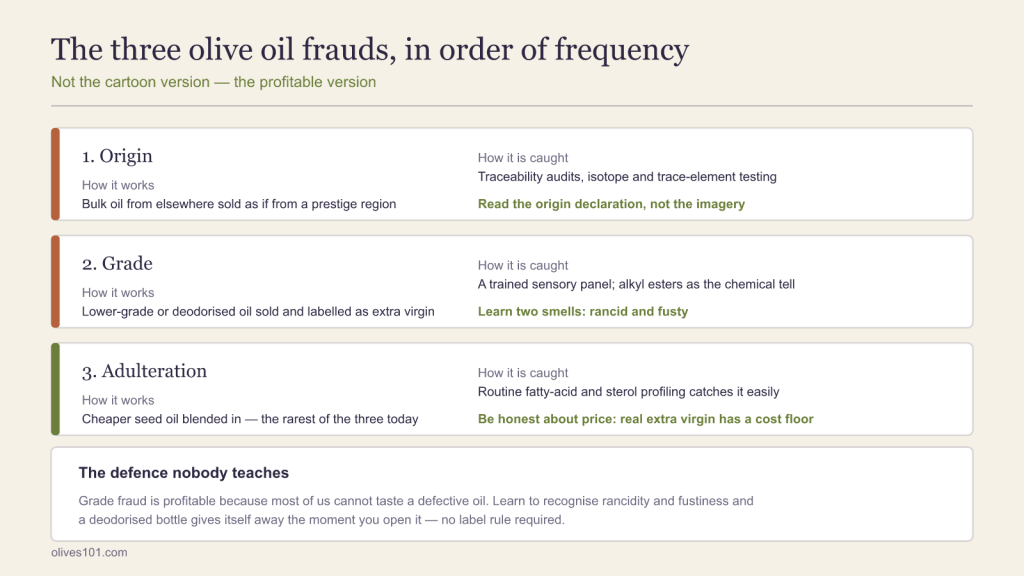
The central argument is not complicated. A great deal of oil sold as extra virgin is not what the label says. Some of it has been cut with cheaper oils. Some is low-grade oil cleaned up and relabeled. Some is a blend from several countries dressed in the flag of the most famous one. Kirkus Reviews, in its early review, summed up Mueller’s diagnosis as corruption in Italy and an indifferent FDA in America, with lax European enforcement letting inferior oil go out labeled “extra virgin” and “100 percent Italian”.
He also takes on the International Olive Council, the intergovernmental body that wrote the modern grade definitions. In an interview with Olive Oil Times a few days before publication, he said he did not believe the Council’s current leadership would push the trade toward quality, and the book accuses the organization of protecting the big commodity bottlers rather than producers of genuine extra virgin, or the people who buy it.
How it has been received
The New York Times reviewed it within days. Dwight Garner had fun with Mueller’s more lyrical passages and treated the fraud itself with something close to a shrug, noting that the FDA considers adulteration a low priority. Olive Oil Times answered with an editorial arguing that the review chased one-liners and missed the point: this is a food fraud story, not a style problem.
In an interview published by Food Republic this week, Mueller put the stakes in commercial terms. His warning, roughly, is that unless buyers learn to tell great oil from bad oil soon, the great oil will simply disappear, because honest producers cannot survive selling at the price of the fakes.
Why it lands now
The timing could hardly be sharper. The trade is in a price crisis. Olive Oil Times reported in November that farm-gate prices in Spain had fallen far enough to trigger European Union private storage aid, which pays approved operators to hold oil off the market. Growers in several countries are asking whether this season’s fruit is even worth picking.
When the price of the real thing collapses, the temptation to cut corners does not go away. It moves to the bottom of the market, where margins are thinnest and nobody is looking closely. Nothing in the book will surprise anyone who has worked in bulk oil. What is new is that it is written for the general reader, by a reporter who went to the groves, mills and laboratories himself.
What it means for buyers
The book is not a reason to stop buying olive oil. It is a reason to buy it differently. The habits that protect you are simple:
- Read the origin line, not the flag. Under EU rules, extra virgin and virgin oil must state an origin. A blend of oils from several countries has to say so, often in small print on the back.
- Look for a harvest date. A best-before date is set by the bottler. A harvest date tells you how old the oil really is.
- Be suspicious of a price far below the rest of the shelf. Good extra virgin has a floor cost, and a bargain well under it has to be explained somehow.
- Taste it. Fresh extra virgin is fruity, with some bitterness and a peppery catch in the throat. Flat, greasy, musty or crayon-like means old or defective.
If you want to learn the difference, a simple home tasting of two or three oils side by side, as described in How to Taste Olive Oil Like a Pro, teaches more in ten minutes than any label. For the mechanics of how oil gets stretched and relabeled, see Olive Oil Fraud: How the Adulteration Really Works and Italy: The trade in adulterated olive oil.
“Packed in Italy” or “imported from Italy” describes where the bottle was filled, not where the olives grew. Italy is the great blending and bottling hub of the trade, so a lot of oil that has never seen an Italian tree leaves the country in an Italian-looking bottle. The legally required origin statement is usually on the back label, in the smallest type on the pack. That line, not the picture of a hill town on the front, is the one to read.
Sources
- Kirkus Reviews: Extra Virginity by Tom Mueller
- Olive Oil Times: New Book Accuses Council of Holding Olive Oil to ‘Lowest Denominator’
- Olive Oil Times: “Extra Virginity” Book Review Has Plenty of Quips, But Misses the Point
- Food Republic: Tom Mueller on “Extra Virginity”