EU Olive Oil Labeling Rules Rewritten Into One Clean Text
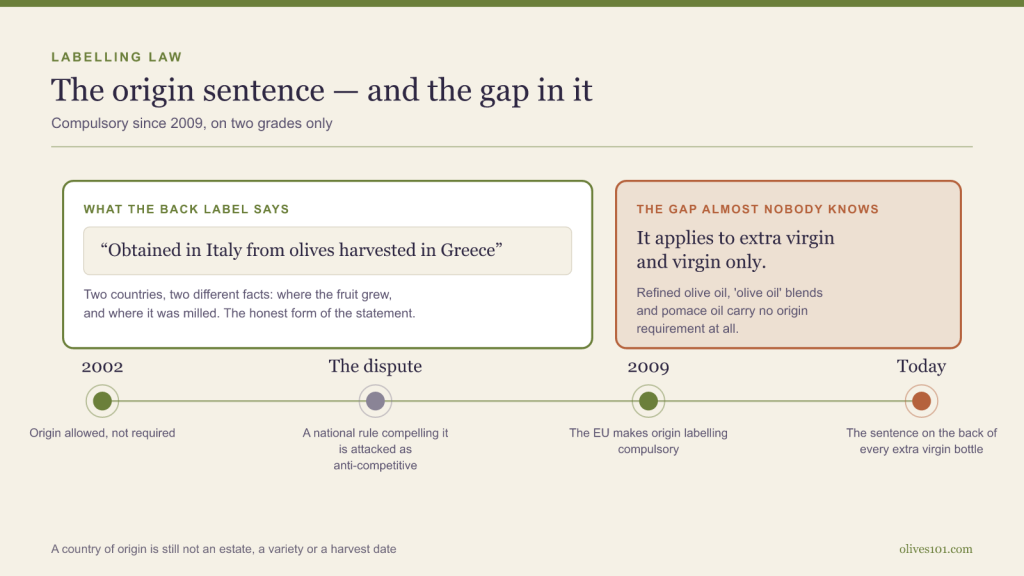
The European Commission has pulled ten years of amendments to its olive oil labeling rules into one clean text: Implementing Regulation (EU) No 29/2012, adopted on January 13 and published in the Official Journal on January 14. Nothing new has been added, but the codified text is the clearest statement yet of what a bottle sold in Europe must say, and what the popular claims on the front actually mean.
What happened
The old rulebook was Commission Regulation (EC) No 1019/2002, the marketing standard for olive oil at the retail stage. It had been amended so many times that reading it properly meant laying the original and every amendment side by side. The new regulation replaces it “in the interests of clarity and rationality”, in the Commission’s own words. As Olive Oil Times reported, it is a clean copy of the rules as they stand, not a new policy.
That makes it easy to dismiss as paperwork. It is worth a closer look, because it is the one document that settles most of the arguments I used to have with buyers about labels.
What the rules say
| Label element | What Regulation 29/2012 requires |
|---|---|
| Pack size | Retail packs up to 5 liters, with a closure that cannot be resealed once opened. Member states may allow bigger packs for restaurants, hospitals and canteens. |
| Category wording | Each grade carries a set explanatory line. Extra virgin: “superior category olive oil obtained directly from olives and solely by mechanical means”. |
| Origin | Compulsory on extra virgin and virgin oil. Not allowed on refined “olive oil” or olive-pomace oil. Regional names are reserved for protected designations (PDO and PGI). |
| “First cold pressing” | Only for extra virgin or virgin oil from a first mechanical pressing below 27°C in a traditional hydraulic press. |
| “Cold extraction” | Only for extra virgin or virgin oil obtained below 27°C by percolation or centrifugation. |
| Taste and aroma terms | Only on extra virgin or virgin oil, and the official terms only when backed by the official panel test. Brands whose trademark was applied for by March 1, 2008 have until November 1, 2012 to comply. |
| Acidity | May be stated only alongside the peroxide value, wax content and ultraviolet absorption, in the same size lettering and the same field of vision. |
| Blends with other oils | Must be called a blend of vegetable oils and olive oil, with the olive oil percentage. Pictures of olives are allowed only if olive oil is more than half the blend. |
The origin rules, in plain terms
This is the part that matters most to shoppers. Oil from a single country is labeled with that country (or simply “the Union”). A blend must use one of three set phrases: a blend of olive oils of European Union origin, a blend not of European Union origin, or a blend of both. If the olives were grown in one country and milled in another, the label has to say both, in the form “obtained in (country) from olives harvested in (country)”.
The origin of oil means where the olives were harvested or where the mill is. It does not mean where the bottling plant is. That distinction is exactly why the rules exist, and why the argument has not gone away. Olive Oil Times noted that Italy’s farm group Coldiretti claims most extra virgin sold in Italy contains oil from other countries, and that shoppers often need a magnifying glass to find the statement that says so.
Why it matters
A tidy rulebook does not enforce itself. The rules on origin and on claims like “cold pressed” have been law for years, and the complaint from honest producers has never been the wording. It has been the checking. Still, a single text makes life easier for inspectors, importers and anyone trying to hold a bottler to account.
For buyers outside Europe, it is also a useful benchmark. Labels there follow local law rather than this regulation, but the terms mean the same thing wherever the oil was made honestly. For the story behind two of the most abused phrases, see “First Cold Pressed” and “Cold Extraction”: What They Actually Mean. For acidity, Olive Oil Acidity: What “Extra Virgin” Actually Measures explains why a single number on the front means little.
What to check on your next bottle
- Find the origin line on the back. If it says a blend of EU and non-EU oils, you are buying a blend, whatever the front says.
- If the front says “cold extraction”, that is the honest modern phrase. Most mills today use centrifuges, not presses.
- If a bottle sold in the EU prints its acidity without peroxide, wax and ultraviolet values beside it, the label is not following the rules.
- Regional names on a label that is not a PDO or PGI should make you ask questions.
Our older guide, How to Read an Olive Oil Label, walks through a real back label line by line.
“First cold pressing” is mostly nostalgia. The rule reserves it for oil from traditional hydraulic presses, and very little oil is made that way any more. Modern extra virgin comes out of a centrifuge, and there is no “second pressing” of extra virgin to compare it with. A bottle that shouts “first cold pressed” is telling you about its marketing department. The date the olives were harvested would tell you far more.
Sources
- EUR-Lex: Commission Implementing Regulation (EU) No 29/2012 of 13 January 2012 on marketing standards for olive oil (codification)
- Olive Oil Times: EU Codifies Marketing Standards for Olive Oil