Green vs Black Olives: What’s the Difference?
It is the most common olive question there is, and the answer surprises people every time: green and black are the same fruit at different moments. What really separates them is when they were picked and how they were cured.

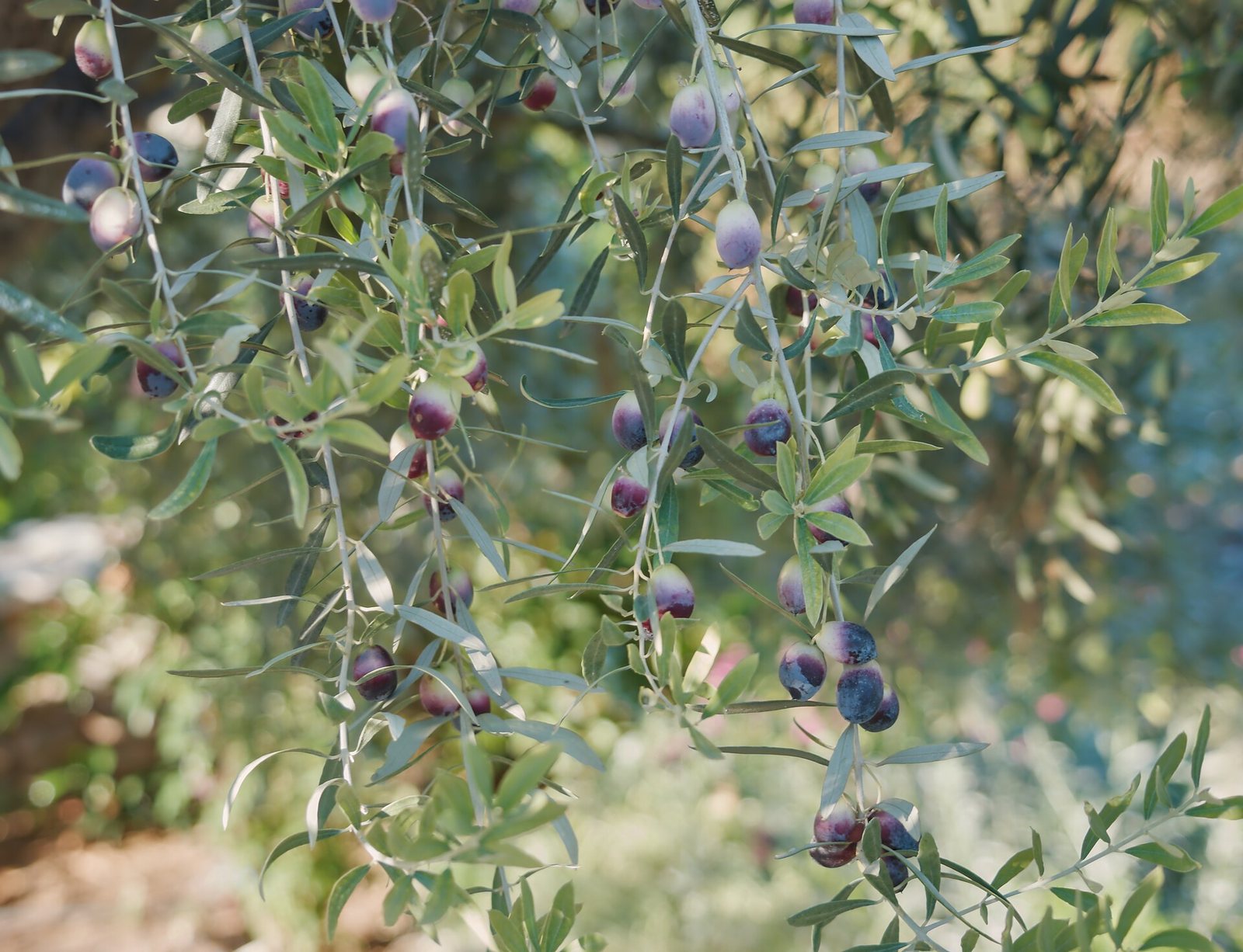
Olives start green and darken as they ripen on the branch — through straw and rose to purple, brown and finally black. Pick the same fruit from the same tree in September and it is firm, bright and bitter; leave it until December and it is soft, dark, mellow and oily. Many varieties are sold both ways for exactly this reason: the Spanish Manzanilla, the Italian Cerignola, the Greek Halkidiki all appear on shelves in both colours.
So the honest answer to ‘what is the difference between green and black olives?’ is: about eight weeks. Everything else follows from that, plus the choice of cure.
What ripening actually changes
Three things move together as an olive ripens. Water content falls and oil content rises, which is why oil producers harvest later than table-olive producers and why a ripe black olive feels richer in the mouth. The flesh softens as the cell walls break down, so a late-picked olive can never have the snap of an early one. And the phenolic profile shifts: the intensely bitter oleuropein declines, so a ripe olive is milder before it is even cured.
That gives you the practical division. Green olives are firm, crisp, higher in moisture, fresh and a little bitter — good for stuffing, good with a cold drink, good where you want a bite. Naturally black, tree-ripened olives are softer, fruitier, richer and oilier — better in salads, on cheese boards, in slow-cooked dishes where they can give up flavour.
But neither is edible straight from the tree. Every olive you have eaten was cured, and the cure shapes the final flavour at least as much as the colour does.
| Method | How it works | Colour | Texture & taste | Typical olives | Time |
|---|---|---|---|---|---|
| Spanish style (lye) | Treated with dilute lye, washed, then brine-fermented | Green to yellow-green | Firm, clean, mildly salty, slightly lactic | Manzanilla, Gordal, Picholine | Weeks |
| Greek style (natural brine) | Fermented in salt brine only, no lye | Green through purple to black | Complex, winey, fruity, a little bitter | Kalamata, Halkidiki, Gaeta | Several months |
| Dry salt cure | Packed in salt, which draws out water | Wrinkled, matte black-brown | Chewy, intense, salty, concentrated | Nyons-style, Moroccan oil-cured | Weeks to months |
| Water cure | Repeatedly soaked and changed to leach bitterness | Green or dark, natural | Mild, delicate, short-lived | Cracked green styles, home curing | Days to weeks |
| Californian black-ripe process | Green olives oxidised with air in lye, colour fixed with an iron salt | Uniform jet black, matte | Soft, mild, faintly metallic, little character | Canned ‘black olives’ | Days |
The fake black olive
Here is the one worth watching for. Those uniform, matte, jet-black olives in a cheap can — the ones on takeaway pizza — usually never ripened at all. They are green olives turned black on purpose: repeatedly treated with lye while air is bubbled through, which oxidises the phenolic compounds and darkens the flesh, then fixed with an iron salt, ferrous gluconate, which appears on the ingredient list as an additive.
It is a legal, labelled, perfectly safe process with a long industrial history, and it produces a cheap, soft, mild olive that holds its colour under a hot oven. But it is not a ripe olive, and it does not taste like one. The oxidation that turns it black also strips out most of what would have made it interesting.
The tell is uniformity. Natural ripening is uneven: a jar of genuinely tree-ripened black olives varies from purple-brown through to true black, with mottling and shade differences from fruit to fruit. If every olive in the tin is identical, matte and inky, you are looking at a manufactured colour. Turn the tin around and look for the iron salt on the label — it is required to be there.
Reading the jar
- Variation is a good sign. Uneven colour means the fruit ripened on the tree.
- Check the ingredients for ferrous gluconate — its presence means the olives were oxidised, not ripened.
- Green does not mean unripe in a bad sense — it means picked early, deliberately, for firmness and freshness.
- Naturally black olives are softer. If a black olive is squeaky-firm, it was probably processed rather than ripened.
- Match the olive to the job: green for crunch and stuffing, natural black for salads, braises and cheese.
- Cure matters as much as colour. A lye-cured green and a brine-fermented green are quite different olives.
- Buy with the pit in for the table — better texture, cleaner flavour, slower to go soft.
Green and black olives: common questions
Are green and black olives different varieties?
Usually not. Colour is mostly ripeness — olives start green and darken on the branch. Many varieties, including Manzanilla and Cerignola, are sold both green and black depending on when they were picked.
Which is healthier, green or black?
They are broadly similar. Ripe black olives are higher in oil and therefore slightly more calorific; green ones are often saltier because of the curing. Choose by taste rather than by any meaningful nutritional gap.
What is ferrous gluconate doing in my olives?
Fixing an artificial black colour. Green olives treated with lye and oxygen turn dark, and the iron salt stabilises that colour. It is legal and safe, but it tells you the olives were never ripened on the tree.
Why do canned black olives taste so mild?
Because the oxidation process that blackens them also removes most of the phenolic compounds that carry flavour and bitterness. They are engineered for consistency, softness and colour stability rather than for taste.
Can I eat olives straight from the tree?
No. Raw olives are intensely bitter because of oleuropein, and they must be cured — in lye, brine, dry salt or repeated changes of water — before they are palatable. Curing takes anywhere from days to many months.
The question I am asked most often is which is better, and the honest answer is that it is the wrong question. Green and black are two moments in the same fruit’s life, and the cure matters more than either. What I would actually ask a shopper to notice is uniformity. A tray of naturally ripened black olives is a range of purples and browns and near-blacks, because no two olives ripened at exactly the same rate. A tin where every single olive is the same matte ink-black is not a triumph of quality control : it is a colour that was applied. That one observation will improve your olive buying more than any variety name.
Curing methods and the oxidation process from standard table-olive production references; additive labelling from food additive regulations.