Why Are Canned Black Olives So Black? Air, Lye and Iron
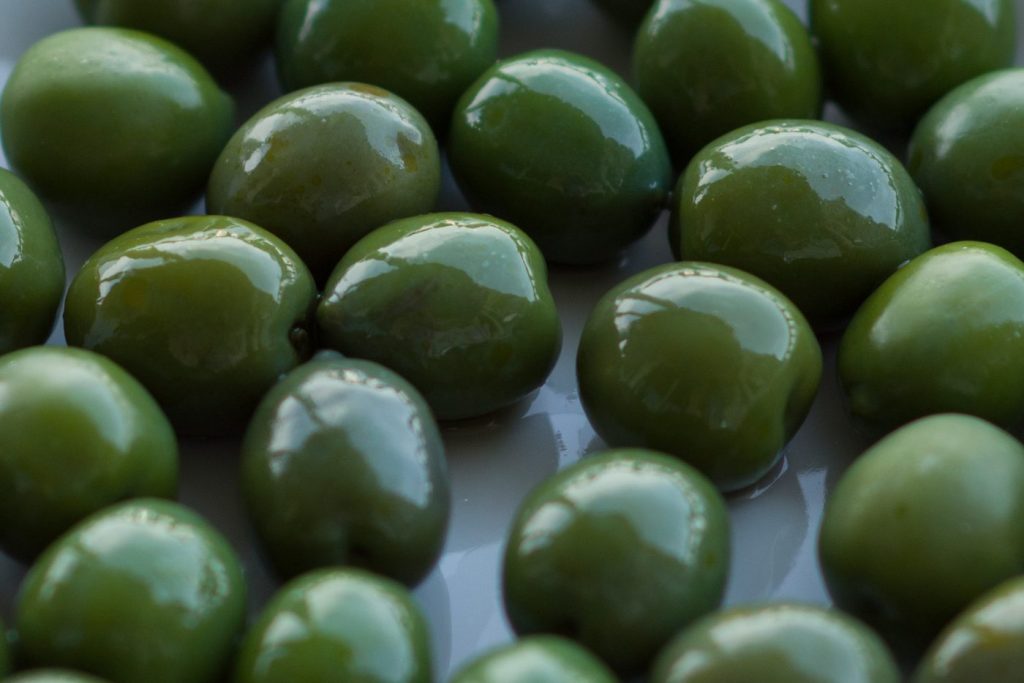
Those glossy, uniformly jet-black olives in the tin aren’t black because they ripened on the tree that way, they’re black because of oxygen and a pinch of iron. Nearly all canned “black ripe” olives (the classic California-style ones you slice over pizza) start out green and unripe. They’re cured in lye, deliberately bubbled with air so they darken, and then fixed with a food additive called ferrous gluconate that locks in that deep, even colour. It’s a clever industrial process, not a sign of a fully tree-ripened fruit.
If you’ve ever wondered why a tin of black olives looks so much more uniform, and so much darker, than the wrinkly, purple-brown olives on a Mediterranean deli counter, this is why. Let’s walk through it properly.
The California ripe process, step by step
The style is usually called the California ripe olive process, and it was developed in the early twentieth century to turn firm, under-ripe fruit into a mild, tinned product with a long shelf life. Whole raw olives are far too bitter to eat straight off the branch because of a compound called oleuropein, so every method of making olives edible has to deal with that bitterness first. Here the tool is lye.
Olives are picked while still green to greenish-straw in colour, then held in a weak lye solution (sodium hydroxide, also called caustic soda). The lye soaks through the flesh, breaking down the bitter oleuropein. This is roughly the same principle behind our home curing guides, the difference is that the cannery repeats and controls it tightly.
The magic, the darkening, happens because the olives are exposed to air between and during the lye treatments. Compounds in the fruit (phenolics) oxidise when they meet oxygen, and oxidised phenolics turn brown-black. Cannery workers often bubble compressed air right through the tanks to speed this along and make the colour even. Green fruit gradually shifts to reddish-brown and then to that familiar deep black over a series of soaks.
There’s one last trick. To make the colour stable and uniform, so it doesn’t fade or blotch in the tin, the olives are treated with ferrous gluconate (or ferrous lactate), an iron salt. The iron reacts with the oxidised phenolic compounds and effectively “sets” the black, the way a mordant fixes a dye. You’ll often see it listed plainly on the ingredients label as “ferrous gluconate,” added for exactly this reason. Finally the olives are canned in brine and heat-sterilised, which is what gives them their soft, mild character.
Ripe on the tree vs. “ripened” in the tank
This is where a lot of confusion creeps in. A truly tree-ripened olive, the kind used for many Greek, Italian, Spanish or French table olives, really does turn dark purple, brown or black on the branch as it matures. Those olives are usually brine-cured, salt-cured or water-cured over weeks or months, and they keep an uneven, natural colour and a more assertive, fruity or briny flavour. Provenance varies hugely: a variety’s name (say Kalamata or Gaeta) tells you the type, not that every black olive comes from one country.
Canned “black ripe” olives are a different animal. The word “ripe” here refers to the finished processed product, not to fruit that ripened fully on the tree. The colour is manufactured. That’s not a scandal, it’s a well-understood, regulated food process, and the additives involved are permitted in many countries, but it does explain why these olives taste so mild and look so machine-perfect. For more on the family tree of olive styles, see our olive encyclopedia.
| Feature | Canned “black ripe” olives (California process) | Naturally tree-ripened black olives |
|---|---|---|
| Colour at harvest | Green to straw (picked unripe) | Purple, brown or black (fully ripe) |
| Why they’re black | Air oxidation + ferrous gluconate fixes the colour | Natural pigment developed on the tree |
| Curing method | Lye, then air, then canned & heat-sterilised | Brine, salt or water cure over weeks/months |
| Colour appearance | Very uniform, matte to glossy jet-black | Uneven, mottled purple-black to brown |
| Flavour | Mild, mellow, low bitterness | Fruity, briny, often more intense |
| Typical texture | Soft, tender | Firmer, sometimes wrinkled |
None of this means one style is “better.” Canned ripe olives are brilliant on pizza, in salads and baked dishes precisely because they’re mild and dependable. Naturally cured black olives shine on a meze board where you want that punch of flavour. They’re simply made in completely different ways, and the tin’s remarkable blackness is the giveaway.
Frequently asked questions people also search
Are canned black olives dyed?
Not with an artificial food colouring in the usual sense. The dark colour comes from the olive’s own phenolic compounds oxidising in air, and it’s stabilised with an iron salt (ferrous gluconate). So the black is “developed” and fixed rather than painted on, but it is deliberately created by the process rather than fully natural.
Is ferrous gluconate safe to eat?
Ferrous gluconate is a permitted food additive used in small amounts to stabilise olive colour, and it’s the same iron compound sometimes used in iron supplements. As always, we’re not offering medical advice, if you have specific dietary or iron-related concerns, check with a healthcare professional. For most people it’s simply a normal part of how canned ripe olives are made.
Why are canned black olives so much milder than deli olives?
Because they’re picked unripe, cured quickly in lye, and then canned and heat-sterilised. That whole process strips out most of the bitterness and mellows the fruit, giving a soft, gentle flavour, quite unlike the slow brine or salt curing behind punchier tree-ripened olives.
Do black and green olives come from different trees?
Usually not. Green and black olives are very often the same fruit at different stages of ripeness, and sometimes even processed from the same green harvest. Whether an olive ends up green or black on your plate depends far more on when it’s picked and how it’s cured than on the variety of tree.