Cortopassi plans major olive oil expansion
It is the strangest factory in the food business: an expensive plant that runs flat out for six weeks and then goes quiet until next autumn. Understanding the milling season explains almost everything about olive oil quality.
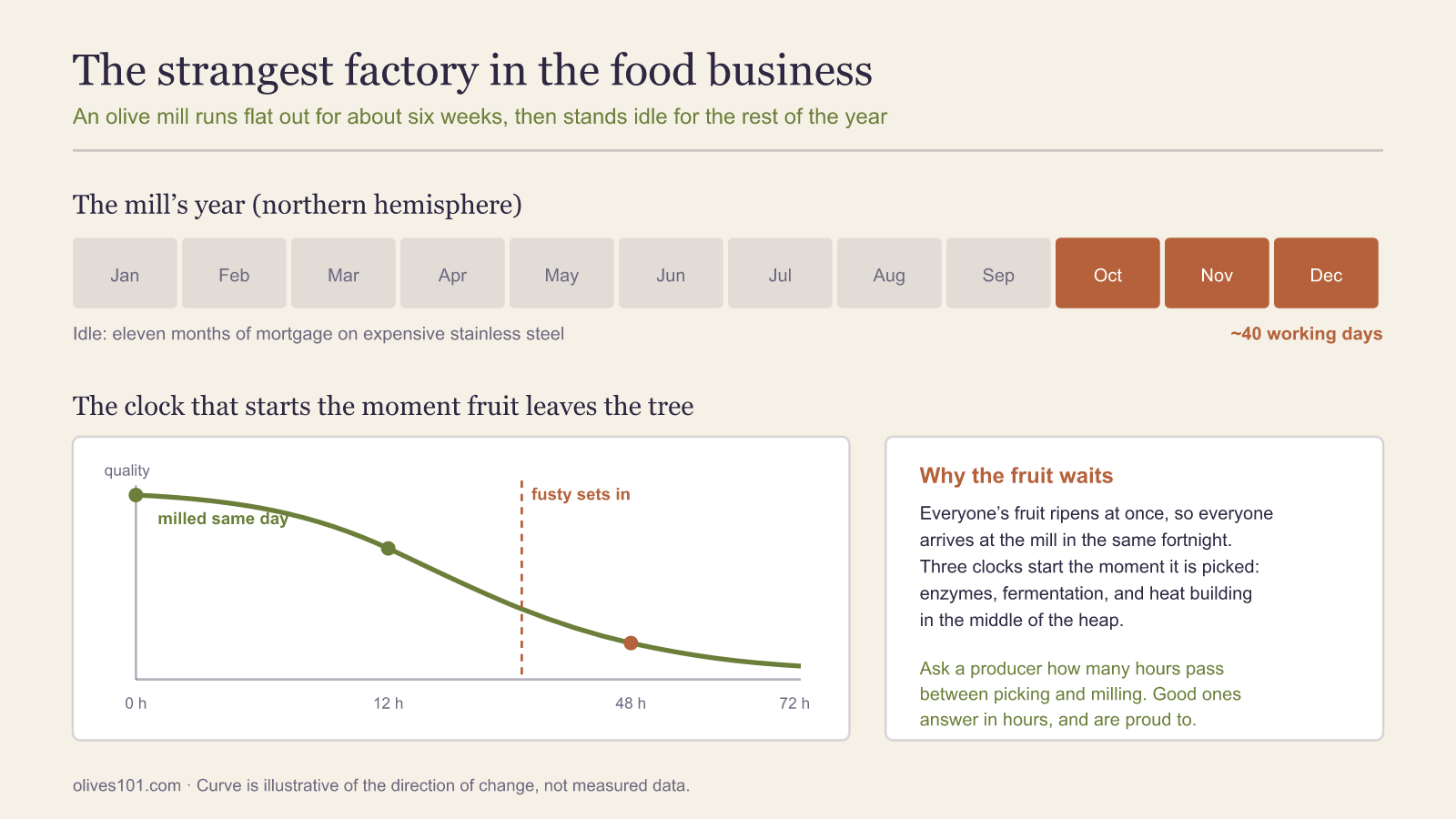
Every autumn, in every olive-growing country, a peculiar thing happens. Buildings full of expensive stainless steel wake up, run day and night for about six weeks, and then shut down again for the best part of a year. No dairy works like this. No bakery, no brewery, no cannery. The olive mill is a seasonal machine with an annual mortgage, and if you understand what that does to the incentives, you understand why some oil is superb, why some is quietly terrible, and why the good stuff costs what it costs.
Why the season is so short
Olives ripen within a fairly narrow window, and where in that window you pick decides what you get. Early, green fruit gives less oil per tonne but far more polyphenol — the bitter, peppery, stable, long-lived oil. Late, ripe fruit gives more oil and a softer, sweeter, shorter-lived one. Wait too long and the fruit drops, bruises, and starts to break down on the tree. Add the risk of rain, frost and fruit fly and the practical window in any given orchard is a few weeks at most.
So a mill’s capacity is not measured in tonnes per year. It is measured in tonnes per hour during those weeks, because that is the only number that decides whether the fruit arriving at the door can be processed today or has to wait until tomorrow. Expanding a mill means buying throughput you will use for forty days and then insure, heat, maintain and depreciate for the remaining three hundred and twenty-five.
What happens while the fruit waits
This is the heart of it. An olive is a living fruit with a bruised skin and a high sugar content, delivered in a bin with several tonnes of its neighbours. The moment it is picked, three clocks start: enzymatic breakdown, microbial fermentation, and heat building in the middle of the heap. Within a day or two you get the classic defect the trade calls fusty — the flat, sour, slightly cheesy smell of fruit that fermented before it was milled. It is the most common defect in the world and it is entirely a logistics failure.
Nothing at the mill can undo it. Malaxation, decanters, filtration, careful storage — none of it removes a defect already created in the bin. This is why the best producers obsess over hours rather than techniques, why fruit is delivered in shallow crates rather than deep bins, and why the phrase worth looking for on a label is not cold pressed but same-day milling. If an oil tastes vaguely of old vegetable water, it almost certainly waited.
| 0 hours | Fruit leaves the tree. Skin bruising has already begun with every knock. |
|---|---|
| 2–6 hours | Best practice: fruit arrives, is de-leafed, washed and milled. Oil is at its cleanest and most aromatic. |
| 12–24 hours | Still acceptable if fruit is in shallow crates and kept cool. Aroma is already softening. |
| 24–48 hours | Fermentation in the heap begins to register on the palate. Fusty notes appear. |
| 48 hours and beyond | Defects are established. The oil may still be sold, but not honestly as extra virgin. |
| At the mill | Malaxation held below about 27 °C to qualify as cold extraction; higher temperatures raise yield and destroy aroma. |
| After extraction | Oxygen, light and heat take over. From here the only question is how well it is stored. |
The queue nobody talks about
In most traditional regions growers do not own a mill; they take their fruit to a cooperative or a contract mill and join a queue. In a good year that queue is the bottleneck for the whole valley. Everyone’s fruit ripens at once, everyone arrives in the same fortnight, and the mill runs twenty hours a day and still cannot keep up. The grower who arrives at four in the afternoon may be milled at midnight, or at noon the next day, and their oil will be measurably worse for it through no fault of their own.
That is why mill capacity, unglamorous as it sounds, is one of the great quality levers in this industry, and why serious estates eventually build their own. When you read that a producer mills within two hours of picking, what you are really being told is that they solved the queue — and that is worth more than any amount of talk about ancient stone wheels. On what else happens to oil after it leaves the mill, see how olive oil is cut.
What to take from the milling season
- Ask how long between picking and milling. Good producers answer in hours and are proud to. It is the single most revealing question you can ask.
- Cold pressed is close to meaningless today. Almost no one presses; modern extraction is centrifugal. What matters is that malaxation stayed below roughly 27 degrees Celsius.
- Buy new-season oil in winter in the northern hemisphere, and remember the southern hemisphere runs six months out of phase.
- Fusty is the defect to learn. Flat, sour, faintly like old dishcloth. Once you can name it you will find it everywhere.
- An estate mill is a real signal, not a marketing flourish — it means the fruit never queued.
- Do not read yield claims as quality claims. Higher yields usually mean riper fruit or warmer malaxation, both of which cost you aroma and polyphenols.
The milling season: common questions
How long does the olive milling season last?
Typically about six to ten weeks in any one region, with an individual orchard’s usable window often only a few weeks. The plant then stands idle for the rest of the year, which is why mill capacity is so expensive per litre produced.
How quickly should olives be milled after picking?
Ideally within a few hours, and certainly within twenty-four. Beyond that, fermentation and heat in the fruit heap create the fusty defect, which no milling technique can remove afterwards.
What does cold pressed actually mean?
In practice, that the paste was kept below about 27 degrees Celsius during malaxation. The word pressed is largely historical — nearly all commercial extraction is now by centrifugal decanter rather than by press.
Why does mill capacity affect oil quality?
Because everyone’s fruit ripens at the same time. If the mill cannot process the day’s deliveries, fruit waits in bins and starts to ferment. Capacity during the harvest window, not annual tonnage, is what protects quality.
Is early-harvest oil better than late?
It is different. Early green fruit yields less oil but far more polyphenol, giving a bitter, peppery, longer-lasting oil. Late ripe fruit yields more oil with a softer, sweeter character that fades faster. Neither is a defect.
If you only ever ask a producer one question, make it this: how many hours between the tree and the mill? Not the variety, not the altitude, not the family history. Hours. I have tasted magnificent fruit turned into ordinary oil because it sat two days in a bin waiting for a cooperative mill, and I have tasted modest fruit turned into a lovely oil because somebody drove it straight to a decanter at six in the evening. The whole craft is a race against fermentation, and everything else in the brochure is decoration.
Drawn from standard mill practice and harvest logistics, the sensory classification of virgin olive oil defects, and the temperature conditions defining cold extraction.