SOS Cuetara declines comment on interest in Unilever’s olive oil Bertolli
In 2008 a Spanish group bought one of the most Italian-sounding olive oil brands in the world from an Anglo-Dutch conglomerate. Nothing about the oil changed that week — but the story explains why a brand name tells you almost nothing about a grove.
For most of a year the trade press circled a rumour: Unilever wanted out of olive oil, and its Bertolli business was in play. Spanish and Portuguese groups were named as suitors and declined to comment, which in this industry is not a denial. In July 2008 it was confirmed — Unilever agreed to sell the Bertolli olive oil business to Spain’s Grupo SOS in a deal reported at around 630 million euros, taking in Italian oil names such as Dante and San Giorgio and a factory at Inveruno near Milan. Grupo SOS, which had already bought Carapelli two years earlier and owned the Spanish stalwart Carbonell, became the largest bottled olive oil company in the world. It is known today as Deoleo.
What was actually sold
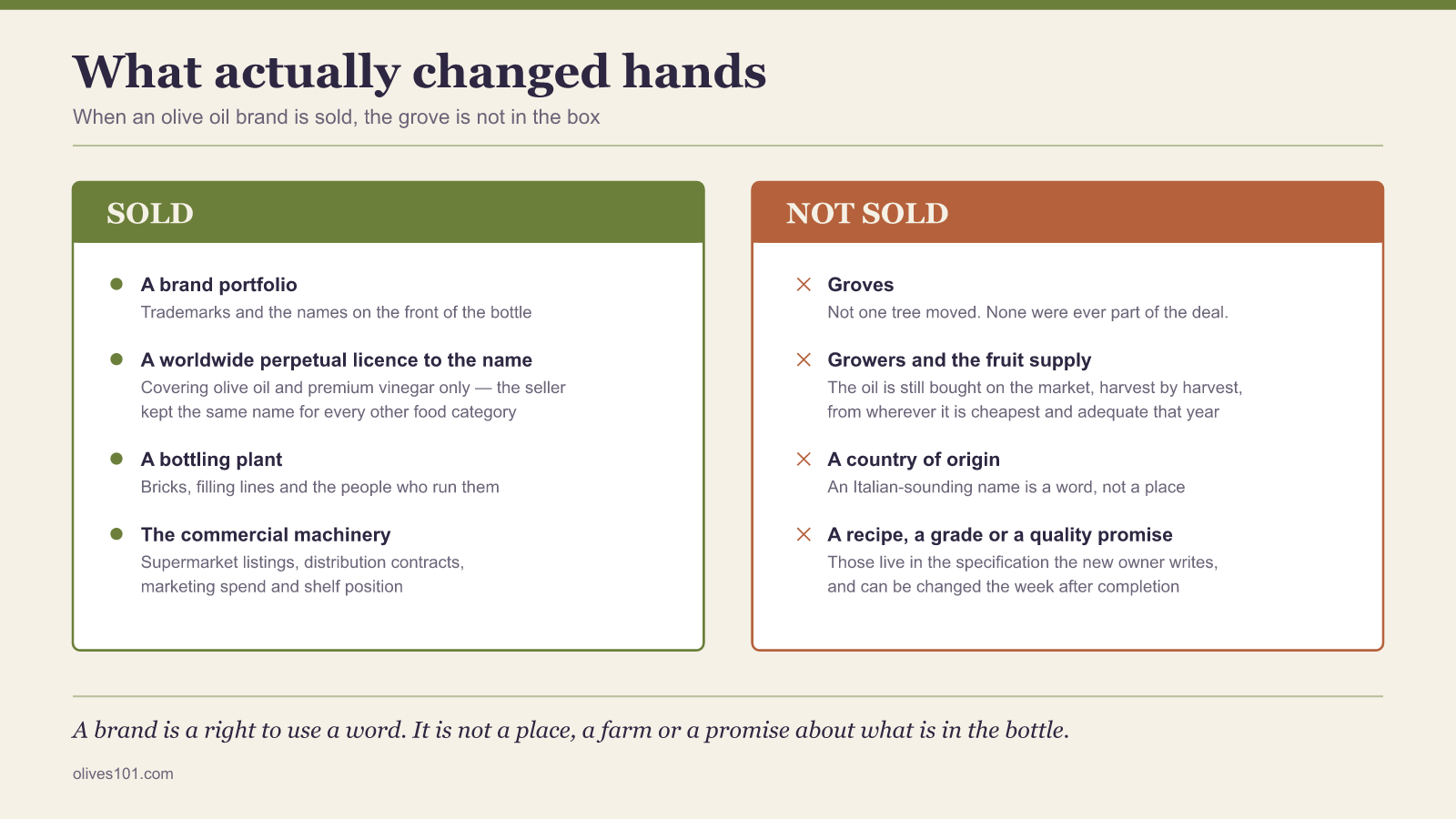
Not groves. That is the first thing to understand about deals like this, and it is the thing most consumers get wrong. What changed hands was a brand portfolio, a bottling plant and the commercial machinery that goes with them — listings, distribution contracts, marketing. The arrangement for the Bertolli name itself was structured as a worldwide perpetual licence covering olive oil and premium vinegar, which meant the seller kept the name for other food categories. That is why you can find the same brand on a bottle of oil and on a completely different product with a completely different owner behind it.
A brand, in other words, is a right to use a word. It is not a place, a farm or a recipe. It can be sold, split by category, licensed by territory and moved between continents without a single tree changing hands.
Why an Italian name is often not an Italian company
The olive oil aisle is one of the most consolidated shelves in the supermarket. A handful of groups own most of the famous names, and the names were chosen long ago because they sounded like where the oil came from. That was true when they were founded. It stopped being a reliable signal decades before most shoppers noticed.
This is not, in itself, a scandal — and I want to be careful here, because there is a whole genre of writing that treats every corporate olive oil as a fraud. Large bottlers can and do sell decent oil, and their laboratories are often better equipped than a small mill’s. But a group headquartered in Spain, bottling in Italy, buying fruit and bulk oil from wherever the harvest was good that year, is running a supply operation, not a farm. The label reflects the company’s address and the bottling line. The oil inside reflects the market.
So what should you actually read?
The useful information on a bottle is rarely the biggest text. Grade first: extra virgin, virgin, refined-and-blended, or pomace. Then harvest date, if the bottler is confident enough to print one — that single number tells you more about how the oil will taste than any provenance claim. Then the origin statement, which is legally defined and often reveals a blend of several countries in small type on the back. Then, if it is there, the mill or estate name, which is the only element that points at an actual place with people in it.
| What is on the label | What it actually tells you | What it does not tell you |
|---|---|---|
| Brand name | Who owns a trademark today | Where the fruit grew, or who milled it |
| Italian or Spanish styling | The market the brand was built for | The nationality of the oil or the company |
| Bottled in [country] | Where the bottling line stands | Where the olives were grown or pressed |
| Grade (extra virgin, etc.) | A real legal and chemical standard | Freshness, quality within the grade, or style |
| Harvest date | How old the oil is — the most useful line on the bottle | Anything about origin |
| Mill or estate name | An identifiable place and producer | Nothing further, but this is the strongest signal there is |
Practical takeaways
- Judge the oil, not the ownership. A change of parent company is a business event, not a quality event.
- Re-taste your usual brand each year. Blends are reformulated quietly when a harvest is short — that is the change worth noticing.
- Prefer a harvest date to a flag. Age degrades oil far faster than a distant head office does.
- Read the small print on origin. A blend of EU and non-EU oils is legal and common, and it will be stated in tiny letters.
- If you want a place, buy a mill. Named estate or co-operative bottlings are the only way to know whose trees you are drinking.
Olive oil brand ownership: common questions
Who bought Bertolli olive oil from Unilever?
Spain’s Grupo SOS, in a deal agreed in July 2008 and reported at around 630 million euros. The group is known today as Deoleo, which also owns names including Carapelli and Carbonell.
Does an Italian brand mean Italian oil?
No. A brand name is a trademark, not a provenance claim. Origin is governed by the origin statement on the label, which may name several countries.
Did the oil change when the brand was sold?
Not because of the sale itself. Recipes and blends do change over time, usually in response to harvests and costs, and those changes are rarely announced.
Is it bad that big groups own the famous brands?
Not inherently. Large bottlers have serious laboratories and consistent standards. It simply means the brand is a commercial entity rather than a farm, so look elsewhere on the label for the facts.
What is the single most useful thing on an olive oil label?
The harvest date, where it is given. Freshness affects flavour more than almost anything else, and a bottler willing to print the date is telling you something about their confidence.
I sat through more than one of these ownership stories and I can tell you what the shelf looked like afterwards: exactly the same. Same bottle, same label, same shopper reaching for it out of habit. What actually moves in a deal like this is procurement — who buys the bulk, from which origins, at what price target. That is where an oil quietly becomes rounder or harsher over a couple of seasons, and no press release will ever tell you it happened. So do not track the corporate news. Track your own palate. If a brand you have bought for ten years tastes flatter this year, trust that, not the label.
Drawn from Unilever’s 2008 announcement of the sale of its Bertolli olive oil business to Grupo SOS, subsequent reporting on the group’s brand portfolio, and EU olive oil labelling rules.