India: Fresh stocks of imported olive oil yet to arrive
When an importing country slashes duty on olive oil, shoppers expect the shelf to follow within days. It never does. Understanding why takes you through every stage between a Mediterranean mill and a hot city warehouse — and explains why imported oil so often disappoints.
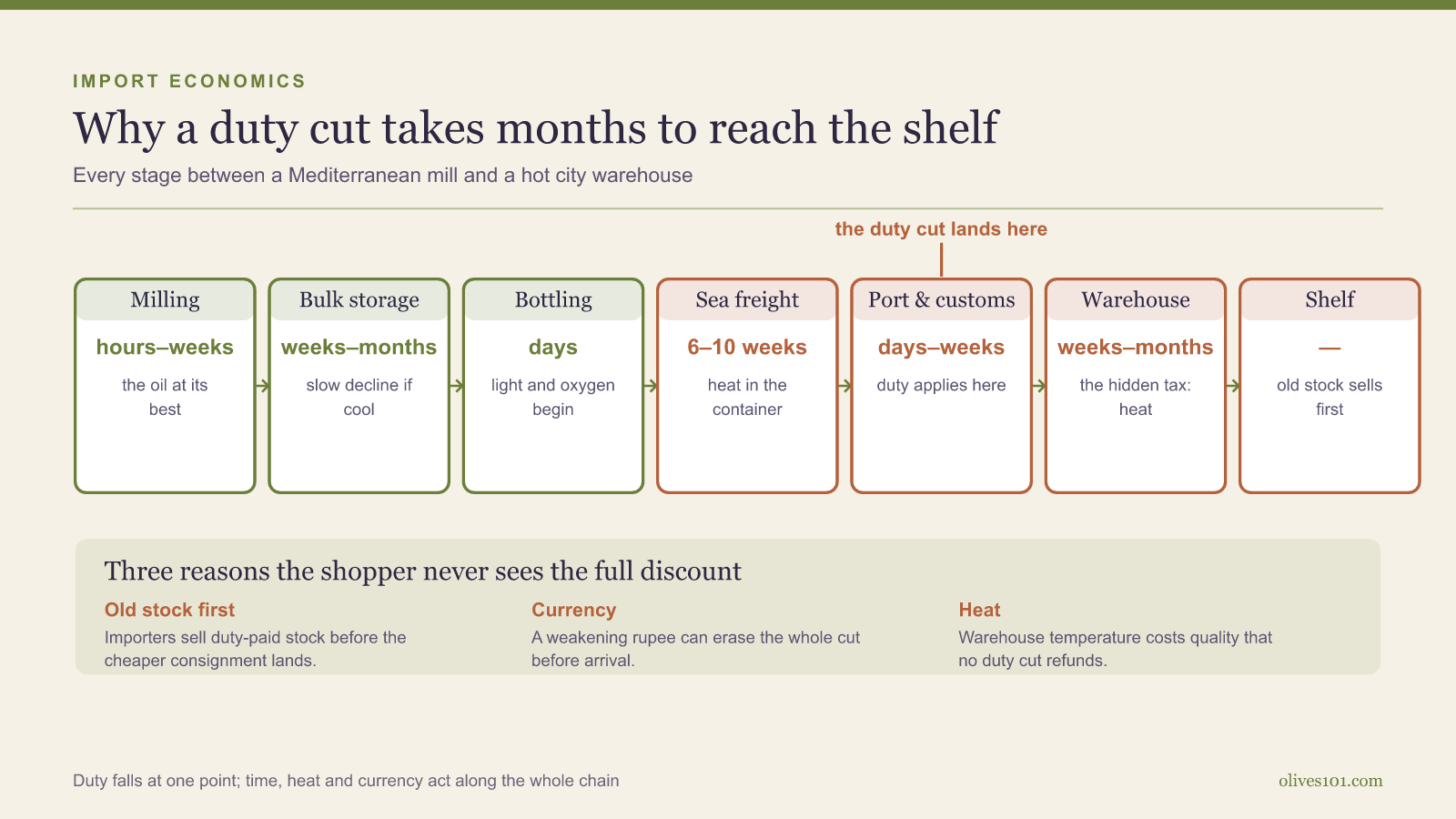
It is one of the most reliable disappointments in the grocery trade. A finance ministry reduces the import duty on olive oil — sometimes dramatically, from tens of per cent down to single figures — the newspapers announce cheaper olive oil, and then nothing happens. Weeks pass. The price on the shelf sits exactly where it was.
Consumers conclude they are being fleeced. Usually they are not. What they are watching is the difference between the price of the next consignment and the price of the oil that is already in the country, and that difference takes an entire supply chain to work through. Here is what stands between the mill and the shelf.
| Stage | Typical time | What it adds to the price | What it does to the oil |
|---|---|---|---|
| Milling and settling | Hours to a few weeks | The producer’s cost | Nothing — this is the oil at its best |
| Bulk storage at origin | Weeks to months | Storage and finance | Slow decline if tanks are cool and inert-gassed |
| Bottling or bulk export | Days | Packaging, the largest single non-oil cost | Light and oxygen exposure begins |
| Sea freight | Roughly 3–6 weeks | Freight and insurance | Container heat — the main enemy |
| Customs and duty | Days to weeks | Duty, clearance, port charges | Standing on hot concrete |
| Importer and distributor | Weeks | Margin, financing, local transport | Warehouse temperature, often uncontrolled |
| Retail shelf | Weeks to months | Retail margin | Light, warmth, and time |
Why the discount takes months to arrive
Two things happen at once. First, the oil already in the country was bought and cleared at the old duty rate, and no distributor writes down perfectly good inventory because the rules changed yesterday. That stock sells through at the old cost, and only then does cheaper oil reach the shelf. In practice, that is a lag of one to three months.
Second — and this is the part that genuinely surprises people — the exchange rate can eat the whole benefit before it arrives. Olive oil is bought in euros. If the euro appreciates sharply against the importing country’s currency in the same months that duty falls, the two effects cancel. A twenty or thirty per cent duty cut can vanish entirely into a fifteen per cent currency move, and the importer, who did nothing wrong, is left explaining to the press why the promised price fall never came.
Heat is the hidden tax
This is the part nobody legislates for, and it matters more to what is in your glass than duty ever will. Olive oil degrades with heat, light, oxygen and time. It is not the pressing that kills a good oil; it is the journey.
A shipping container crossing the tropics can sit for weeks at temperatures far above anything the oil ever saw in a cellar. It then stands at a port, moves to a warehouse that may be a tin shed, and finally arrives in a shop where it is displayed in clear glass under bright lights. By the time it is bought, an oil milled the previous autumn may be a year old, and the aromatic compounds and phenols that justified the price have quietly left.
This is why oil in a hot importing market so often tastes flat and faintly waxy compared with the same brand tasted in Europe. Nobody adulterated it. It just cooked slowly on the way. If you buy imported olive oil in a hot country, the practical defences are simple: buy tins or dark glass, buy small, buy from shops with fast turnover, and treat any bottle sitting in a sunlit window as decoration rather than food.
Or grow your own
Importing countries eventually ask the obvious question, and India was among the more determined to answer it. A joint venture set up in 2007 between the Rajasthan state marketing board, an Indian irrigation company and an Israeli olive specialist planted trial groves in the desert state — something over a hundred thousand saplings of Mediterranean cultivars including Barnea, Arbequina, Koroneiki, Picual, Frantoio and Picholine, across a couple of hundred hectares. The first fruit came in 2012 and the first commercial Indian olive oil the following year.
It worked, in the sense that olives grew and oil was made. It has not displaced imports, and it was never going to: Rajasthan’s output is a rounding error beside a national market measured in thousands of tonnes. But it is a genuinely interesting piece of agronomy — desert cultivation under drip irrigation, in a country with no olive tradition at all — and it is a reminder that the olive is far less fussy about geography than romance suggests. What it is fussy about is water, winter chill, and what happens to the oil after it leaves the mill.
Buying imported olive oil well
- Buy tins or dark glass. In a hot climate this matters more than the brand.
- Buy small and often. A large tin is only a bargain if you finish it quickly.
- Look for a harvest date, and do the arithmetic on how long it has been travelling.
- Prefer fast-moving shops. Turnover protects oil better than any packaging.
- Never buy from a sunlit shelf, whatever the discount.
- Store it away from the stove — the cupboard above the hob is the worst place in the kitchen.
Imported olive oil: common questions
Why does a duty cut take months to reach the shelf?
Because stock already in the country was bought and cleared at the old rate and sells through first. Only the next consignment carries the lower duty, and it still has to be ordered, shipped, cleared and distributed — typically one to three months.
Can currency movements cancel out a duty cut?
Yes, completely. Olive oil is bought in euros, so if the euro strengthens sharply against the importing currency at the same time, the two effects offset each other and the shelf price does not move.
Does shipping damage olive oil?
Heat does. Containers crossing warm latitudes can spend weeks at temperatures well above cellar conditions, and the oil ages faster as a result. The oil is still safe and legal — it has simply lost aroma and phenols.
Is olive oil grown in India?
Yes, on a small scale. Trial plantings in Rajasthan from 2007 produced first fruit in 2012 and commercial oil from 2013, using Mediterranean cultivars under drip irrigation. The volumes are tiny next to imports.
How should I store olive oil in a hot climate?
Cool, dark, sealed and finished quickly. Buy tins or dark glass in small sizes, keep them away from the stove and any window, and treat the oil as a fresh product rather than a pantry staple.
In an importing market, the enemy is never the duty rate — it is the calendar and the thermometer. I have opened bottles in hot cities that were chemically flawless and sensorially dead : fifteen months old, three of them in a steel box on the equator, then six on a bright shelf. Nobody cheated anybody. If you buy imported oil in a warm climate, forget the brand argument and buy on three things : a printed harvest date, opaque packaging, and a shop whose stock visibly moves. That will improve what is in your kitchen far more than any budget announcement.
Supply-chain stages from standard import practice; the Rajasthan trial details from published accounts of the state olive cultivation venture.