IOC Turns 50 and Adds an Alkyl Ester Limit for Extra Virgin
The International Olive Council marked its 50th anniversary in Madrid this week with a ceremony presided over by King Juan Carlos I, and its members came away from their 97th session with a revised trade standard that adds a new test for extra virgin olive oil: a ceiling on alkyl esters. This note covers what was decided, what the new limit actually measures, and why it matters far more to buyers than the anniversary speeches.
What happened
The IOC’s Council of Members met at the organization’s Madrid headquarters from November 16 to 20. On the morning of November 19 the King of Spain presided over the ceremony commemorating the council’s fiftieth year, and visiting ministers made a day of it. Albania’s agriculture minister, Genc Ruli, whose country joined the international olive agreement earlier this year, toured the headquarters afterward and planted an olive tree brought from Albania in front of the building. Iran’s agriculture minister, Sadegh Khalilian, also met the executive director, Mohammed Ouhmad Sbitri. The day before, the IOC held an international seminar on olive growing and the environment to mark the anniversary.
The working business of the week was less ceremonial. Along with the usual review of world production and prices, the council’s standards work produced a new revision of its trade standard for olive oils and olive-pomace oils, issued as COI/T.15/NC No 3/Rev. 4 and dated November 2009.
The new limit, in plain terms
The revision adds a quality criterion for extra virgin olive oil based on alkyl esters, the combined total of fatty acid methyl esters (FAMEs) and fatty acid ethyl esters (FAEEs). They are measured by capillary gas chromatography under the IOC method COI/T.20/Doc. No 28, the same analysis that measures waxes.
| Result for FAMEs plus FAEEs | Can it be extra virgin? |
|---|---|
| Below 75 mg/kg | Yes, on this criterion |
| Between 75 and 150 mg/kg | Only if the ratio of ethyl to methyl esters is below 1.5 |
| Above 150 mg/kg | No |
Why these compounds? Alkyl esters form when olives start to ferment or break down before milling: fruit that is damaged, overripe, left in piles for days or gathered off the ground. The alcohols produced by that fermentation combine with free fatty acids, and the esters stay in the oil. The ethyl esters in particular point to fermentation, which is why the ratio matters in the middle band.
Why it matters
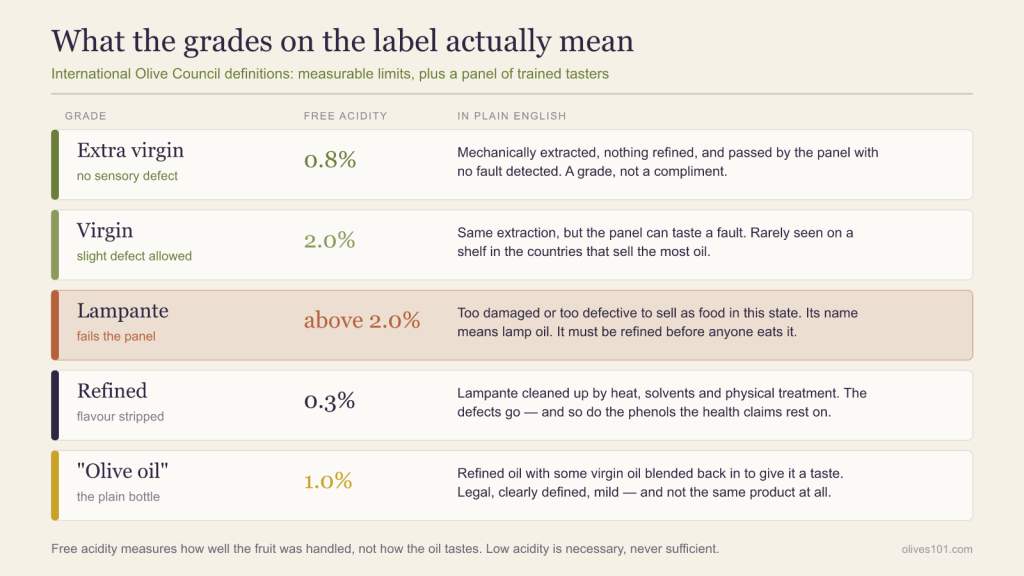
The trade’s quiet problem for years has not been seed oil in the bottle. It has been oil made from poor fruit, lightly deodorized at low temperature to strip the bad smells, then blended with a fruity oil and sold as extra virgin. Such oil can have a low acidity and pass most of the classic chemical checks, which is why acidity alone tells you less than the label suggests. Gentle deodorizing removes odors, but it does not remove alkyl esters. For the first time, the international standard has a number aimed squarely at that practice, which we described in our look at how olive oil adulteration really works.
- Mills that let fruit wait in the yard will see more lots fail.
- Oil from ground-picked or fermented fruit gets harder to pass off as extra virgin.
- Laboratories testing for importers and retailers will need to add the method.
What comes next
The IOC standard governs trade between its member countries and serves as the reference many governments copy, but it is not a law in any shop by itself. The European Union writes its own marketing rules, and those, along with national rules in importing countries, would have to take up the same criterion before an inspector can act on it. Expect argument over where exactly the line sits, since producers who pick late and mill slowly have the most to lose.
For shoppers nothing changes overnight. For honest producers, though, it is a genuinely useful tool, and a better anniversary present than any speech.
Buyers in the bulk trade have long talked, off the record, about “soft” oils that pass the lab and still taste flat and tired. The tell was always the price: a so-called extra virgin offered well below what good fruit costs to mill. An alkyl ester result on a lab sheet now gives a buyer a number to reject it with, instead of a hunch.
Sources
- International Olive Council, press release on the 97th session of the Council of Members, Madrid, November 16 to 20, 2009 (archived)
- International Olive Council, Albanian agriculture minister visits IOC headquarters after the 50th anniversary ceremony (archived)
- International Olive Council, Trade Standard COI/T.15/NC No 3/Rev. 4, November 2009 (archived PDF)