Olive oil, your health, your kitchen
There was a period when olive oil was viewed with suspicion for the crime of being a fat. Nothing about the oil changed. What changed was the science, and the composition of the bottle turns out to be far more interesting than either the panic or the hype.
It is genuinely difficult now to remember how odd the position was. For a stretch of the late twentieth century, dietary advice ran on a simple rule — fat is bad, less fat is better — and olive oil, being almost entirely fat, was lumped in with everything else in the category. People who had cooked with it for four thousand years were advised to cut down. Then the picture became more granular, the distinction between kinds of fat came into focus, and olive oil went from suspect to icon almost overnight.
What is actually in the bottle
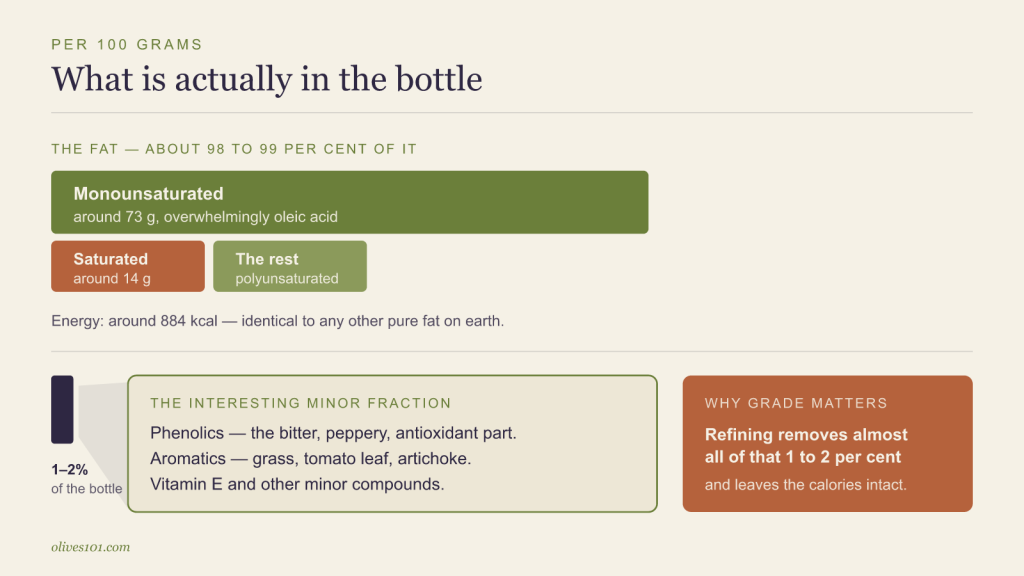
Olive oil is roughly ninety-eight to ninety-nine per cent triglycerides — fat, plain and simple, at about nine calories a gram like every other fat on earth. The composition of that fat is what distinguishes it: predominantly oleic acid, a monounsaturated fatty acid, typically making up something like three-quarters of the total, with a modest saturated fraction and a small polyunsaturated one.
The remaining one to two per cent is where all the interest lies. That sliver contains vitamin E and vitamin K, squalene, plant sterols, chlorophyll and carotenoid pigments, and the phenolic compounds — oleuropein derivatives, hydroxytyrosol, tyrosol, oleocanthal. The phenolics are what make a good extra virgin taste bitter and peppery and what give it its oxidative stability. Refining removes essentially all of them, which is precisely why refined olive oil is bland, pale and long-lasting, and why extra virgin is none of those things.
| Energy | Around 884 kcal per 100 g — identical to any other pure fat |
|---|---|
| Total fat | Effectively 100 g per 100 g |
| Monounsaturated | Around 73 g per 100 g, overwhelmingly oleic acid |
| Saturated | Around 14 g per 100 g |
| Polyunsaturated | Around 11 g per 100 g, mostly linoleic acid |
| Vitamin E | A useful amount ; a tablespoon supplies a meaningful share of daily needs |
| Phenolic compounds | Highly variable in extra virgin, from modest to several hundred mg/kg ; near zero after refining |
| Cholesterol | None. It is a plant product |
How the reversal happened
The shift came from separating fats rather than counting them. Once research distinguished saturated from monounsaturated from polyunsaturated, and later separated out industrially produced trans fats, the blanket advice stopped making sense. Replacing saturated fat with unsaturated fat improved blood lipid profiles. Trans fats, meanwhile, turned out to be genuinely harmful and were progressively restricted in many countries.
Olive oil benefited enormously from this reframing, and deservedly. But note the shape of the finding: it is about replacement. The evidence supports olive oil in place of butter, lard and hardened vegetable fats. It does not support olive oil as an addition to an unchanged diet, and it does not make olive oil a low-calorie food. A generous glug is still a couple of hundred calories, whatever the label says about the Mediterranean. This is general information, not medical advice.
Where health and kitchen actually meet
Here is the practical consequence that the health coverage almost always misses. If the interesting fraction of olive oil is that one or two per cent — the phenolics and aromatics — then everything that destroys that fraction matters, and everything that preserves it matters. Which turns the health question into a storage and freshness question.
Light degrades it. Heat degrades it. Oxygen degrades it. Time degrades it. An extra virgin oil bought in clear glass, stored on a sunny counter next to the hob, and used slowly over a year has quietly become, in all the ways that count, a refined oil that cost four times as much. The grade on the label was assessed at bottling and does not update itself.
So the kitchen advice and the health advice are the same advice: buy a size you will finish, buy dark glass or a tin, keep it in a cupboard, use a cheaper oil for the hot pan and the good one raw on the plate. That does more for the nutritional content of what you eat than any amount of reading about polyphenols. And if you want to understand what the grade on the front really guarantees, read extra virgin that is not.
Sensible takeaways
- It is a fat, not a supplement. Nine calories a gram, and the benefit lies in what it replaces.
- The valuable minor fraction is fragile. Light, heat, oxygen and time are its enemies.
- Extra virgin and refined are chemically different products, not just different price points.
- Freshness is a nutritional variable, not just a flavour one.
- Cook with the everyday bottle, finish with the good one, and you get both economy and benefit.
Olive oil composition and health: common questions
Why was olive oil once considered unhealthy?
Because dietary advice at the time treated all fat as a single category to be minimised. Once research distinguished between saturated, monounsaturated, polyunsaturated and trans fats, that blanket position no longer held.
What is olive oil actually made of?
Around ninety-eight to ninety-nine per cent triglycerides, mostly oleic acid. The remaining one to two per cent contains vitamin E, vitamin K, squalene, sterols, pigments and the phenolic compounds that give extra virgin its character.
Is extra virgin nutritionally different from refined olive oil?
The fat itself is broadly similar. The difference is the minor fraction: refining removes essentially all the phenolic compounds and most of the vitamin E and pigments.
Does olive oil contain cholesterol?
No. Cholesterol is found in animal products. Olive oil is a plant product and contains none, though it does contain plant sterols.
Is olive oil low in calories?
No. Like every pure fat it supplies around nine calories a gram, roughly 884 kcal per 100 g. Its advantages come from replacing less favourable fats, not from being light.
The thing I would tell anyone worrying about the health of their olive oil is to stop reading and go and smell the bottle they already own. If it smells of nothing, or of old walnuts and crayons, then every clever molecule the articles are excited about left months ago and you are pouring a mildly expensive cooking fat on your salad. Nutrition here is inseparable from freshness — and freshness is the one variable entirely within your control. Small bottle. Dark glass. Cupboard. Finish it.
Drawn from standard published composition data for olive oil, International Olive Council grade definitions, and the literature distinguishing dietary fatty acid classes.