Italian police arrest 39 over fake olive oil export
The dramatic fraud — coloured seed oil in bottles marked extra virgin — makes headlines and is comparatively easy to catch. The quiet fraud is legal-looking, far more common, and sitting on your supermarket shelf right now.
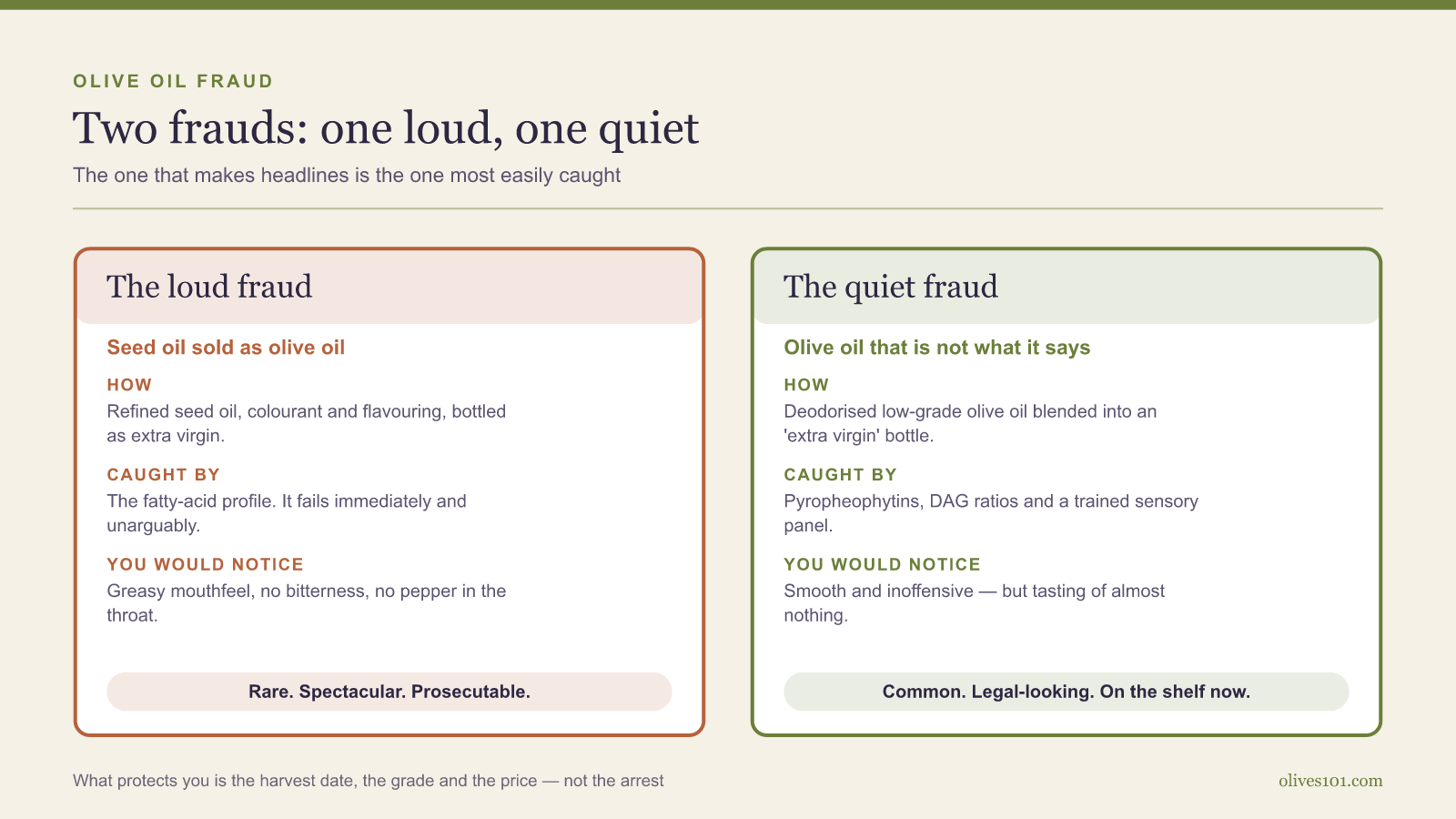
Every few years there is a raid: warehouses sealed, tankers impounded, dozens of arrests, and a quantity of counterfeit extra virgin measured in tens of thousands of litres, bound for export. The recipe in these cases is almost always the same — cheap seed oil, a green or yellow colourant, some flavouring, and a printer.
It is worth knowing how that works. But it is more worth knowing that this is the rare fraud, and the one most likely to be caught. The fraud you will actually encounter is duller, harder to prosecute, and produces a bottle that is legally a food and honestly a disappointment.
The loud fraud: oil that is not olive oil
Take a cheap refined seed oil — sunflower, soya, rapeseed — tint it green with chlorophyll or yellow with beta-carotene, add a trace of low-grade olive oil or flavouring for aroma, bottle it, and label it extra virgin. The margin is enormous and the counterfeiting is trivial.
It is also, technically, easy to detect. Every fat has a characteristic fatty-acid fingerprint, and seed oils differ from olive oil in ways no dye can hide. Laboratories also profile sterols, waxes and fatty-acid ethyl esters. A crude adulteration fails on the first test. This is precisely why these cases end in mass arrests: the criminals were counting on nobody testing, and the moment someone did — usually after a suspicious restaurateur or retailer complained — the whole thing collapsed.
The quiet fraud: olive oil that is not what it says
Now the common version. Start with real olive oil, but of a low grade — lampante, unfit for consumption as it stands. Refine it: strip the defects out with heat, and deodorise. What you get is bland, odourless, and perfectly edible, but it is not virgin anything. Blend in a little genuine extra virgin for colour and a hint of aroma, and you have a product that will pass a casual palate and, if the blending is skilful, may even scrape through some chemical thresholds.
This is what people in the trade mean when they say oil has been cut. It is much harder to prove than dyed sunflower oil, because everything in the bottle really is olive oil. Detection leans on subtler markers — pyropheophytins, which increase when oil is heated or aged, and diacylglycerol ratios, which shift with refining and time — and on a trained sensory panel, because European law makes a taste test part of the legal definition of extra virgin. A panel that finds any defect at all disqualifies the oil, whatever the chemistry says.
Alongside it sits the third and most legal-looking fraud: misdescribed origin. The oil is genuine extra virgin, but the olives came from somewhere cheaper than the flag on the front implies. That is a labelling offence rather than an adulteration, and it is why the origin statement on the back is worth more than any picture of a Tuscan hillside. See what ‘bottled in Italy’ really means.
| Fraud | How it is done | How it is caught | What a shopper might notice |
|---|---|---|---|
| Seed oil sold as olive oil | Refined seed oil, colourant, flavouring, false label | Fatty-acid profile — fails immediately | Greasy mouthfeel, no bitterness, no pepper, no aroma |
| Refined oil sold as extra virgin | Deodorised low-grade olive oil blended with a little good oil | Pyropheophytins, DAG ratios, sensory panel | Smooth and inoffensive, but nothing at the back of the throat |
| Old oil sold as new | Simply not stating the harvest date | Panel finds rancidity; peroxide value | Crayon, putty or stale-nut smell |
| Misdescribed origin | Cheaper foreign oil under a prestige flag | Paper trails, isotope and trace-element analysis | Nothing — this is why the back label matters |
| Pomace oil sold as olive oil | Solvent-extracted residue oil in the wrong bottle | Wax and sterol content | Very cheap price, no flavour at all |
What actually protects you
Not the brand. Not the country on the front. Four things, in order of usefulness.
Price. Real extra virgin has a floor cost — the fruit, the picking, the milling, the packaging. Roughly five to ten kilos of olives make a litre of oil. An extra virgin priced near the cheapest oil in the shop is telling you something, and it is not that you found a bargain.
A harvest date. Voluntary, and therefore meaningful.
Your own mouth. Good extra virgin is bitter and peppery. That catch at the back of the throat is oleocanthal, a real phenolic compound, and it cannot be faked cheaply. A completely smooth, buttery, characterless oil is either very old or very refined.
The back label. Grade, origin, and any protected designation. A PDO or PGI means a documented supply chain, which is the single strongest structural defence a shopper has.
A shopper’s checklist
- Distrust the bargain. Genuine extra virgin cannot be the cheapest oil on the shelf.
- Taste for bitterness and pepper. Their absence is the most reliable warning sign there is.
- Smell for staleness. Crayon, putty and old walnut mean rancid, whatever the label claims.
- Read the origin sentence on the back, not the imagery on the front.
- Prefer PDO, PGI or a named estate when you can — documentation is protection.
- Buy dark glass or tin, in a size you will finish. Most bad oil in kitchens was fine when it was bought.
Olive oil fraud: common questions
How common is fake olive oil?
Outright counterfeits — seed oil dyed and labelled as olive oil — are rare and usually caught, because the chemistry gives them away instantly. Misgrading and misdescribed origin are far more common, because everything in the bottle really is olive oil.
How do laboratories detect adulteration?
By fingerprinting the fat: fatty-acid composition, sterols, waxes and ethyl esters catch foreign oils. Markers such as pyropheophytins and diacylglycerol ratios reveal heating, refining and age. A trained sensory panel then has to confirm there are no defects.
Can I tell fake olive oil at home?
Not reliably, but you can spot poor oil. Real extra virgin smells fresh and green or fruity, tastes bitter, and gives a peppery catch in the throat. Smooth, odourless, entirely inoffensive oil is a warning sign — and the fridge test is a myth, since genuine oils cloud at different temperatures.
Is cheap olive oil always suspect?
Price is a signal, not proof. It takes roughly five to ten kilos of olives to make a litre of oil, before picking, milling, bottling and shipping. An extra virgin priced like a bulk seed oil has had a corner cut somewhere.
Does a PDO or PGI label help?
Yes, more than most things. Protected designations require a documented, auditable chain from a defined area, which makes substitution far harder — and gives an investigator something to follow when it happens anyway.
The raids make the news and the raids are the easy part. What I would like people to understand is that the bottle most likely to disappoint you was never criminal at all : it is legally extra virgin, it was fine at the mill, and it died slowly in a warm warehouse and a bright supermarket over fourteen months. Fraud costs the industry its reputation ; time and heat cost you your dinner. So yes, read the back label and distrust the bargain — but the habit that will improve your oil most is buying small, dated bottles and finishing them.
Detection methods from published olive oil authenticity and analytical chemistry literature; grade and panel requirements from EU olive oil marketing standards.