Ranzo Italy: Olive Oil Festival
A steep coastal strip with almost no flat ground, terraced by hand centuries ago, producing a small sweet olive that gives one of Italy’s gentlest oils. Liguria’s olive economy makes no commercial sense, and that is rather the point.
Every spring the villages of the Ligurian hinterland hold their olive oil festivals. They are not tourist inventions. In a valley where every household has a few hundred trees on terraces their great-grandparents built, the new oil is the year’s most important product and the festival is where it is judged, argued over and sold. Understanding why Liguria bothers — on land that would be abandoned anywhere else — tells you a great deal about how the olive really works.
The least convenient olive region in Italy
Liguria is a narrow arc of coast with mountains pressed hard against the sea. There is essentially no flat farmland. What there is instead are fasce: dry-stone terraces cut into steep slopes, generations of them, holding a few metres of soil apiece. Trees are planted where the terrace allows, not where a machine would like them. Nets are spread by hand on ground that slopes away beneath you, and the fruit is carried out in crates.
Nothing about this can be mechanised in any meaningful way. No straddle harvester will ever drive a Ligurian terrace. Yields per hectare are modest, labour per litre is enormous, and the cost of production is among the highest in Italy. Every economic force of the last century has pushed against this landscape, and a good deal of it has indeed been abandoned to scrub. What survives, survives because the oil is worth it and because people are stubborn.
The Taggiasca itself
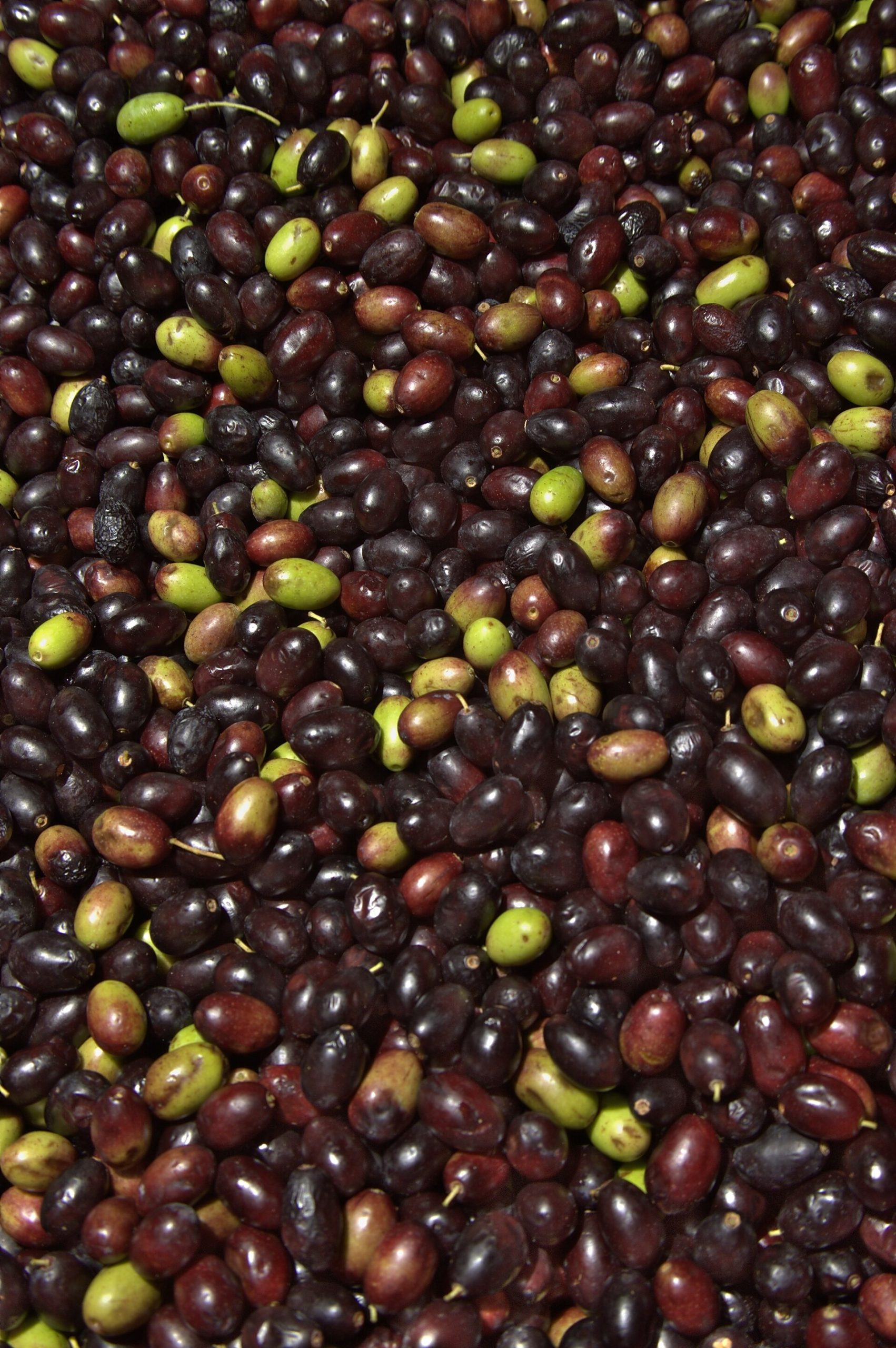
The olive that made the region is small, oval and dark purple-black when ripe, with comparatively little flesh around the stone. That sounds like a drawback and is not: the fruit carries a very high proportion of oil, commonly cited around a quarter of its weight, which is what makes such a fiddly harvest viable at all. It is genuinely dual-purpose — one of the few great oil olives that is also a first-rate table olive.
The oil is the mild end of the Italian spectrum: yellow to yellow-green, delicate, sweetly fruity, with gentle bitterness and only a whisper of pepper, and notably high in oleic acid. Set beside a Tuscan Frantoio or a Pugliese Coratina it can seem almost shy. That is not a failing, it is a cuisine: Ligurian cooking is built on fish, herbs, vegetables and pesto, none of which survives a ferocious oil. The protected designation Riviera Ligure covers the region’s oils, with the Imperia sub-zone requiring a large majority of Taggiasca fruit.
| Liguria (Taggiasca) | Tuscany (Frantoio blends) | Puglia (Coratina) | |
|---|---|---|---|
| Intensity | Delicate to light-medium | Medium, grassy and balanced | Intense, robust |
| Bitterness | Low and soft | Clear, clean | Strong, long |
| Pepper | A whisper | Definite | Throat-catching |
| Classic flavours | Ripe fruit, almond, faint sweetness | Cut grass, artichoke, green tomato | Green almond, grass, bitter herb |
| Kitchen | Fish, pesto, vegetables, delicate sauces | Bruschetta, soups, grilled meat, salads | Bean dishes, brassicas, strong meat |
| Terrain | Hand-worked stone terraces | Hills, partly mechanisable | Plains and plateaux, highly mechanised |
The jar that says taggiasche
Now the part the festival will not tell you. Taggiasca is a famous name attached to a small, expensive, low-volume crop, which makes it exactly the sort of product that attracts substitution. Small black olives from cheaper origins are widely sold in a style that echoes the Ligurian original, and shoppers reasonably assume that a jar described in Taggiasca terms contains Ligurian Taggiasca fruit. Often it does. Sometimes what you are buying is a look-alike from elsewhere, packed in the same herbs and the same oil.
This is not unique to Liguria — the olive trade is full of famous names doing duty for cheaper fruit, and anyone who has looked closely at the black olives sold across France as Greek-style will recognise the pattern. The defence is the same everywhere: read the origin statement rather than the product name, be suspicious of a price that seems impossible for hand-picked terrace fruit, and buy the protected designation when you want certainty. For the wider version of this problem, see what bottled in Italy actually means.
Buying and using Ligurian oil
- Do not judge it against a Tuscan oil. Delicacy is the intended character here, not a shortfall of quality.
- Use it where a strong oil would bully the plate — white fish, shellfish, steamed vegetables, fresh cheese, and above all pesto.
- Buy the protected designation if you want a guarantee of origin and cultivar composition.
- Read the origin line on table olives, not the poetic product name. Terrace-picked fruit cannot be cheap.
- Drink it young. A delicate, lower-polyphenol oil has less natural protection against oxidation, so freshness matters even more than usual.
- If you visit in winter, go inland. The mills run from November and the new oil is at its best straight off the decanter.
Ligurian olive oil: common questions
What is a Taggiasca olive?
A small, oval, dark-purple olive from western Liguria, especially the province of Imperia. It has little flesh but a high oil content and is dual-purpose — prized both as a table olive and for a delicate, sweetly fruity oil.
What does Ligurian olive oil taste like?
Mild and elegant: yellow to yellow-green, sweetly fruity with notes of ripe fruit and almond, low bitterness and only light pepperiness. It is one of the gentlest of the classic Italian styles.
What is the Riviera Ligure protected designation?
The protected origin covering Ligurian olive oil, with sub-zones across the region. In the Imperia area the designation requires oils to be made overwhelmingly from Taggiasca fruit.
Why is Ligurian olive oil so expensive?
Because it is grown on hand-built stone terraces on steep slopes where no machinery can work. Harvest is manual, yields per hectare are modest, and labour per litre is among the highest in Italy.
Are all olives sold as taggiasche really from Liguria?
Not necessarily. The name is famous and the genuine crop is small and costly, so similar-looking small black olives from other origins are widely sold in the same style. Check the stated origin and treat an impossibly low price as a warning.
Two things about Liguria that the sagra will not put on the poster. First, the economics are brutal: this is some of the most expensive olive oil in Italy to produce, and every abandoned terrace you see on those hillsides is a family that did the arithmetic and stopped. Second, and more useful to you at the shop: the word Taggiasca has become a marketing asset detached from the place. Small black olives are small black olives to look at, and the name travels far more easily than the fruit does. Buy the designation, or buy from someone who can name the valley.
Drawn from Ligurian growing practice and terrace agriculture, the characteristics of the Taggiasca cultivar and the Riviera Ligure designation of origin.