Chile’s Olive Oil Exports More Than Triple
Chile exported 1,522 tons of olive oil in the first five months of this year, a rise of 221 percent on the same period of 2010, worth about 6.1 million dollars. The figures come from ODEPA, the agriculture ministry’s office of studies and policy, and they confirm that a country with no olive oil tradition to speak of is now a real exporter. Here is what is behind the jump, and what it says about where the oil is going.
The numbers
Value rose more slowly than volume, up 131 percent, which is the first thing a trader notices. Chile is selling a lot more oil but at a lower average price, and the reason is in the mix: bulk orders make up the majority of what goes to the United States, and the United States takes roughly 40 percent of the total, a share that has grown by about 8 points since 2006. Spain, Brazil and Venezuela are the other significant destinations. Selling oil into Spain, the largest producer on earth, is a small curiosity worth pausing on. It tells you that Chilean oil is priced to compete as a blending and filling oil, not only as a bottled specialty.
| Measure | January to May 2011 |
|---|---|
| Volume exported | 1,522 tons, up 221 percent |
| Value | About 6.1 million dollars, up 131 percent |
| Largest market | United States, about 40 percent, mostly bulk |
How a young industry got here
Chile has grown olives since the middle of the last century, but the money arrived in the late 1990s, when growers planted modern varieties in high density and built mills to match. In 2004 the country had about 3,700 hectares and twenty mills turning out some 1,500 tons of extra virgin. Today there are more than 20,000 hectares with the capacity for roughly 8,500 tons, and the trade expects over 35,000 hectares by 2014.
The marketing has been organized rather than left to chance. ChileOliva, the association of 47 producers, won a Corfo branding competition last October worth about 1.9 million dollars, and put the money into a campaign in the United States, its biggest market. Its general manager, Iris Carmona, has been open about the model: do for olive oil what Chile did for wine, build the country name first and let the brands follow. ODEPA’s director, Gustavo Rojas, credits the steady work of the producer group for this year’s jump.
Medals have helped. Chilean oils have been picking up prizes at Terraolivo, Oil China, Sol de Oro, Armonia and the Los Angeles competition, and in a market where nobody knows the names yet, a medal is a shortcut to a listing.
What it means for buyers
Southern hemisphere oil is milled around April to June, so a Chilean oil arriving in the northern autumn is fresher than the local oil still sitting from last year. That is the genuine advantage, and it is the reason northern bottlers buy it.
- Fresh southern hemisphere oil can fill the gap in the northern year, if the label says when it was harvested.
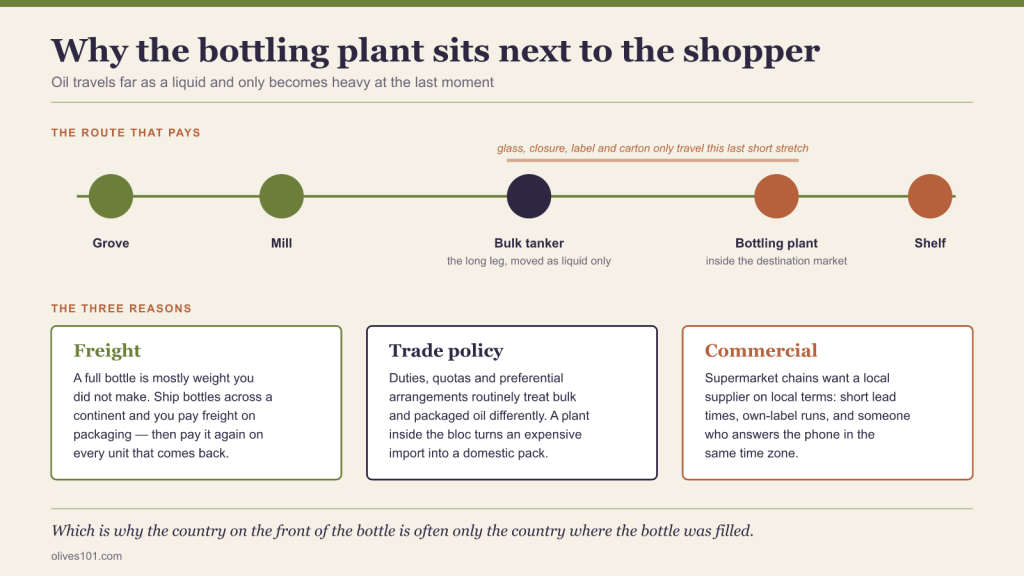
- Bulk exports mean much of this oil will be sold under somebody else’s name, in another country.
- Volume rising faster than value is the sign of a young industry buying market share. It rarely lasts.
Chile is not alone in South America, and the pattern is familiar from the Spanish investment that built the country’s largest olive oil business. We looked at the early export push in a taste of Chilean gold, and at the wider agricultural strategy in Chile’s move into health markets.
When a country sells most of its oil in bulk, the quality that wins the medals and the quality that fills the tanker are not always the same oil. Ask an importer where a Chilean oil was bottled. If it was bottled in Chile and carries a harvest date, you are buying the producer’s work. If it crossed the ocean in a tank, you are buying somebody else’s blending decisions.
Sources
- Olive Oil Times: Chilean Olive Oil Continues Gains, 7 July 2011 (archived copy)
- ChileOliva: annual market report 2010 (archived copy)