EU Olive Oil Action Plan: Tougher Tests, Sealed Bottles
EU Agriculture Commissioner Dacian Cioloş has put an action plan for the struggling olive oil sector on the table, with tougher testing against fraud, a possible new grade, and sealed bottles in restaurants among the ideas. He outlined it to ministers from the producer countries in Luxembourg on Monday, June 18, and presented it to all 27 member states yesterday. Here is what is in the EU olive oil action plan, why it has come now, and which parts a shopper might actually notice.
What happened
The Commission’s own briefing ahead of Monday’s Agriculture Council said Cioloş would meet ministers from the olive oil producing member states over lunch to discuss the medium- to long-term market situation. Those countries are Cyprus, France, Greece, Italy, Malta, Portugal, Slovenia and Spain. According to Olive Oil Times, he told them he hoped to agree concrete changes by the end of July, once governments have sent their feedback.
The background is grim. Producer prices are at record lows, farm incomes are falling, and there is a large surplus from this season’s harvest. Brussels has opened private storage aid three times in seven months, and prices have barely moved. Cioloş says the sector’s problems are structural, which is a polite way of saying storage aid cannot fix them.
What the plan proposes
The paper, released in French, has six sections: quality control, restructuring of the sector, the value chain, promotion, the International Olive Council, and competition with non-EU producers. Among the ideas reported by Olive Oil Times from a draft version:
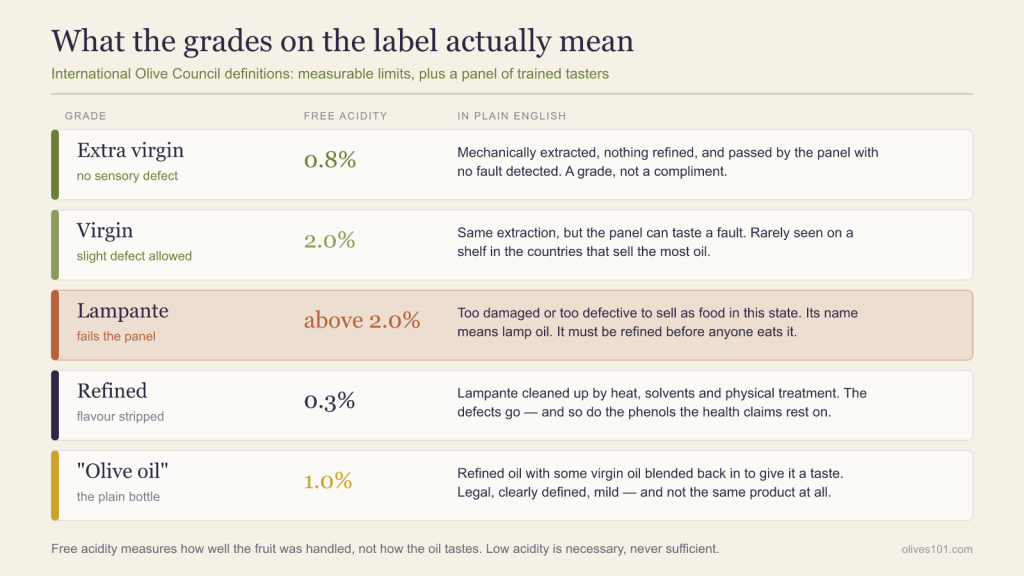
- A new classification. Cioloş said the plain “olive oil” category, which covers blends of refined and virgin oil, is too broad and could be split to show the differences between oils more clearly.
- A crackdown on deodorization, the soft refining used to hide defects in low-grade oil that is then blended and sold as virgin.
- Faster technical work at the IOC on four points: a lower limit for stigmastadienes, which betray refined oils; a lower limit for alkyl esters, to shut out more deodorized oil; final adoption of a “global method” for detecting other vegetable oils; and a method measuring di- and triglycerides to catch fraudulent blends and judge freshness.
- More testing and sanctions, with member states required to report irregularities found and penalties applied.
- Non-refillable bottles in restaurants, encouraged in every member state.
- Best-before dates: flagged as needing a technical study of how oils change over time before any rule is written.
- Stronger growers: incentives to reduce fragmentation so producers can bargain with big retail chains, and a way for producer organizations to take a category such as lampante oil off the market when prices are weak, without breaking competition law.
- A wider IOC: the current agreement expires at the end of 2014, and the draft suggests bringing in countries that consume olive oil as well as those that produce it.
The draft also takes aim at newer producers that are big importers of EU oil, saying some have pushed quality parameters that differ from the IOC standard. The EU, it says, should oppose any deviation from Codex rules that could act as a trade barrier. Reaction so far is broadly positive, though some in Spain say the plan lacks concrete measures to help growers right away.
Why it matters for buyers
Most of this is technical, and that is exactly why it matters. The frauds that cost shoppers most are not bottles of pure sunflower oil; they are low-grade oils cleaned up just enough to pass. Tighter limits on alkyl esters and a freshness test based on glycerides go straight at that problem. If the chemistry is new to you, Diacylglycerols: the freshness clock hidden in the oil explains the idea behind one of those tests, and Fusty, musty, winey, rancid: the chemistry of off-flavours covers the defects that deodorizing tries to hide.
The one change you would see is on restaurant tables. A refillable cruet can be topped up with anything, and a sealed bottle cannot. The new classification would matter too, because the plain “olive oil” grade confuses many shoppers; our guide Light, Pure and Pomace: The Lesser Olive Oils, Explained shows why.
Deodorized oil is the quiet fraud of this trade. Oil from damaged or fermented olives smells bad, so it is treated gently with heat and steam until the smell goes, then blended with real extra virgin. The blend can pass the basic chemistry and taste bland rather than faulty. Nobody gets sick, and nobody gets what they paid for. That is why the dull-sounding line about alkyl ester limits is the most important sentence in this plan.