High-end olive oil for connoisseurs in Boston
Sealed bottles tell you almost nothing, so a shop that lets you taste from the tank is a genuine advance. Just understand what a fusti does to oil once it has been open for three months, and which of the words on the wall have no legal meaning at all.
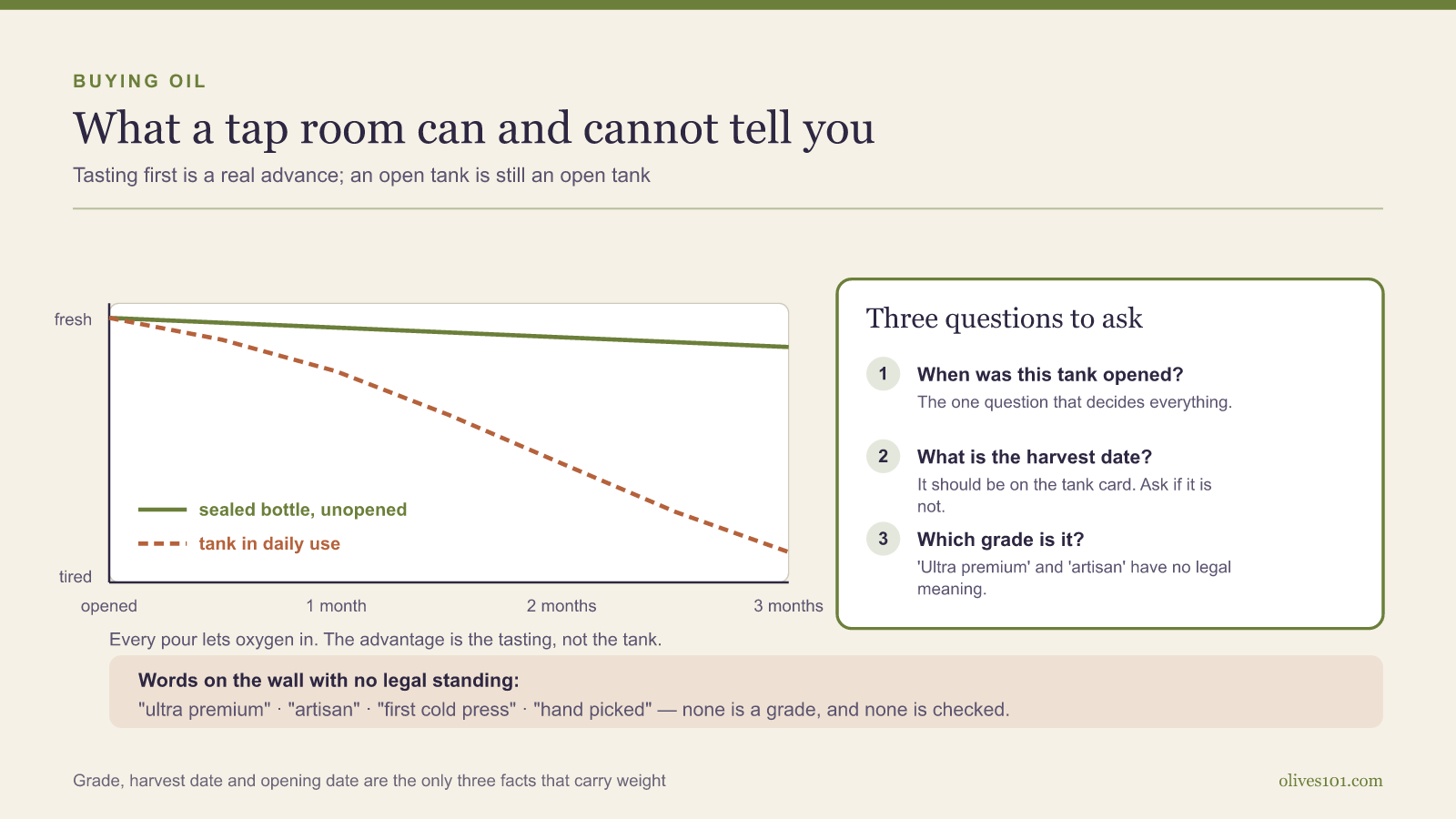
The problem with buying olive oil is that the container is opaque to the one thing that matters. You cannot taste a sealed bottle. Price, brand, country and a picture of a hillside are all you get, and none of them reliably predicts whether the oil is fresh, well made, or the style you like. Shops that decant from stainless tanks and let you taste before you fill a bottle address that problem head-on, and for that alone they deserve credit.
But a tap room is a shop, and the format has its own economics and its own risks. Here is what is genuinely good about it, what to ask, and which parts of the vocabulary on the wall are marketing rather than law.
What the shop is actually selling
Strip away the fittings and the product is a stainless steel vessel — a fusti — with a tap, holding anything from a few litres to a few dozen. The oil arrives in bulk and is decanted into these tanks for display. You taste from small cups, choose, and the assistant fills a bottle for you.
The tasting is the real value, and it is substantial. In twenty minutes you can learn more about what you like — grassy versus buttery, mild versus fiercely peppery, Spanish versus Greek versus Californian — than in five years of buying supermarket bottles blind. That education is worth paying for, and the staff in a good shop know their stock and will talk about harvest dates without being pushed.
What you are also buying, though, is convenience and presentation at a considerable premium, and an oil whose history after arrival is entirely in the shop’s hands.
The oxygen question
Olive oil has four enemies: heat, light, time and oxygen. A stainless tank handles the first two beautifully — steel is opaque, and a shop is climate-controlled. It handles the fourth badly, because every single pour draws air in to replace the oil that left.
A fusti that turns over in three weeks is a superb container. A fusti that has been sitting a third full since the spring is the worst container in the room: a large headspace of air, in constant contact with oil, opened and closed daily. The oil in it may still be perfectly legal extra virgin, but its aroma and phenols are quietly leaving.
This is not a reason to avoid tap shops. It is a reason to ask two questions that any good shop will answer cheerfully: when was this fusti opened? and what is the harvest date? A shop that cannot or will not answer either is telling you something. And prefer the tanks that are visibly popular — turnover protects oil better than any equipment.
| Tap-room fill | Sealed bottle from a producer | |
|---|---|---|
| Can you taste first? | Yes — the format’s real advantage | No |
| Harvest date | Should be on the tank card — ask if not | Printed by the better producers |
| Oxygen exposure | Increases with every pour and every week open | Minimal until you open it |
| Traceability | Depends entirely on the shop’s honesty | Lot number, bottler, origin statement |
| Typical price | A significant premium | Lower for equivalent quality |
| Range | Wide, including flavoured oils | Narrow, but specific |
| Best for | Learning what you like; small quantities | Buying a known oil at its best |
The vocabulary that is not law
Here is the part worth being blunt about. Extra virgin is a legal grade, defined by chemistry and by a trained tasting panel. ‘Cold extracted’ has a legal definition too. Almost nothing else on the wall of a specialist shop does.
‘Ultra premium’ is the most common example: it sounds like a grade above extra virgin, and it is not one. It is a private marketing category originating with a supplier group, with its own chemical parameters, but it is not a legal designation and no authority polices it. It may well denote genuinely good oil — the parameters are stricter than the legal minimum — but you are trusting a private standard, not a public one.
Similarly, ‘first cold pressed’ is a legacy phrase for a pressing process most modern mills no longer use, and ‘robust’, ‘delicate’ and ‘medium’ are useful descriptions with no fixed thresholds. See what ‘extra virgin’ really means before you pay for a word.
Flavoured oils: two different things
Every tap room sells lemon, garlic, chilli and basil oils, and they are not all made the same way. The good version is co-milled — olives and whole citrus or herbs crushed together at the mill, which in Italy is called agrumato. The flavour is integrated, the aroma is real, and it is a genuine product with centuries behind it.
The other version is infusion or, at the bottom end, flavouring added to oil after the fact. It is not fraudulent, but it is a different and cheaper thing, and it should not cost the same. Ask which it is.
One caution from the trade: strong flavourings are also an excellent way to hide a defective base oil. A rancid or fusty oil with enough garlic in it will pass unnoticed. If a shop’s plain oils are dull and its flavoured ones are the pride of the display, draw your own conclusion.
How to use a tap room well
- Ask when the fusti was opened and what the harvest date is. Both questions are reasonable and both should be answered.
- Buy from busy tanks. High turnover is the single best protection against oxidation.
- Buy small. A 250 ml bottle you finish in three weeks beats a litre that lives on the counter until spring.
- Taste the plain oils first, before your palate is coated in garlic and lemon.
- Look for bitterness and pepper, and be suspicious of an oil that is entirely smooth.
- Treat ‘ultra premium’ as a private label, not a legal grade, and ask what the parameters actually were.
- Use the shop to learn, then buy the winner by the bottle from a producer with a printed date.
Olive oil tap rooms: common questions
What is a fusti?
The stainless steel tank with a spigot used to display and dispense olive oil in specialist shops. Steel protects oil from light and is easy to keep cool, but every pour admits air, so a slow-selling tank exposes its oil to oxygen for months.
Is tap-room olive oil fresher than bottled?
Not automatically. It may have been decanted from bulk months earlier and stood open ever since. The freshness depends entirely on turnover and on when the tank was filled — which is exactly what to ask.
Does ‘ultra premium’ mean anything official?
No. It is a private marketing category with its own chemical parameters, not a legal grade recognised by any regulator. The oil may be excellent, but the term is a supplier standard rather than a public one.
Are flavoured olive oils worth buying?
Co-milled ones, where fruit or herbs are crushed with the olives, are a genuine traditional product and taste integrated. Post-production infusions and added flavourings are a cheaper, different thing — and strong flavours can also mask a defective base oil.
Should I buy a large bottle to save money?
Rarely. Once opened, oil oxidises steadily, so a big bottle in a domestic kitchen usually ends up worse value than two small ones. Buy what you will finish in a month or two.
I like these shops, and I want to be fair to them : letting people taste before they buy fixes the deepest flaw in the whole retail category. But I have also seen the other side of the counter, and the same tank of oil can be a triumph in October and tired by April, with nothing on the display card to tell you which one you are getting. So use the format for what it is uniquely good at — learning your own palate, and buying small — and ask the two questions that separate a serious shop from a well-decorated one : when was this opened, and when was it harvested. The answers, or the lack of them, tell you everything.
Grade definitions from EU olive oil marketing standards; the private ‘ultra premium’ category as described by its originating supplier group.