Homemade acne scar remedy by olive Oil
The internet has been recommending olive oil for acne scars for twenty years. The evidence does not support it, one common companion tip is actively bad for skin, and the honest answer is duller and more useful.
It is one of the most durable pieces of folk skincare on the internet: exfoliate with baking soda, then massage in a little olive oil, and your acne scars will fade. It is repeated because it is cheap, natural-sounding and satisfying to do. Unfortunately, the best available evidence points the other way on both halves of it, and the part that does work for scars is not in your kitchen at all. This site loves olive oil unreservedly — which is exactly why it is worth being straight about what it cannot do.
What olive oil does to the skin barrier
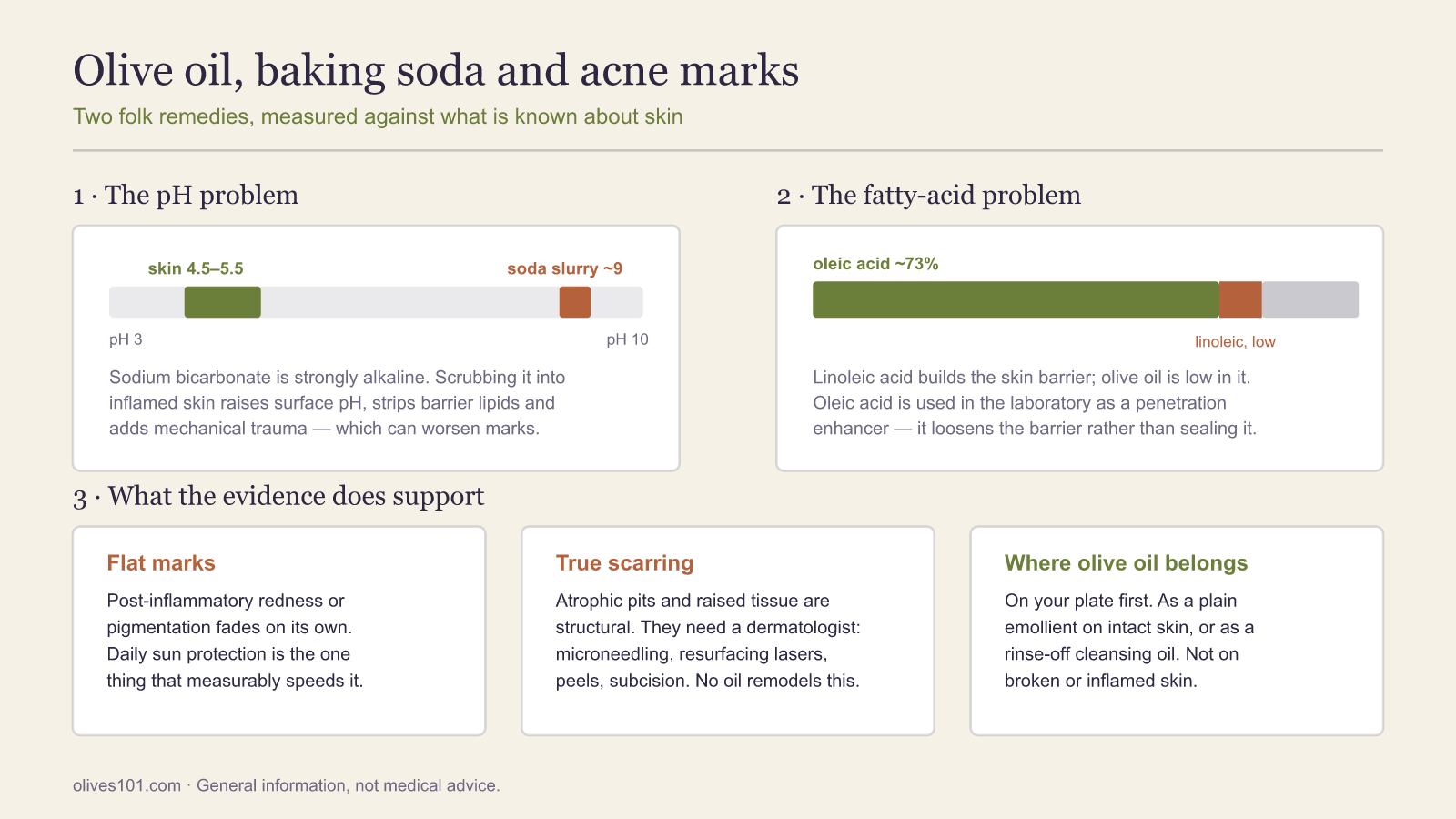
Skin holds itself together with a lipid mortar in the outermost layer, the stratum corneum. Different fatty acids behave very differently there. Linoleic acid, an omega-6, is a building block of that barrier. Oleic acid, a monounsaturate, is known in laboratory work as a penetration enhancer — it loosens the lipid packing so other substances can pass through. Useful in a drug patch; not obviously what you want on already-inflamed skin.
Olive oil is roughly three-quarters oleic acid and comparatively low in linoleic. A small but well-known adult study in a dermatology journal compared topical olive oil with sunflower seed oil on forearm skin and found that the olive oil measurably reduced stratum corneum integrity and produced mild redness, while the higher-linoleic sunflower oil did not. That result is why paediatric and dermatology guidance moved away from recommending olive oil for infant skin and for eczema-prone skin. It is a single line of evidence, not a scandal — but it points firmly in one direction.
| Main fatty acid | Oleic acid, typically around 55–83 per cent of the oil |
|---|---|
| Linoleic acid | Usually a low single-digit to low double-digit percentage — low relative to seed oils |
| Polyphenols | Hydroxytyrosol, oleuropein, oleocanthal — genuinely antioxidant in the lab |
| Vitamin E | Present, modest quantities; an antioxidant, not a scar treatment |
| Effect on barrier | Human data suggest topical olive oil can reduce stratum corneum integrity |
| Comedogenicity | Debated and person-dependent; occlusive oils can worsen some acne |
| Evidence for scar fading | No good clinical evidence in humans |
| Sensible topical use | Emollient on intact, non-acne-prone skin; makeup or grime removal |
And the baking soda is worse
Healthy skin surface sits at a mildly acidic pH, somewhere around 4.5 to 5.5. That acid mantle is not decoration: it regulates the enzymes that build barrier lipids and it keeps the surface microbial community in balance. Sodium bicarbonate slurry is strongly alkaline, around pH 9. Scrubbing inflamed, acne-prone skin with an alkaline abrasive raises surface pH, strips lipids and adds mechanical trauma to tissue that is already injured — and mechanical irritation of acne lesions is one of the recognised ways to make post-inflammatory marks worse, not better.
So the classic remedy manages to combine a barrier-disrupting abrasive with a barrier-disrupting oil, on skin whose problem is inflammation. If it appears to work, what you are usually seeing is time: post-inflammatory redness and pigmentation fade on their own over months.
What actually helps acne marks
First, a distinction the folk advice always blurs. Post-inflammatory redness or pigmentation is flat discoloration left after a spot heals — it fades by itself, faster with sun protection. True scarring is a change in the skin’s structure, atrophic pits or raised tissue, and it does not fade on its own; it needs a dermatologist and procedures such as microneedling, resurfacing lasers, chemical peels or subcision. No topical oil remodels dermal collagen.
The most effective everyday measure is unglamorous: daily broad-spectrum sun protection, which prevents ultraviolet from darkening healing marks and is the single highest-value habit for anyone with fading discoloration. Beyond that, treating the active acne is what prevents the next mark, and topical retinoids are the mainstay with real evidence behind them. This is general information, not medical advice.
So where does olive oil belong?
- On your plate first. The strongest evidence for olive oil and health is dietary, not topical.
- As a plain emollient on intact skin — dry shins, cuticles, rough hands — if it suits you and does not sting.
- As a cleansing oil for removing makeup or grease, rinsed off rather than left on.
- Not on broken, eczema-prone or actively inflamed skin, where the barrier evidence argues against it.
- Not as a scar treatment, because nothing supports that claim.
- Not with baking soda. Alkaline abrasives have no place on facial skin.
- Check the grade in cosmetic products. Much of the olive oil in bathroom bottles is refined or pomace-grade, chosen for cheapness and neutrality, not the polyphenol-rich extra virgin the marketing implies — see what extra virgin really means.
Olive oil and skin: common questions
Does olive oil fade acne scars?
There is no good clinical evidence that it does. Flat post-inflammatory marks fade with time and sun protection regardless of what you put on them; true textured scarring needs dermatological treatment. This is general information, not medical advice.
Is olive oil bad for skin?
Not universally, but it is a poorer topical choice than its reputation suggests. Human studies indicate topical olive oil can reduce skin-barrier integrity, most likely because it is high in oleic acid and relatively low in linoleic acid. On intact, non-sensitive skin it is a harmless emollient.
Does olive oil clog pores?
It can, for some people. Comedogenicity is highly individual and older laboratory ratings translate poorly to real skin, but heavier occlusive oils on acne-prone facial skin are a reasonable thing to be cautious about.
Is baking soda good for exfoliating skin?
No. It is strongly alkaline, around pH 9, while the skin surface is mildly acidic. It disrupts the acid mantle and adds abrasion to inflamed skin, which can make post-inflammatory marks worse.
What is the single most useful thing for fading acne marks?
Daily broad-spectrum sun protection, plus effective treatment of the active acne so that new marks stop forming. Both are far better supported than any kitchen remedy. This is general information, not medical advice.
I have spent my life selling the stuff and I will still tell you to keep it out of the bathroom cabinet. Two reasons. One, the science on oleic acid and the skin barrier is not on the folk remedy’s side. Two, and this is the part nobody says out loud: the olive oil in cosmetic products is very often refined or pomace-grade, bought on price and bleached to nothing. Whatever polyphenols the marketing is gesturing at were stripped out at the refinery. If you want the good of an olive, eat it.
Drawn from published work on topical olive oil and skin-barrier function, olive oil fatty-acid composition, and standard dermatological guidance on post-inflammatory marks and scarring. General information, not medical advice.