Olive Extract Protects Against Neurodegenerative Disorders
Olive extract protected brain cells in a dish. That is a real result and a genuinely interesting one — and it is a very long way from protecting a person. Here is how to read the polyphenol story without either dismissing it or swallowing it whole.
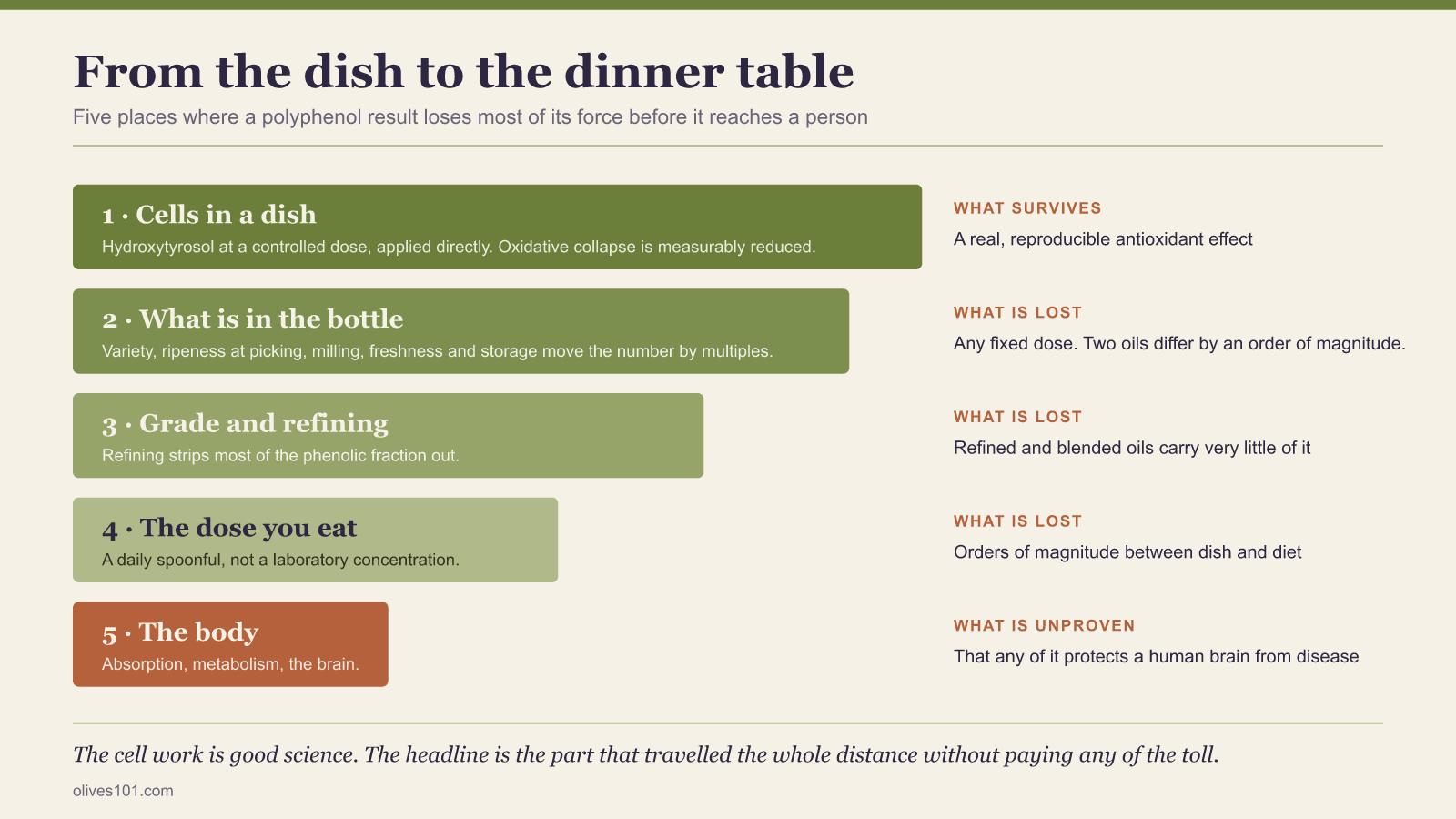
The experiment that started this genre of headline is easy to describe. Take brain cells, hit them with oxidative stressors, and measure the collapse in cellular energy. Then run it again with an olive extract rich in hydroxytyrosol present, and watch the collapse be much smaller. Published work of exactly this shape has been appearing for two decades, and it is not junk science — it is careful, reproducible cell work showing that a molecule from olives is a powerful antioxidant in a controlled system. The trouble starts on the journey from the dish to the dinner table, where an enormous amount of nuance gets lost and a headline about protecting against Alzheimer’s gets born.
What hydroxytyrosol is, and where it comes from
The olive’s signature phenolic compound is oleuropein, and it is the reason a raw olive off the tree is inedible. During milling and during the oil’s life in the tank and the bottle, oleuropein breaks down, and one of the things it yields is hydroxytyrosol — a small, very active antioxidant molecule that also occurs alongside its relative tyrosol.
Two practical consequences follow, and they matter more than any study. First, the amount varies enormously: variety, ripeness at picking, how gently the fruit was milled, how fresh the oil is and how it has been stored all move the number by multiples, not percentages. Second, refining destroys most of it — so refined oil, pomace oil and the bland blends that lean on them carry very little. The polyphenols you are reading about live overwhelmingly in fresh, well-made extra virgin oil, and they announce themselves as bitterness and that peppery catch at the back of the throat.
What the evidence actually supports
There is one claim about olive oil polyphenols that has cleared a serious regulatory bar in Europe: that they contribute to protecting blood lipids from oxidative stress. It comes with a condition that is far more informative than the claim itself — the oil must contain at least 5 mg of hydroxytyrosol and its derivatives per 20 g of oil. That threshold quietly excludes a great many bottles on a supermarket shelf.
The brain story sits at a different stage entirely. Cell and animal work is genuinely promising: olive polyphenols interfere with the aggregation of the proteins implicated in Alzheimer’s disease, dampen neuroinflammation, support mitochondrial function, and hydroxytyrosol appears able to cross the blood-brain barrier. Human evidence is thinner and mostly indirect — it comes from dietary trials of a whole Mediterranean pattern with olive oil in it, not from trials of the isolated compound against a disease endpoint. A diet is not a molecule, and an association is not a mechanism proven in people.
The dose problem nobody mentions
Cell experiments report concentrations in the dish. Nothing about that number tells you what reaches a human brain after digestion, absorption and metabolism, and the honest answer is that far less arrives than the headline implies. Meanwhile the realistic dietary quantity is modest: the European threshold is written per 20 g of oil, which is a bit under two tablespoons a day. That is an achievable amount of good oil. It is not a supplement dose, and it will not do what a drug does.
This is general information, not medical advice. If you are managing a diagnosed condition, the person to talk to is your doctor, not a bottle.
| Oleuropein | The bitter phenolic of the leaf and unripe fruit; the parent compound and the reason raw olives are inedible |
|---|---|
| Hydroxytyrosol | Breakdown product of oleuropein; a small, highly active antioxidant, and the compound named in the EU claim |
| Tyrosol | A related phenolic, generally present alongside hydroxytyrosol and counted with its derivatives |
| Oleocanthal | Responsible for the peppery throat catch; studied for anti-inflammatory activity, largely in laboratory models |
| EU claim condition | At least 5 mg of hydroxytyrosol and derivatives per 20 g of olive oil |
| What the claim covers | Protection of blood lipids from oxidative stress — not cognition, not disease treatment |
| Where the levels are | Fresh, well-made extra virgin oil; refined and pomace oils retain very little |
| Status of the brain research | Promising in cell and animal models; human evidence limited and mostly dietary |
What to do with all this
- Buy for bitterness and pepper. They are the sensory signature of the compounds under study, and they cost you nothing to detect.
- Buy fresh and check the harvest date. Polyphenols decline steadily with age — a two-year-old bottle is a different product chemically.
- Store it properly. Dark glass, cool cupboard, cap on. Light and heat destroy exactly what you paid extra for.
- Do not switch to a supplement to get more. The evidence base sits on the whole oil in a whole diet, not on isolated compounds at high dose.
- Be sceptical of any olive product sold as protection against a disease. That is not a claim the science currently supports.
Olive polyphenols: common questions
Does olive oil prevent Alzheimer’s disease?
No — that is not something current evidence supports. Cell and animal studies show olive polyphenols acting on mechanisms involved in the disease, but human trials testing prevention of dementia with olive compounds are not there.
What is hydroxytyrosol?
A small antioxidant phenolic compound derived from oleuropein, the olive’s characteristic bitter substance. It is the compound named in the European health claim on olive oil polyphenols.
How much olive oil would I need?
The European claim is written around 20 g of oil a day — a bit under two tablespoons — provided that oil actually contains at least 5 mg of hydroxytyrosol and its derivatives per 20 g.
Do all olive oils contain these compounds?
No. Levels vary hugely with variety, ripeness, milling and freshness, and refining removes most of them, so refined and pomace oils contain very little.
Can I taste the polyphenols?
Broadly, yes. Bitterness and a peppery catch at the back of the throat track phenolic content, which is why a harsh-tasting fresh oil is often the more interesting one nutritionally.
Every few years the trade gets a health headline and a wave of people asking for the highest-polyphenol oil in the room, which is fine until they taste it and hate it. Very high-phenol oil is aggressive — it bites. My advice is less heroic than the studies: buy a fresh, properly bitter extra virgin you actually enjoy, use it raw and use it up, and stop treating a food as a prescription. The compounds are real and the research is worth following. But the honest version of the story is that fresh good oil is a pleasure with a plausible bonus attached, and anyone selling it as a treatment has left the evidence behind.
Drawn from published cell and animal research on hydroxytyrosol and olive polyphenols, and the European conditions attached to the olive oil polyphenol health claim.