Natural preservative from olives keeps fish fresh
The compound that makes a raw olive inedible is also one of the most powerful natural antioxidants in the food supply. Most of it is thrown away as mill waste — and the food industry has spent years working out how to get it back.
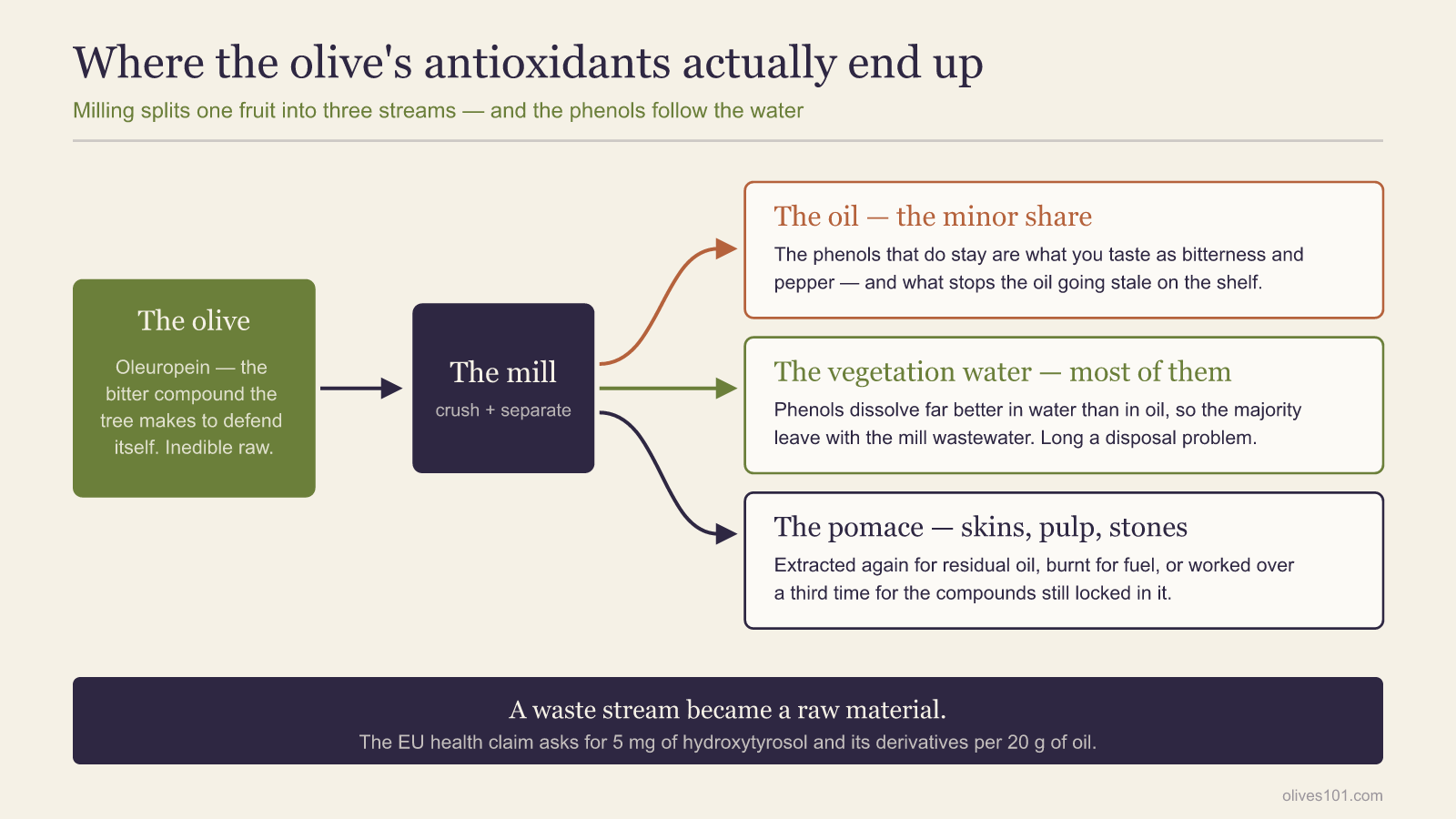
Bite a raw olive straight off the tree and you will not do it twice. The astonishing bitterness is oleuropein, a phenolic compound the tree makes to deter insects, fungi and browsing animals. Curing an olive is, chemically speaking, the business of getting rid of it — in brine, in lye, in water, or slowly under salt. When oleuropein breaks down it yields, among other things, hydroxytyrosol, and hydroxytyrosol is where things get interesting.
This is general information, not medical advice.
A defence chemical that turns out to be useful
Hydroxytyrosol is an unusually effective antioxidant. In laboratory systems it slows the oxidation of fats extremely well, which is precisely the problem the food industry has with the fats people most want to eat more of. Fish oil is the classic case: rich in the long-chain omega-3 fatty acids everyone recommends, and so prone to oxidation that it rapidly develops the rancid fishy smell that puts people off the product entirely.
Published work has repeatedly found that hydroxytyrosol can stabilise fish oil, oil-in-water emulsions and frozen minced fish comparably to synthetic antioxidants of the kind long used in processed foods. That is a real, unglamorous, industrially useful result: a plant compound doing a job that a synthetic additive was doing, with a label consumers prefer. It is also why olive phenols are now extracted commercially rather than merely discussed.
| Hydroxytyrosol | A simple phenolic alcohol, formed largely as oleuropein breaks down; the most studied olive antioxidant |
|---|---|
| Oleuropein | The bitter parent compound in the fruit and leaf; removed or transformed during curing |
| Tyrosol | A related phenol, less potent as an antioxidant but abundant and stable |
| Oleocanthal | Responsible for the peppery catch at the back of the throat in fresh oil |
| Oleacein | A close relative associated with bitterness and green sensory notes |
| Where they end up | The great majority partition into the watery fraction at the mill, not into the oil |
| Typical oil content | Highly variable; falls with fruit ripeness, milling heat and time, and storage age |
| Authorised EU claim | Olive oil polyphenols contribute to the protection of blood lipids from oxidative stress, where the oil supplies at least 5 mg of hydroxytyrosol and derivatives per 20 g |
The waste stream that turned into a resource
Here is the fact that surprises people. When olives are milled, the phenolic compounds are far more soluble in water than in oil, so the great majority of them leave with the vegetation water rather than staying in the oil you buy. That watery residue — olive mill wastewater, black, acidic and heavily phenolic — has historically been one of the Mediterranean’s more difficult agricultural pollution problems, precisely because those same antioxidant compounds are toxic to microorganisms and disrupt treatment ponds and soils.
The commercial logic follows immediately. If the pollutant is a valuable antioxidant, recover it. A whole small industry now extracts and purifies olive phenols from mill wastewater and from leaves and pomace, selling them as food antioxidants, cosmetic ingredients and supplements. It is one of the tidiest circular-economy stories in food processing: the thing that was expensive to dispose of became the thing worth selling.
What this means for the oil in your kitchen
Two practical consequences follow, and both are worth knowing. First, phenol content is why good extra virgin keeps. An oil rich in these compounds resists oxidation for far longer than a bland one, which is why a peppery early-harvest oil can still be lively a year on while a soft, mild oil is flat in six months.
Second, the bitterness and the throat-catch are not flaws to be tolerated — they are the direct sensory signature of the compounds in question. Generations of shoppers have been steered towards mild, smooth, inoffensive oils, which is very close to being steered towards the oils with the least of what makes olive oil interesting in the first place. If you want the compounds, you have to accept the taste.
Be careful about the leap from there to health, though. An antioxidant effect in a test tube or a food emulsion is a statement about chemistry, not about your arteries. European regulators authorised one narrow claim on protecting blood lipids from oxidation at a defined dose, and declined to go further. That restraint is the correct posture, and it is worth keeping when you read stronger claims on a supplement label.
Practical takeaways
- Bitterness and pepper are the phenols talking. Choosing mild oil selects them out.
- Early harvest, fresh bottling — phenol content peaks in green fruit and declines every month afterwards.
- Heat and light destroy them. A bottle by the cooker is losing the good part fastest.
- Refined and light olive oils have had the phenolic fraction stripped out; they are cooking fats, not the health story.
- Treat leaf and mill-water extracts as ingredients, not medicines, and look for a stated hydroxytyrosol content rather than the word extract.
- If an oil still tastes lively a year after harvest, it was phenol-rich to begin with. That is the cheapest quality test there is.
Olive phenols: common questions
What is hydroxytyrosol?
A phenolic compound found in olives, olive leaves and virgin olive oil, formed largely from the breakdown of the bitter compound oleuropein. It is one of the most studied natural antioxidants in food science.
Why do olives taste so bitter raw?
Because of oleuropein, which the tree produces as a defence against insects and grazing. Curing in brine, lye, water or salt removes or transforms it, which is what makes olives edible.
Can olive antioxidants replace synthetic preservatives?
In several published studies olive phenols stabilised fish oils and emulsions comparably to synthetic antioxidants. They are used commercially as natural antioxidant ingredients, though suitability depends on the specific food system.
Why is olive mill wastewater a problem?
Because it is acidic and rich in the same phenolic compounds that are antioxidant in food and toxic to microorganisms in soil and water treatment systems. Recovering those phenols turns the problem into a product.
Does more bitterness mean a healthier oil?
Bitterness and throat pepper do indicate higher phenolic content, which is what the authorised European claim about protecting blood lipids from oxidative stress is based on. It is a useful guide, not a medical guarantee. This is general information, not medical advice.
For decades the trade sold mildness. Buyers asked for smooth, supermarkets asked for inoffensive, and producers obliged by picking later and filtering harder. Then the same compounds we had spent a generation designing out turned up in the health literature and in the food-additive catalogues, and suddenly bitterness was a feature. My advice is simpler than the science: buy the oil that makes you cough a little, use it raw, and finish the bottle within a few months. Everything else is packaging.
Drawn from published food chemistry research on olive phenolic compounds as natural antioxidants, work on olive mill wastewater valorisation, and the European authorised health claim on olive oil polyphenols. This is general information, not medical advice.