Olive oil industry, production getting bigger by moment
The biggest change in olive growing in two thousand years was not a new variety or a new mill. It was planting the trees close enough together to drive a grape harvester over them.
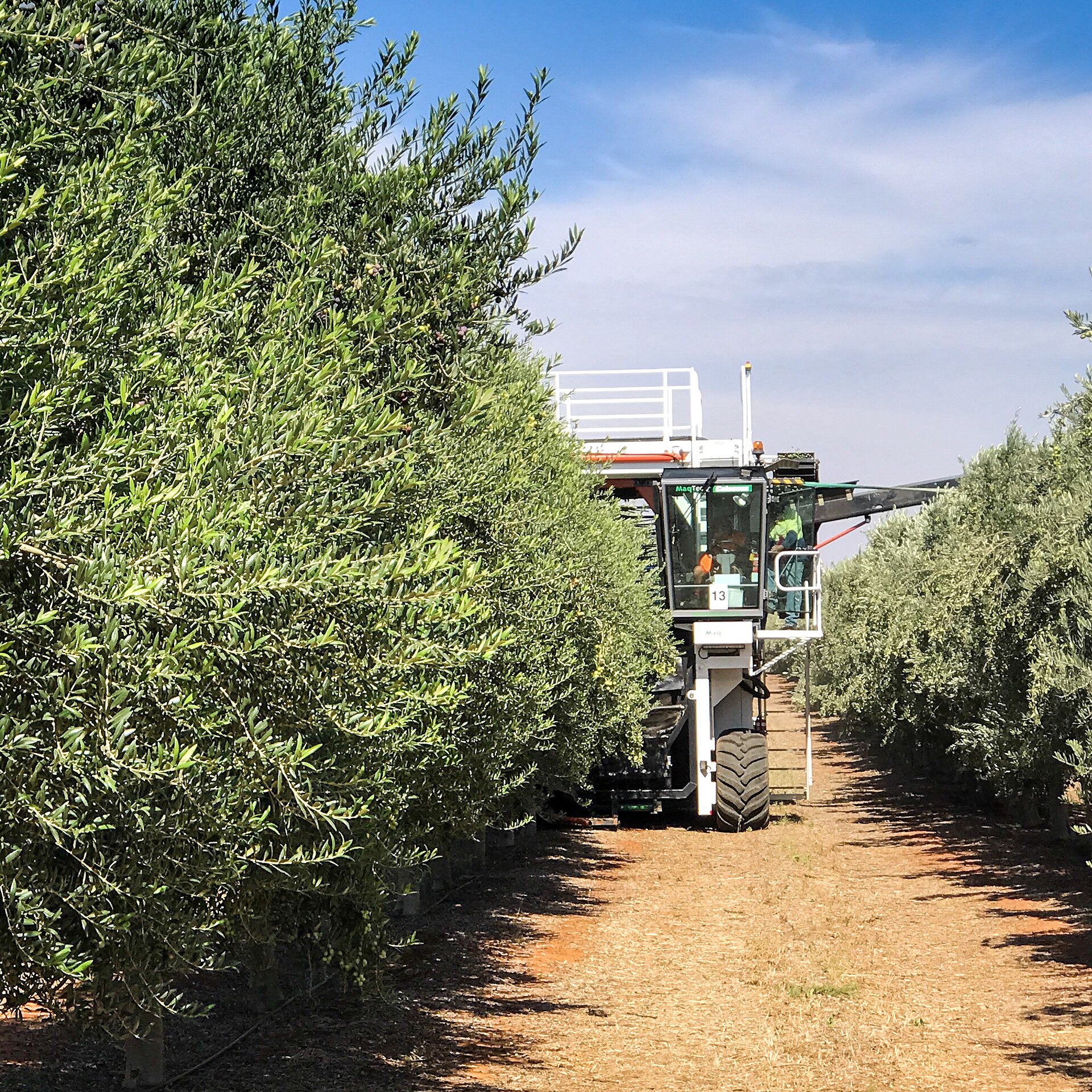
For most of recorded history an olive orchard looked the same: widely spaced trees, big open canopies, maybe eighty to a hundred trees on a hectare, harvested by hand or by beating with poles, and productive for centuries. Then in the 1990s Spanish growers and nurseries did something quietly radical — they planted olives like a vineyard, in continuous hedgerows on wire, close enough that a machine could straddle the row and shake the fruit off as it drove. Everything about the modern oil trade follows from that decision.
What super-high-density actually means
The label refers to planting density and to the machinery it enables. Traditional groves run to roughly a hundred trees per hectare; intensive plantings a few hundred; super-high-density orchards, commonly abbreviated SHD, run from around 1,000 to more than 2,000 trees per hectare in narrow rows. The trees are trained onto a trellis as a continuous fruiting wall, mechanically topped and hedged every year or two to keep them within the harvester’s tunnel, and they come into meaningful production in the third year rather than the eighth.
The harvester itself is the punchline: it is essentially a grape machine, adapted. It straddles the hedgerow, beats the canopy with rods, catches the fruit and delivers it to a trailer. One machine and two people replace a picking crew, and the fruit reaches the mill within hours rather than days. That last point matters more than anything else, because time between tree and mill is the single largest cause of defective oil.
| Traditional grove | Intensive orchard | Super-high-density hedgerow | |
|---|---|---|---|
| Trees per hectare | Roughly 80–150 | About 200–500 | Around 1,000–2,000+ |
| First real crop | Seven to ten years | Four to six years | Around year three |
| Harvest | Hand, poles, nets, trunk shakers | Trunk shakers with catch frames | Over-the-row straddle harvester |
| Varieties | Whatever the region has always grown | Regional plus some introductions | Chiefly Arbequina, Arbosana, Koroneiki |
| Orchard life | Centuries | Decades | Commonly planned around 15–25 years |
| Labour per litre | Very high | Moderate | Very low |
| Typical oil style | Whatever the local cultivar gives | Varies | Soft, mild, low bitterness, very consistent |
Why only three varieties
This is the part that should trouble anyone who loves olives. An SHD hedgerow needs a tree that is naturally low in vigour, compact, early-bearing and tolerant of being hacked back by a machine every year. Out of the hundreds of cultivars in the Mediterranean, only a handful behave that way, and in practice the world’s hedgerow orchards are planted almost entirely with three: Spanish Arbequina, Spanish Arbosana, and Greek Koroneiki. Breeding programmes are working on more, and there are promising candidates, but the concentration today is extreme.
That has a taste consequence you can find on any supermarket shelf. Arbequina and Arbosana give soft, mild, low-bitterness oils; Koroneiki gives a firmer, greener one but is still the gentlest of the classic Greek intensities. So the global baseline for cheap-to-midrange extra virgin has drifted towards the mild and the pleasant, while the fierce regional cultivars — Coratina, Picual at full bitterness, Moraiolo, Cornicabra — survive mostly in traditional and intensive groves that cost more to farm.
The honest ledger
Romantics loathe SHD and they are half right. Set against it: a narrowing gene pool, hedgerows that are ecologically poorer than an old grove, heavy irrigation and input demands, an orchard designed around a couple of decades rather than a couple of centuries, and the slow disappearance of regional character from the mass market. An old grove is a landscape and a habitat; a hedgerow is a crop.
Set for it, and this is where the romantics go quiet: SHD made clean, fresh, genuinely well-made extra virgin available cheaply, at a scale the traditional system never could. Fruit picked and milled the same day, in a modern centrifugal plant, produces oil with no defects at a price that would have been fantasy in 1980. A great deal of the rancid, fusty, technically-not-extra-virgin oil that used to be normal on supermarket shelves was pushed out by hedgerow oil, not by connoisseurs. If you want the old world instead, you can still have it — you just have to pay for it, and understand what an olive really costs.
What it means at the shelf
- A very mild, consistent, inexpensive extra virgin is probably hedgerow Arbequina. That is not an insult — it is a reliable everyday oil.
- If you want bitterness and pepper, buy by cultivar, and look for the ones the machines cannot easily harvest: Coratina, Picual, Cornicabra, Moraiolo.
- Hedgerow oils are usually very fresh, because the harvest-to-mill gap is measured in hours.
- Consistency year to year is a hedgerow signature. If a supermarket brand tastes identical every year, that is the system working as designed.
- Old-grove oil is a different product with a different price — hand harvest, low yields, and trees that may outlive everyone reading this. See the oldest olive tree in the world.
- Support regional cultivars if you value them, because they will only survive if somebody buys them.
Hedgerow olive growing: common questions
What is a super-high-density olive orchard?
An orchard planted as a continuous hedgerow on trellis at roughly 1,000 to 2,000 or more trees per hectare, mechanically pruned and harvested by an over-the-row straddle machine adapted from grape harvesting.
Which olive varieties are used in hedgerow orchards?
Overwhelmingly three: Arbequina and Arbosana from Spain, and Koroneiki from Greece. They are low-vigour, compact and early-bearing enough to tolerate annual mechanical hedging. Breeding programmes are working to widen that list.
Is hedgerow olive oil lower quality?
Not inherently — often the opposite on technical quality, because fruit reaches the mill within hours. What it tends to be is milder and less bitter, with a narrower flavour range, because of the varieties involved.
How long does a super-high-density orchard last?
They are generally planned around a productive life of roughly fifteen to twenty-five years, after which the block is typically replanted. Traditional groves, by contrast, can crop for centuries.
Why has cheap olive oil got milder over time?
Because the varieties that suit mechanical hedgerow harvesting are naturally gentle and low in bitterness. As those orchards came to supply the mass market, the average flavour of inexpensive extra virgin drifted towards the soft end.
I will not join the chorus against hedgerows, and here is why. I spent years tasting supermarket oil in the 1980s and a great deal of it was quietly awful — fusty, flat, oxidised, extra virgin in name only. Hedgerow orchards and modern mills killed off most of that, because fruit picked at dawn and milled by lunchtime cannot develop those defects. The real cost is not quality, it is variety. We have traded a hundred regional cultivars for three very well-behaved ones, and the flavours we are losing will not come back on their own. Buy a bitter, difficult, single-cultivar oil now and then. It is the only vote you get.
Drawn from published work on super-high-density orchard density, cultivar performance and orchard lifespan, and on mechanical over-the-row harvesting practice.