The 5th Vinolive Fair & Symposium is coming soon
The olive world runs on a handful of fairs a year, and almost everything written about them describes the wrong part. The pretty bottles at the front are the least interesting thing in the hall. The deals happen in the machinery aisles and the corridors.
Anyone who has spent a career in olives has spent a slice of it walking fairground carpet. There is a rhythm to it: a big Spanish industry fair, an Italian quality showcase or two, a scattering of regional and national events, and the general food shows where oil has to compete for attention with everything else people eat. They all look the same in photographs — stands, bottles, small white tasting glasses — and they do entirely different jobs. If you turn up without knowing which job you are there for, you will have a pleasant few days and come home with nothing.
Three fairs wearing one badge
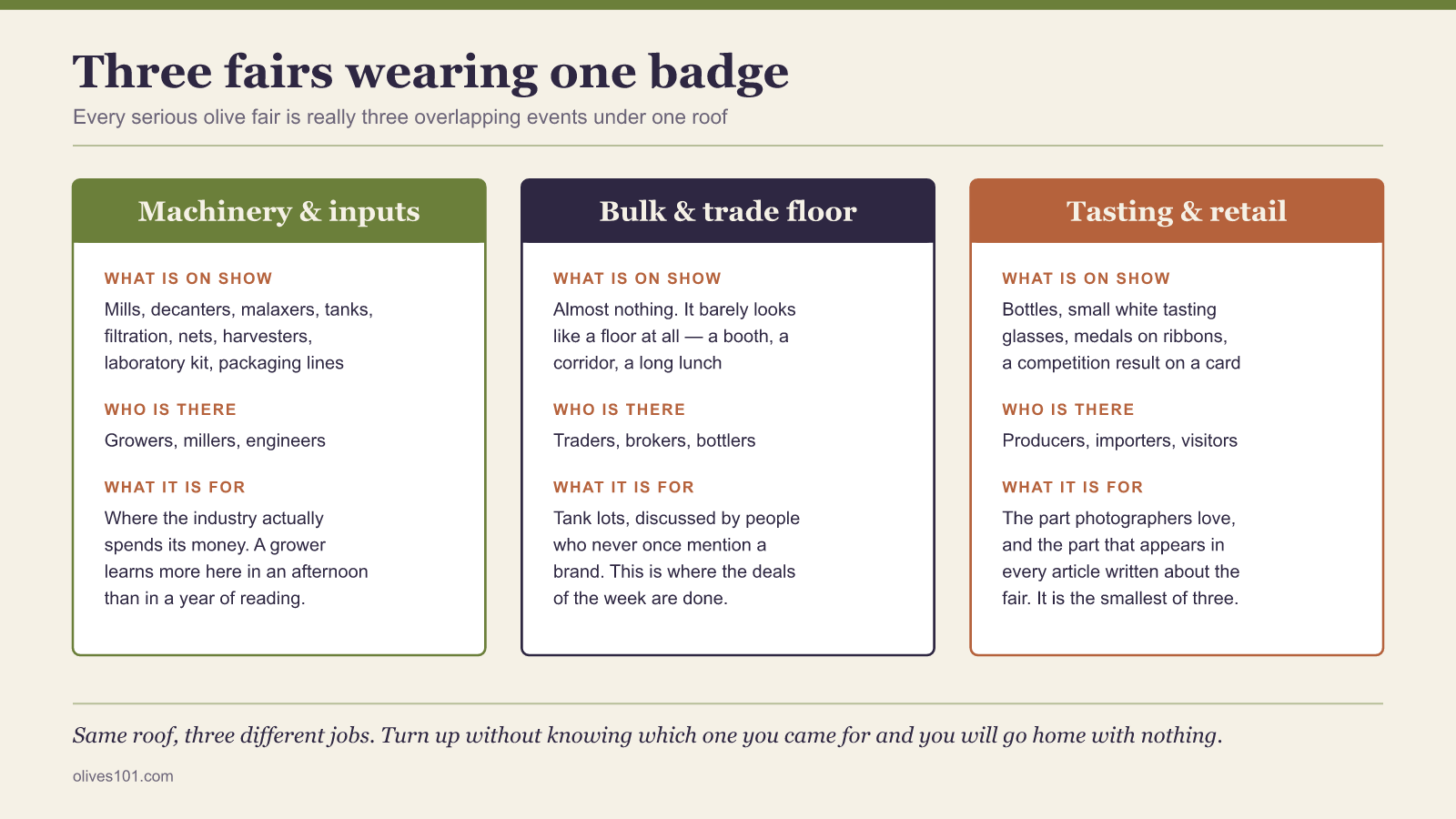
Every serious olive fair is really three overlapping events. The first is the machinery and inputs show: mills, decanters, malaxers, tanks, filtration, nets, harvesters, laboratory kit, packaging lines. This is where the industry actually spends money, and where a grower learns more in an afternoon than in a year of reading. The second is the bulk and trade floor, which barely looks like a floor at all — it is a set of meetings, some of them in a booth and most of them in a corridor or over a long lunch, in which tank lots are discussed by people who never once mention a brand. The third is the tasting and retail showcase, the part photographers love: producers pouring for buyers, importers and visitors, medals on ribbons, a competition result on a card.
They share a roof and share almost nothing else. The visitor who walks in expecting a farmers’ market gets the third event and misses the two that pay for the hall.
What each of the big ones is for
Spain’s Expoliva, held in Jaén in the middle of the world’s densest olive country, is the industrial heavyweight — biennial, enormous, and as much a technology congress as a fair. If you want to see what a modern mill line looks like, that is where it is standing on the floor with the panels open. Verona’s SOL sits alongside the great Italian wine fair, which shapes it: it is quality-facing, buyer-facing, and it borrows an international audience that came for wine and stays for oil. Trieste’s Olio Capitale leans consumer and tasting-led, which makes it an unusually good place to watch how ordinary buyers actually behave in front of a bottle. Underneath that top layer sits a long tail of regional and national events, and those are where a small producer can genuinely be seen rather than lost.
The medal economy
Here is the part nobody prints in the programme. Competition medals sell oil — they demonstrably move a bottle on a shelf — and that has produced an ecosystem of competitions of wildly uneven seriousness. Some are rigorous, blind, panel-judged and stingy with awards. Others hand out gold to a substantial share of everything entered, for a fee, and the sticker looks identical to the untrained eye. Neither the medal nor the ribbon tells you which kind you are looking at.
This is not a fraud story and I am not calling anyone a crook — entering competitions is a legitimate marketing expense, and plenty of excellent oils win plenty of honest medals. But if a producer tells you their oil is award-winning, the only useful follow-up questions are which competition, judged how, and how many awards it gave that year. A producer who is proud of the answer will give it to you immediately.
| Fair type | What it is really for | Who should go |
|---|---|---|
| Industrial fair (Expoliva style) | Machinery, mill technology, inputs, technical congress | Growers, millers, co-operative managers |
| Quality showcase (SOL style) | Meeting export buyers and importers, quality positioning | Producers with bottled brands seeking distribution |
| Tasting fair (Olio Capitale style) | Consumer contact, direct sales, feedback on a bottle | Small estates, new labels, anyone testing packaging |
| Regional / national event | Local trade, growers’ associations, visibility at home | New producers, small mills, local co-operatives |
| General food show | Competing with every other category for attention | Brands with budget and a retail listing to defend |
How to work a fair properly
- Taste early in the day. Palates die by mid-afternoon, and a hall full of oil is brutal on the throat. Twenty samples tasted properly beats a hundred tasted badly.
- Go to the machinery aisles even if you buy nothing. Equipment tells you where the technology is heading a full season before the marketing does.
- Ask about the harvest date and the mill, not the story. Every stand has a story. Not every stand has a recent harvest.
- Book meetings before you travel. The people who matter are booked solid, and the corridor conversations are diary-driven, not luck.
- Bring a bottle from home to taste against. A reference sample keeps your palate honest when everything in the room is pitching at you.
Olive trade fairs: common questions
Are olive oil fairs open to the public?
It depends on the event. Consumer-facing tasting fairs welcome visitors and sell bottles; heavy industrial fairs are aimed at trade professionals, though most admit interested visitors who register.
Which is the biggest olive oil fair?
Spain’s Expoliva in Jaén is generally regarded as the largest specialist olive event, drawing tens of thousands of visitors and a large international professional contingent.
Do producers actually sell at fairs?
Retail sales are a small part of it. The value is in meeting importers, distributors and bulk buyers, and in the technical side — equipment, laboratory services and inputs.
Do competition medals mean an oil is good?
Sometimes. Competitions vary enormously in rigour and in how freely they award. Ask which competition, how it was judged, and how many awards were given that year.
Is a fair worth it for a small producer?
Often yes, but pick the right one. A small estate is invisible at a giant industrial fair and highly visible at a regional or tasting-led event where buyers came specifically to taste.
My honest advice to anyone going to their first olive fair: skip the front rows. The stands nearest the entrance bought their position, which tells you about their marketing budget and nothing about their oil. Walk to the back, where the small mills and the equipment people are, and start there. That is where you meet someone who will actually tell you what a bad year did to their yields, what the water cost, and why the price you think is high is barely covering the picking. You will learn more in two of those conversations than in a whole day of ribbons.
Drawn from the published profiles of the major olive-sector fairs — Expoliva in Jaén, SOL in Verona and Olio Capitale in Trieste — and long familiarity with the trade-fair circuit.