Mineral oil in land of the olive
Every so often an edible-oil contamination story breaks and everyone makes the same joke about salad dressing you could service a tractor with. It is not funny, and it is not rare: mineral oil is a standing hazard in every bulk liquid-fat chain — olive oil very much included.
In 2008 the European alert system lit up over sunflower oil. Shiploads out of Ukraine had reached several member states carrying mineral oil at levels nobody could explain away — some samples were reported well above a thousand milligrams per kilo. Brussels improvised a temporary ceiling for paraffinic hydrocarbons, the trade made its jokes, and the story faded within a season. It should not have. That incident was not a freak event. It was the moment the food industry finally noticed a contaminant that had been riding quietly along in bulk liquid fats for decades — and olive oil, which spends most of its life in tanks rather than bottles, was never outside the problem.
What mineral oil in food actually means
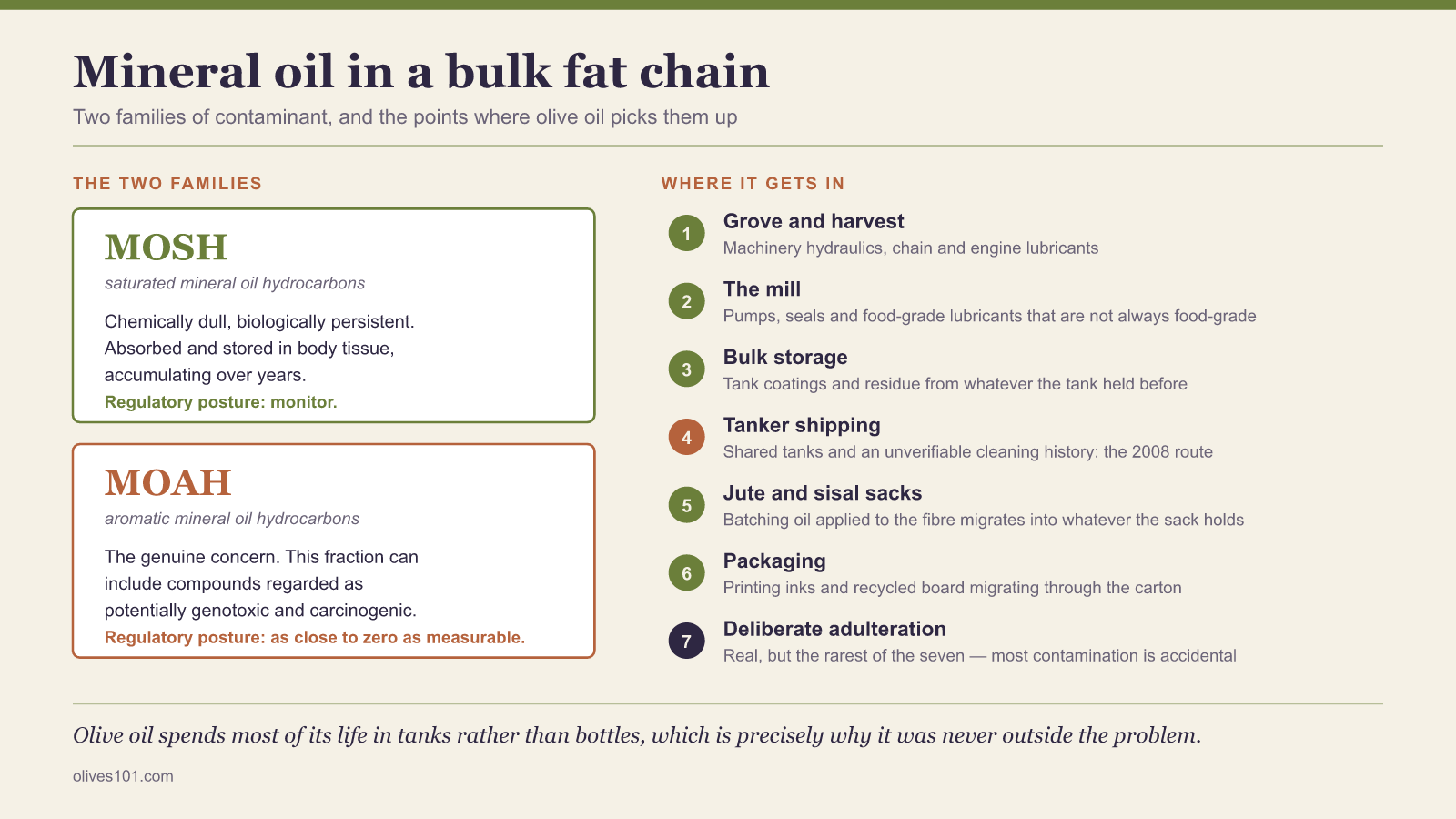
Mineral oil hydrocarbons come in two families, and the distinction matters far more than any headline. MOSH — the saturated ones — are chemically dull but biologically persistent: they are absorbed and can accumulate in body tissue over years. MOAH — the aromatic ones — are the genuine concern, because that fraction can include compounds regarded as potentially genotoxic and carcinogenic. European food-safety opinion has hardened along exactly that line: monitor the saturated fraction, and push the aromatic fraction as close to nothing as the analysis can measure. There is no comfortable level of MOAH that anyone defends.
What makes the pair awkward to police is that they are not one substance from one source. They are a signature — a smear of hydrocarbons that can arrive from a dozen ordinary industrial contacts, most of them accidental, a few of them criminal, all of them producing a similar trace in the laboratory.
How it gets into an oil that never saw a machine shop
Start in the grove. Shakers, harvesters, trailers and hoppers all run on diesel and lubricants, and fruit that bounces through steel and dust picks up traces. Then the mill: pumps, gearboxes, hydraulic lines, conveyor chains. Then storage and movement, which is where the numbers get serious — bulk oil travels in road tankers, rail tankers and ship tanks, and a tank is only ever as clean as its previous cargo and its last wash. Then packaging: jute and hessian sacks have historically been treated with batching oils, and recycled board and printing inks carry mineral oil of their own, which migrates happily into a fatty food sitting against it.
And then, at the ugly end, there is deliberate adulteration — which is what the 2008 case looked like. Mineral oil is cheap, it passes for a liquid fat by eye and by feel, and it does not announce itself on an ordinary specification sheet. That is the whole difference between a contamination problem and a fraud problem. Both give the analyst the same chromatogram; only one of them has an intention behind it.
Where olive oil sits in all this
Uncomfortably close, and for a structural reason: most of the world’s olive oil is not bottled where it was pressed. It is milled, tanked, sold, shipped, blended and bottled somewhere else — very often in another country — and every one of those transfers is a fresh chance for a hydrocarbon trace to join the journey. The flag on the front of the bottle frequently describes a bottling line, not a grove.
One grade deserves a specific warning. Olive pomace oil is made by hitting the spent paste with solvent and refining the result, and published surveys have repeatedly found it carries the heaviest mineral-oil loads of any olive product. Partly that is the processing; partly it is simply that pomace sits at the bottom of the value chain, where the least care and the smallest margins live. Worth knowing before you reach for the cheap pomace bottle to fill the fryer.
| Route in | What actually happens | What keeps it out |
|---|---|---|
| Machinery & harvest | Lubricants, hydraulic oil and exhaust in contact with fruit | Food-grade lubricants, clean bins, fast milling |
| Bulk transport | Tank holds whose previous cargo or wash residue leaves traces | Dedicated food tanks, wash certificates, per-lot testing |
| Packaging | Batching oil on jute sacks; mineral oil in recycled board and inks | Food-grade liners, virgin board, tested inks |
| Refining & solvent extraction | Pomace and refined grades concentrate what was already present | Buying virgin grades; supplier analysis |
| Adulteration | Cheap mineral oil blended into an anonymous bulk lot | Laboratory screening, traceable suppliers, refusing unnamed oil |
What a buyer can actually do
- Prefer virgin grades. Extra virgin and virgin oil is pressed, not solvent-treated — the whole pomace and refining route is skipped.
- Buy oil that names something. A mill, an estate, a co-operative. Anonymous oil is oil whose history nobody has to answer for.
- If you buy in volume, ask for the analysis. A serious supplier has a certificate for the lot and is unbothered by the question.
- Do not store oil against cardboard or newsprint in a warm room — migration is real, and it is the one part of the chain that is in your hands.
- Treat silence as silence. A label that says nothing about origin or milling is not making a claim you can check.
Mineral oil and edible oils: common questions
What are MOSH and MOAH?
Two families of mineral oil hydrocarbons. MOSH are the saturated ones, which can accumulate in body tissue; MOAH are the aromatic ones, which may include compounds considered potentially genotoxic and carcinogenic. MOAH is the fraction regulators want as low as analysis allows.
Was the 2008 sunflower oil case an accident or fraud?
The European alert record describes shipments adulterated with mineral oil, which points to deliberate blending rather than a stray trace. That is why it triggered withdrawals across several member states and an emergency limit.
Is olive oil affected by mineral oil contamination?
It can be. Olive oil is exposed at the same points as any bulk fat — machinery, tanks, packaging — and published surveys find measurable traces, with olive pomace oil consistently carrying the highest levels.
Does extra virgin olive oil avoid the problem?
It avoids the solvent-extraction and refining routes, which helps a great deal. It does not make the oil immune to machinery, tanker or packaging contact, so sourcing and testing still matter.
Can I detect mineral oil at home?
No. It is odourless, tasteless in small amounts and invisible in a bottle. Detection is a laboratory job using coupled chromatography, which is precisely why buying from traceable sources is the only consumer-level defence.
Here is the unglamorous truth the trade knows and the shelf never shows: with a contaminant like this, the paperwork is the product. Two bottles can look identical and one of them has a certificate of analysis behind every lot while the other has a broker’s handshake. Nobody markets that difference, because nobody wants to advertise the existence of a risk. My rule was simple and it still holds — the further an oil travels anonymously, the more chances it has to pick up something nobody intended. Buy oil with a name attached to it and you are not paying for romance, you are paying for someone who has to answer the phone.
Drawn from the European rapid-alert record of the 2008 sunflower-oil incident, EFSA’s re-assessment of mineral oil hydrocarbons in food, and published surveys of mineral oil in olive and pomace oils.