Shaking up the olive harvest
Everything that makes an olive oil good or bad is decided in about a fortnight. Harvest is the biggest cost in the grove, the biggest quality lever in the bottle, and the reason the modern olive industry looks the way it does.
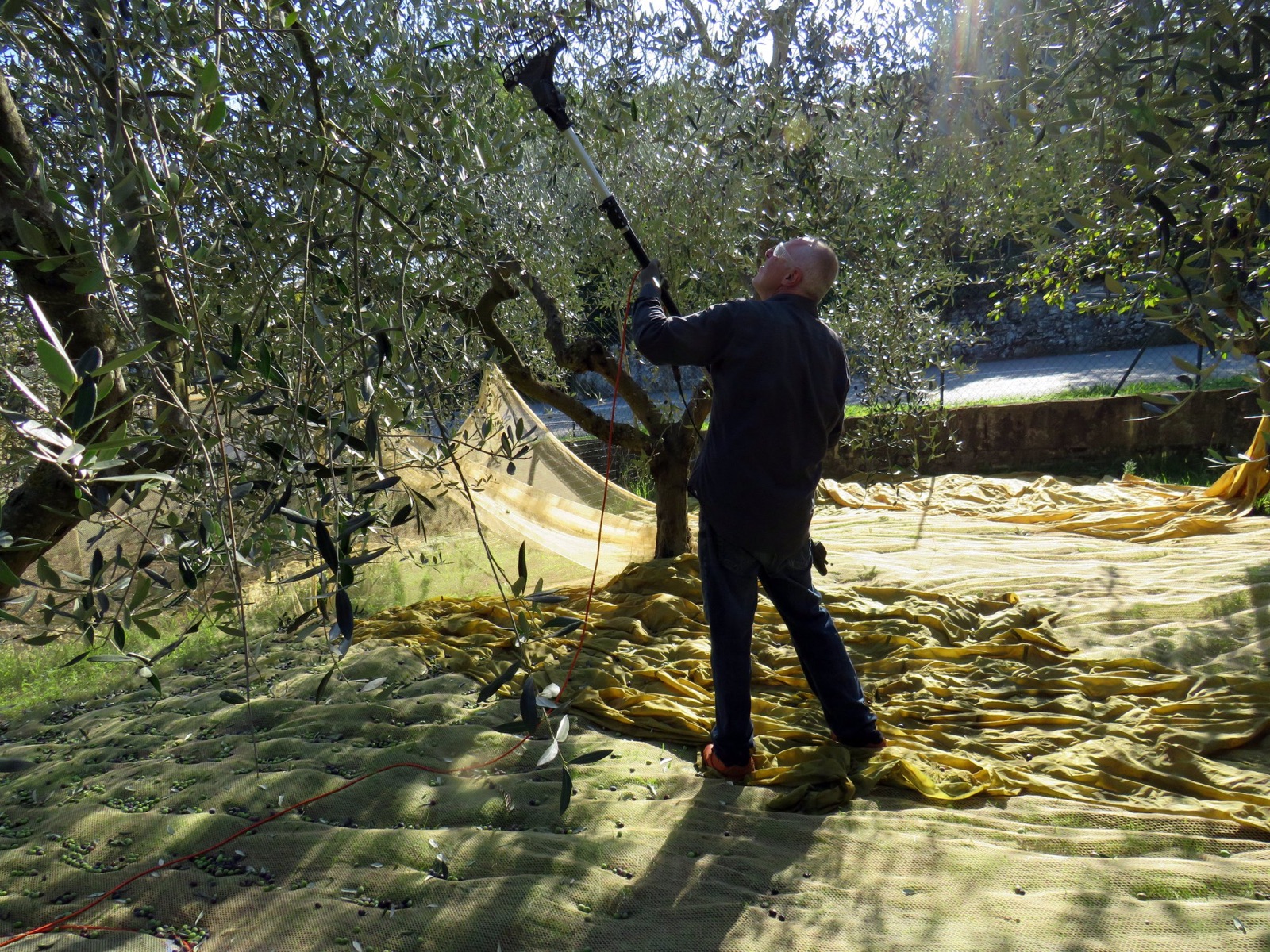
Ask a grower what keeps them awake and it is never pruning. It is harvest. For thousands of years olives were stripped by hand or beaten out of the tree with poles onto cloths, and the arithmetic was brutal — a good picker manages a fraction of what a machine does in an hour, and the crop ripens on its own schedule whether or not you have found the labour. Every clever contraption in the history of olive growing, from the humble comb to the over-the-row harvester, exists to solve the same problem: get the fruit off the tree fast, without hurting it, and into the mill before it starts to spoil.
Why harvest is the whole ball game
An olive is a fruit, and a bruised fruit begins to break down immediately. The moment the skin is damaged, enzymes and wild yeasts go to work on the flesh, free fatty acids climb, and the oil inside starts acquiring the flavours the trade politely calls defects — fusty, muddy, winey. Nothing that happens afterwards in the mill can take those flavours back out. That is why the two numbers that matter most on any harvest day are how gently the fruit was handled and how many hours passed before it was milled. Serious producers aim for the same day. A grove that piles fruit in sacks over a weekend has thrown away its extra virgin before the press was even switched on.
Harvest is also where the money goes. Depending on the country and the system, picking commonly accounts for something close to half the cost of producing a litre of oil — more in steep, old, hand-picked groves. That single fact explains most of what has happened to olive growing in the last forty years.
The methods, ranked by what they do to the fruit
There is no single best method. There is only the best method for a given tree shape, slope, cultivar and end use. Table olives, where a single blemish makes the fruit unsellable, still lean heavily on hands. Oil olives, where the fruit is going to be crushed anyway, can take far more mechanical abuse — but only up to a point, and only if the mill is close.
| Method | How it works | Speed | What it does to the fruit | Best for |
|---|---|---|---|---|
| Hand picking | Fingers, ladders, buckets on a harness | Slowest | Gentlest possible | Table olives, prized single-variety oils |
| Combs and rakes | Plastic or electric combs pull fruit onto nets below | Slow to moderate | Minor bruising, some leaf and twig | Small groves, old trees, steep ground |
| Poles and nets | Branches beaten, fruit falls onto spread nets | Moderate | Bruising plus broken shoots that cost next year | Traditional smallholdings |
| Trunk shaker | A clamp grips the trunk and vibrates; fruit drops into an inverted umbrella | Fast | Good, if the catch frame is used and fruit never touches soil | Intensive groves of single-trunk trees |
| Over-the-row harvester | A grape-style machine straddles a hedgerow and beats fruit onto conveyors | Fastest | Acceptable for oil; fruit goes straight to bins | Super-high-density oil orchards |
| Ground gathering | Fruit left to fall and collected later | Cheapest | Worst — soil contact, fermentation, insect damage | Only ever a last resort |
The shaker revolution, and the price it quietly charged
The trunk shaker was the first genuine break with antiquity: one machine, one operator, a tree emptied in under a minute. Then came the real upheaval — planting olives like a vineyard hedge, close enough that a straddle harvester could drive over the row. Yield per hectare jumped, the first crop arrived years earlier, and the labour bill collapsed.
Here is the part the brochures skip. The machine chose the varieties. An over-the-row harvester needs a small, compact, low-vigour tree with fruit that detaches easily, which in practice means a very short list — Arbequina, Arbosana, Koroneiki and a handful of bred selections. Thousands of local cultivars, some of them magnificent, simply do not fit the machine, and so they do not get planted. When people complain that supermarket oil all tastes the same, this is a large part of the answer. It is not a conspiracy. It is a harvester specification quietly rewriting the genetics of a crop.
What it means in your bottle
Harvest timing is the other half of the story. Pick early, while the fruit is still green-purple, and you get less oil per tonne but far more of the bitter, peppery phenols that make an oil taste alive and keep it stable on the shelf. Pick late, when the olives are black and soft, and the yield goes up while the character goes down. Every producer sits somewhere on that trade-off, and the honest ones tell you where by printing a harvest date.
So when you read that a grower invented a better catcher, or halved the seasonal crew, do not file it under farm machinery trivia. That is the single decision that determines whether the oil in front of you tastes of fresh grass and almond, or of nothing much at all. See also how olive oil gets cut and the true cost of an olive.
Practical takeaways
- Look for a harvest date, not a best-before date. A bottle that hides its harvest is hiding something.
- Early-harvest oils are greener, more bitter and more peppery — that pepper is phenols, and phenols are shelf life.
- Ask how far the mill is. Hours between tree and mill matter more than almost anything else in the grove.
- Table olives are still hand work, which is exactly why good ones cost what they cost.
- Fruit picked off the ground is a defect waiting to happen, whatever the label says about tradition.
- If you grow a few trees yourself, a cheap electric comb plus nets will beat poles for both speed and next year’s crop.
Olive harvesting: common questions
When are olives harvested?
In the northern Mediterranean, roughly October to January, with early-harvest oils picked from late September. In the southern hemisphere the same window falls around April to June, which is why Australian, Chilean and South African oils are freshest in the northern summer.
Does machine harvesting ruin olive oil?
No, provided the fruit is caught rather than dropped on the soil and milled quickly. A well-run mechanical harvest beats a slow hand harvest that leaves fruit sitting in sacks for two days.
Why are table olives still picked by hand?
Because a bruise that is invisible in an oil olive makes a table olive unsellable. Appearance is the product, so the fruit is handled like fruit for the fresh market.
How soon must olives be milled?
The same day is the target and under 24 hours is the practical limit. Beyond that, free acidity rises and fermentation flavours develop that no processing can remove.
What is a super-high-density olive orchard?
Olives planted as a narrow hedgerow at well over a thousand trees per hectare so that a straddle harvester can drive over them. It cuts harvest cost dramatically but only works with a few small, compact cultivars.
Growers love to talk about their trees and their terroir. In practice, the two things that decide whether their oil is any good are how the fruit came off and how fast it reached the mill — and neither is on the label. If you ever get the chance to ask a producer one question, do not ask about the variety. Ask what time the fruit was picked and what time it was crushed. The good ones answer instantly, to the hour, and rather enjoy being asked. The vague ones change the subject.
Drawn from standard olive-growing practice across Mediterranean and New World producing regions, and from published extension guidance on harvest timing, mechanical harvesting systems and mill delay.