El País Report on Mislabeled Extra Virgin Stirs Spain
Spain’s El País devoted a long Sunday report yesterday to what it called the olive oil con: according to the paper, analysis of 50 batches sold as extra virgin in Andalusia found that half were of a lower grade. Claims of widespread mislabeling had already caused a row when a national daily first reported them in late November, with Andalusia’s agriculture minister saying the cases were unverified and the cooperatives denying any widespread fraud. Here is what was reported, why the industry is angry, and what it means for anyone buying Spanish oil.
What was reported
The El País piece, by Ginés Donaire, says Andalusian officials sampled the 50 batches because some extra virgin olive oil on sale in the region was priced extraordinarily low. Half of them turned out to be of an inferior grade. The oil posed no danger to health, and the officials said they were investigating further before naming the companies involved.
The paper puts the problem in the context of how Spanish oil is sold. Consuelo Ariza, an agricultural engineer with the farm union Asaja-Córdoba, told it that about half the extra virgin sold in the biggest supermarkets is store brand, often priced at a loss to bring shoppers through the door, and that nine in ten bottles of olive oil in Spain are sold in those big stores. El País also points to how concentrated bottling has become: just over twenty companies pack 80 percent of national production, and the largest of them dominate distribution as well.
The timing is awkward. The report ran as Spain’s harvest was getting under way, with the president of SOS, one of Spain’s leading bottlers, sounding optimistic about exports to Brazil and the United States.
The pushback
When a national daily first reported claims of widespread fraud in late November, citing the regional administration as its source, the reaction in Andalusia was fierce. The Andalusian federation of agricultural cooperatives, FAECA, flatly denied that there was any widespread fraud in the sale of extra virgin olive oil and noted that no company was known to have been sanctioned in connection with the story. It called the report alarmist and damaging to a region with more than 1.5 million hectares of olive groves and some 320,000 farms that live from them.
The regional agriculture minister, Clara Aguilera, went further, saying the information had not been checked and that the cases had not been verified or acknowledged by anyone. She added that the administration has protocols for detecting irregularities and would impose the corresponding sanctions if labeling breaches were confirmed.
That is a fair point as far as it goes: nobody has yet named a brand or published the analyses. But it sits uneasily with what happened only in September, when Andalusia’s own consumer authorities proposed fines against the retailer Alcampo after its store-brand “extra virgin” in three- and five-liter bottles turned out to be a blend of refined and virgin oils.
What it means for buyers
- The issue here is grade, not safety: oil sold as extra virgin that should have been labeled virgin or plain olive oil.
- The cheapest extra virgin on the shelf, especially in large bottles, is where the risk concentrates.
- Until the companies are named, the best protection is a label with a named producer or cooperative, a harvest date, and a price that makes sense.
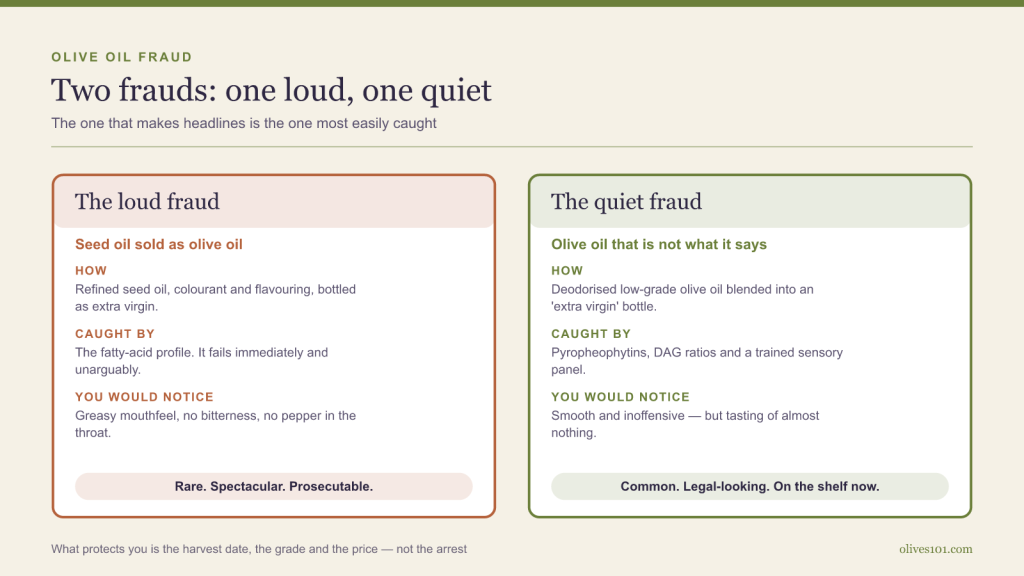
Our guide on how to read an olive oil label covers what to look for on the back of the bottle, and our look at how olive oil adulteration really works explains why quiet grade problems are far more common than the dramatic seed-oil kind.
The line between extra virgin and virgin is often a single slight defect found by a tasting panel, or acidity a little over 0.8 percent. When a supermarket needs a headline price for its own brand, oil that sits just the wrong side of that line is the obvious temptation, because it costs noticeably less and most shoppers could not tell the difference in a salad. That is why a store-brand extra virgin sold below what good oil costs at origin should make you curious, not grateful.