Florence Prosecutors Open a Deodorized Olive Oil Case
Prosecutors in Florence are investigating whether transport documents were falsified to turn low grade oil into extra virgin, in a case involving about 450 tons of oil worth some 4 million euros and paperwork seized at packing plants in Florence, Reggio Emilia, Genoa and Pavia. The investigation, announced by Italy’s forestry corps last week, has put deodorized oil back at the center of the argument about what extra virgin means. Here is what is alleged, what deodorizing actually is, and why the new European test matters to the case.
What the investigators say
The Corpo Forestale, the state forestry corps that polices food origin in Italy, said last Thursday that an inquiry begun in September 2010 covers roughly 450,000 kilos of oil. Documents and samples were taken from packing plants in four cities. The agency did not name companies, but described one of them in terms that point unmistakably at Grupo SOS, the Spanish group that owns the historic Italian brands Bertolli, Carapelli and Sasso, and the Florence prosecutors are reported to be looking at that company’s paperwork.
The allegation is not that anything poisonous was sold. It is that the documents accompanying the oil turned a cheaper grade into an expensive one on paper. Laboratory analysis is under way and the results are expected before the prosecutors return to the file in the middle of March. Grupo SOS, which reported a loss of 50 million euros for 2010, has not been charged.
What deodorized oil is
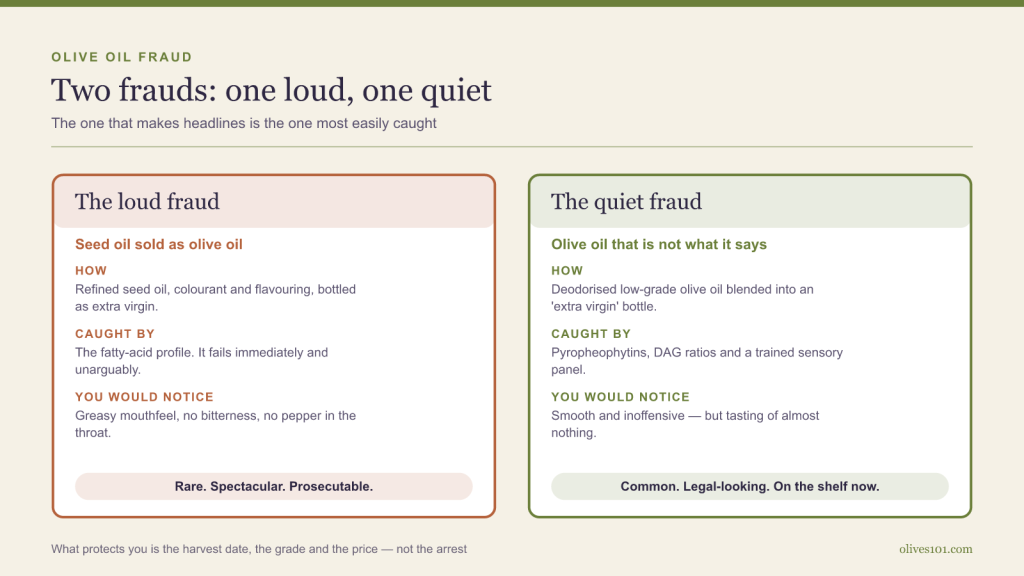
Deodorizing is a mild refining step. Take a virgin oil that is technically lampante, meaning it has defects and cannot be sold for eating as it stands, and treat it gently with heat and vacuum. The defects go away. What is left is almost colorless in taste: no fusty note, no winey note, nothing to complain about and nothing to enjoy. Blend a little real virgin oil back in and you have something that tastes like a soft extra virgin, costs a great deal less to make, and until recently passed the standard tests.
That is the quiet fraud. The loud one, seed oil sold as olive oil, is easy to find in a laboratory and rare in the modern trade. The quiet one is legal chemistry applied to olive oil and then sold under the wrong name, and it has been the industry’s open secret for twenty years.
- It is not dangerous, it is dishonest.
- It is invisible to free acidity and peroxide tests.
- A tasting panel will often call it out as too flat to be extra virgin, which is one reason the panels have enemies.
- It is profitable only at scale, which means big packers, not village mills.
The test that changed the odds
In January the European Union set a limit for alkyl esters in extra virgin olive oil: 75 milligrams per kilo, with a conditional band up to 150. These compounds build up when olives ferment before milling, so a high reading points to fruit that was in poor condition, which is exactly the raw material that gets deodorized. Investigators in this case say the new test will be part of the analysis.
Italian commentators have already complained that the limit is too generous, and La Repubblica argued that it does not protect consumers because a skilled blender can sit comfortably under it. That is fair criticism. It is also true that a limit which can be measured is worth more than an outrage that cannot, and that the industry now has to account for a number it could ignore a year ago.
Meanwhile the farm lobby Coldiretti is making the price argument, telling shoppers that a liter selling below 5 or 6 euros is unlikely to be genuine extra virgin, with supermarket oil at 2 euros a liter as its example. Italy’s agriculture minister, Giancarlo Galan, has told consumers they can trust Italian traceability and the labeling rules. Both statements are marketing as much as advice.
The trade word to listen for is soft. A buyer who tells you an oil is soft, easy, no bitterness, suitable for the mass market, is describing either a very ripe fruity oil from a good mill or a deodorized one, and the price tells you which. Genuine mild extra virgin from late picked fruit exists, and it costs more than lampante oil that has been cleaned up, not less. When an own brand extra virgin is cheaper than the bulk price of decent oil at origin, the arithmetic has to be coming from somewhere.
Sources
- Olive Oil Times, Deodorized Olive Oil Back in the Spotlight
- Commission Regulation (EU) No 61/2011 of 24 January 2011, EUR-Lex