The EU’s Alkyl Ester Limit Starts on Friday
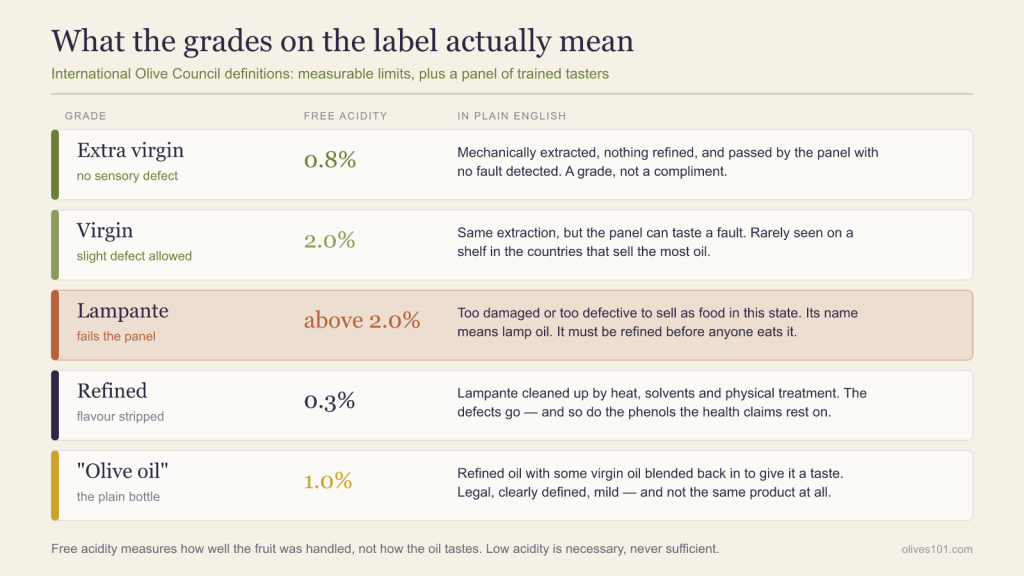
From tomorrow, April 1, any oil sold as extra virgin in the European Union has to pass a new chemical test: the sum of its fatty acid methyl and ethyl esters must not exceed 75 milligrams per kilo, or 150 where the ratio between the two types stays low. The rule comes from Commission Regulation 61/2011, adopted on January 24. It is the most serious change to the extra virgin definition in years, and it exists because of one particular trick. Here is what it does.
What the regulation says
The regulation amends the 1991 rules on the characteristics of olive oil and adds a method for measuring waxes and fatty acid methyl and ethyl esters by capillary gas chromatography. The Commission says the chemical experts concluded that these esters are a useful quality parameter for extra virgin, and the change follows the work done at the International Olive Council, which adopted its own limit in 2009.
| Category | Alkyl ester requirement |
|---|---|
| Extra virgin olive oil | Methyl plus ethyl esters at or under 75 mg/kg, or up to 150 mg/kg if the ethyl to methyl ratio is 1.5 or less |
| Virgin olive oil | No limit set |
| Lampante and refined grades | No limit set |
There is a transition. Oil that was legally made and labeled in the Union, or legally imported and released for free circulation, before April 1 can be sold until the stock runs out. In a trade that holds oil for months, that matters more than it sounds.
What the test catches
Alkyl esters form when the alcohols produced by fermenting fruit combine with the free fatty acids in the oil. Olives that sat in sacks or piles, olives picked off the ground, olives that traveled a long way in a warm truck: all of them ferment a little, and all of them leave this signature behind. A high reading is evidence about how the fruit was handled, and no amount of later processing removes it.
That is why the limit is aimed, in practice, at deodorized oil. Mild refining strips out the taste of defects, but it does not strip out the esters. Before this rule, a skilled blender could take poor fruit, clean up the flavor and sell the result under a grade it had no business carrying, and the standard chemical tests would not object. Now there is a number that objects.
What it misses
Italian commentators have spent the winter arguing that 75 milligrams is too generous, and they are not wrong. Careful producers of fresh oil come in far below it, often in single figures. A blend built to sit at 70 passes, and a blender who knows the limit can blend to it. The Italian investigation into deodorized oil that opened this winter will be the first real test of whether the number bites in practice.
The limit also applies only to extra virgin, which is the right target and leaves the virgin grade untouched. And, as always, a limit is only worth the testing behind it. Member states decide how many samples they take and how often, and a rule that is checked once a year in one country is a rule with a hole in it.
For a buyer, nothing changes tomorrow. Stock made before April 1 can legally be sold through, so the bottle in front of you this spring is governed by last year’s rules. The effect will show up quietly over the next season, in which oils that used to be passable stop being passable, and in the price of the cheapest extra virgin on the shelf.
Every chemical limit in this trade eventually becomes a target rather than a threshold. Acidity was supposed to prove freshness until everybody learned to hit 0.8. Alkyl esters will go the same way: within a few seasons the big blenders will be managing the number as a specification, buying a little clean oil to dilute a lot of marginal oil. It still raises the floor, and raising the floor is most of what standards ever do.
Sources
- Commission Regulation (EU) No 61/2011 of 24 January 2011 amending Regulation (EEC) No 2568/91, EUR-Lex
- Olive Oil Times, Tests Find Higher Alkyl Ester Levels in Supermarket Olive Oils (archived, November 2010)
- Olive Oil Times, Deodorized Olive Oil Back in the Spotlight