A Seed Compound That Could Catch Oil Adulteration
Chemists at the University of Alcala near Madrid have patented a method for spotting seed oil in olive oil by looking for trigonelline, a compound that soy and sunflower carry and olives do not. The test uses capillary electrophoresis with ordinary ultraviolet detection, which means it is cheap enough for a routine laboratory. Here is how it works, what it can find, and where it stops.
What they did
The group, which includes Laura Sanchez Hernandez, Carmen Garcia Ruiz, Antonio Crego and Maria Luisa Marina, published the underlying method in the Journal of Agricultural and Food Chemistry and has now patented a system they hope laboratories will adopt. Sanchez, whose doctoral work laid the groundwork, describes trigonelline as a compound nobody had looked at before in this context because betaines are minor components of oil and the standard tests concentrate on fatty acids, sterols and lipids.
The chemistry is simple to state. They ran soy and sunflower seeds, three olive varieties, and sunflower, soy and extra virgin olive oils through the method. Trigonelline turned up in the seeds and in the seed oils. It did not turn up in the olives or in the olive oils at all. A marker that is present in one material and absent in the other is the cleanest kind of evidence you can have.
What it catches
Tested on mixtures, the method found soy oil in extra virgin olive oil down to about 10 percent of the blend. That is the number to hold on to, because it defines both the use and the limit of this test.
| Question | Answer |
|---|---|
| What does it detect | Soy and sunflower oil added to olive oil |
| How little | Down to roughly 10 percent of the blend |
| What equipment | Capillary electrophoresis with ultraviolet detection |
| What it does not see | Refined or deodorized olive oil, pomace oil, oils blended within the standard limits |
Ten percent is a crude blend. The established method for this job, comparing the measured and calculated triglyceride profile, picks up seed oil at lower levels than that, and any laboratory doing routine authenticity work already runs it. So the selling point here is not sensitivity. It is that the equipment is cheap, the run is quick and the answer is yes or no rather than a calculation, which suits a mill, a bottler or a customs laboratory doing screening rather than forensics.
The fraud it does not address
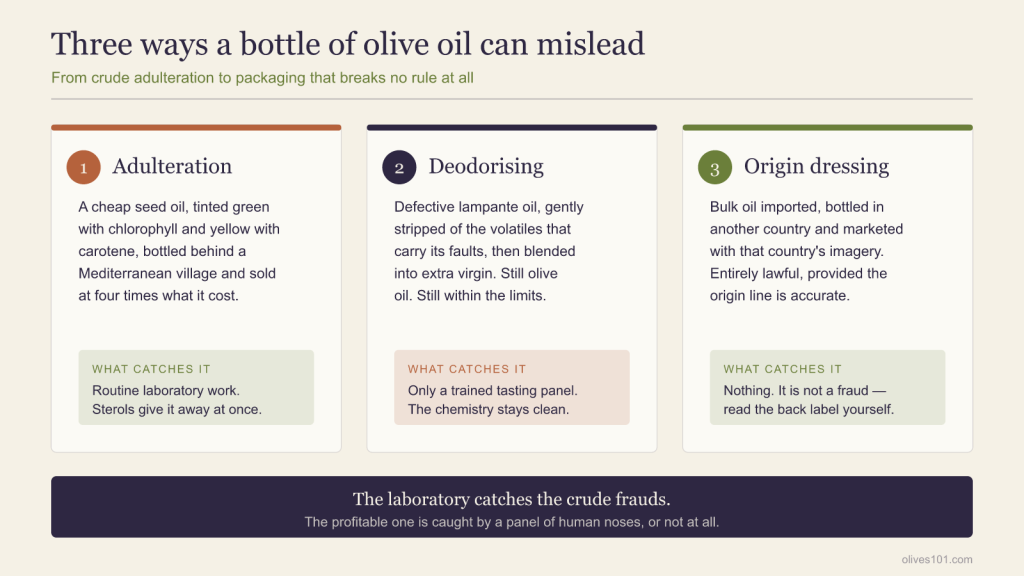
Crude adulteration with seed oil is the fraud people imagine and the rarest one in the modern European trade, because it is easy to find and the penalties are criminal. The frauds that actually move volume are quieter: virgin oil sold a grade above what a tasting panel would give it, deodorized lampante oil blended into extra virgin, oil of one origin labeled as another. None of those leave a trace of soy behind.
That is not an argument against this work. A cheap screening test adds a rung to the ladder, and it is most valuable where the crude fraud still happens, which is in markets with weak testing and imported bulk oil. It is an argument against reading the phrase new test to detect olive oil adulteration as if the problem had been solved.
There is a reason laboratories keep inventing tests for seed oil. It is the fraud that can be proved. A chemist can put a number on soy in olive oil and a court will accept it. The frauds that cost consumers most are graded, not adulterated, and proving them still comes down to eight trained people tasting blind in little blue glasses, which is why the panels get attacked and the chemists get funded.
Sources
- Olive Oil Times, A New Way to Detect Olive Oil Adulteration
- Sanchez-Hernandez et al., Determination of trigonelline in seeds and vegetable oils by capillary electrophoresis as a novel marker for the detection of adulterations in olive oils, Journal of Agricultural and Food Chemistry, 2010
- Sanchez-Hernandez et al., Determination of betaines in vegetable oils by capillary electrophoresis tandem mass spectrometry, Electrophoresis, 2011